Tools, hands, and brain: the AI stack of the future
A tool is announced. Another one adds an AI agent.
Your team evaluates it, and by the time procurement clears the paperwork, Claude has gotten three generations smarter and the vendor you shortlisted has pivoted twice.
The cycle time of corporate adoption is now longer than the cycle time of AI product evolution.
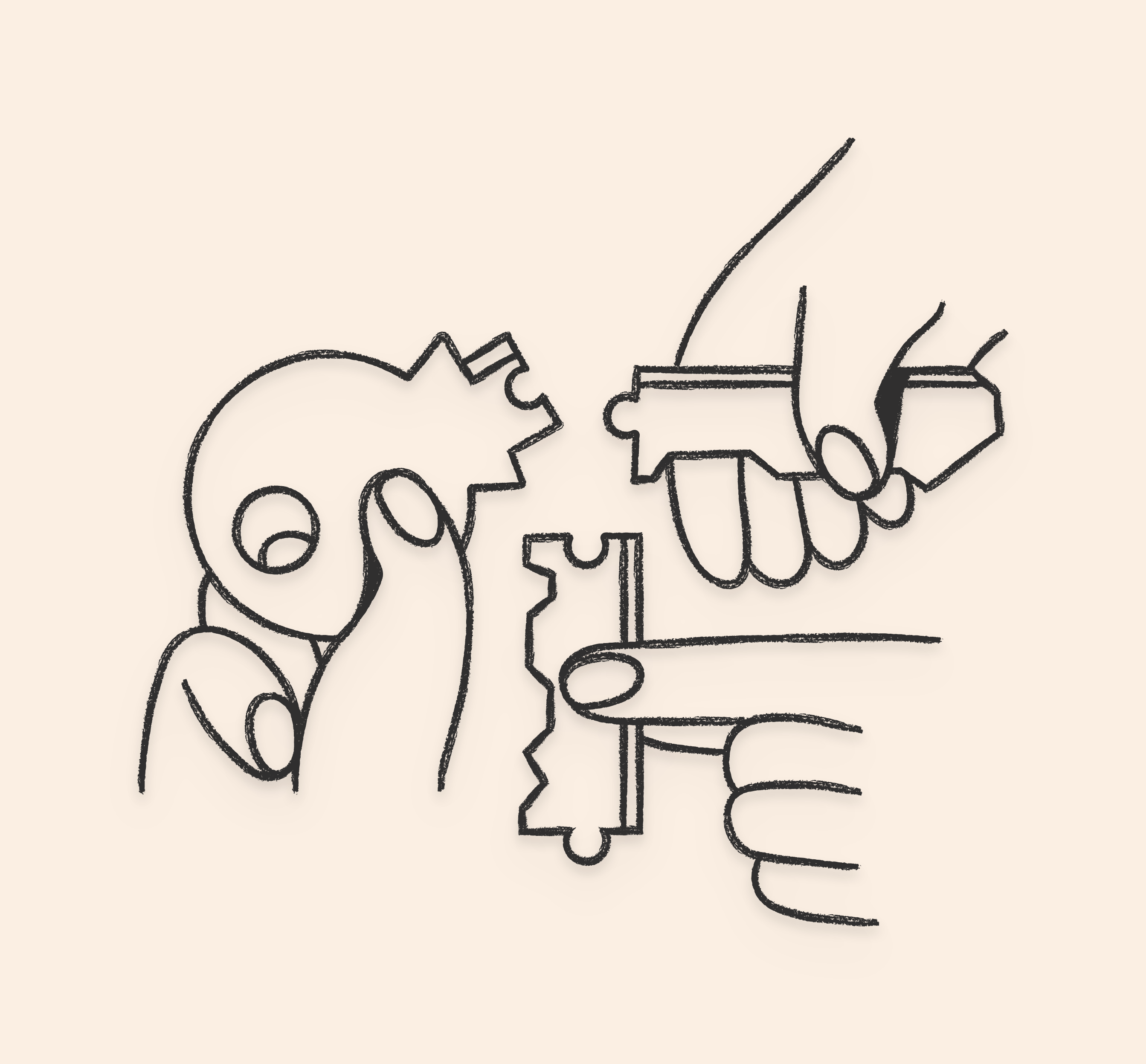
I think the way out is to stop treating your software as a stack and start treating it as a nervous system: specialized tools that do the work, hands that execute, and a brain that remembers everything.
Three layers.
Keep them separate, and every future change becomes a swap instead of a rebuild.
Why your SaaS stack is eating itself
Every vendor is eating the vendor next to it.
Your project tracker wants to be your wiki. Your wiki wants to be your CRM. Your CRM just shipped an agent that promises to replace both.
SaaS has become a snake eating its own tail, and buying software during this feeding frenzy feels impossible. Whatever you pick will be leapfrogged within a quarter.
The accelerating cycle is not going to stop. What can change is how exposed you are to it.
When everything in your stack is tangled into everything else, each change is a migration.
When the layers are separate, each change is a swap.
The companies that internalize this now will spend the next five years upgrading calmly while everyone else rebuilds from scratch.
The three layers of an AI-native stack
After the dust settles, I believe every company's software architecture will have three layers. They are already emerging. Most companies just have not noticed that they are three separate things rather than one tangled mess.
- Tools do the domain work.
- Hands execute and coordinate.
- The brain remembers everything and connects the dots.
The logic that makes this durable:
- When the tools change, the hands adapt.
- When the hands change, the brain persists.
Nothing breaks, because nothing is tangled.
Hands: what an AI orchestrator actually is
An AI orchestrator is your digital pair of hands. It reads, plans, iterates, coordinates, and produces output. Claude Code and Codex are early shapes of it. Soon every team member will have one at the personal, team, and company level.
But try holding a phone, a coffee, and two bags of groceries while unlocking a door. Something drops.
Orchestrators are going through the same thing, because right now they are doing triple duty:
- Executing the task.
- Roleplaying as domain experts, because vertical agents are not mature enough yet.
- Gathering context from scratch every session. First about you, then your work, then the tools they need to call.
Mixing three kinds of context in one window leads to context rot, and output quality degrades fast.
You have felt this if you have ever copied a clever workflow from X: the first responses feel sharp, and twenty iterations later the AI agent seems to have forgotten what it was doing.
Your hands are too full. They need the other two layers to hold what they cannot.
Tools: why vertical agents beat a pile of MCPs
Hands are versatile, but they cannot cut a straight line or stitch a wound. Tools concentrate capability into one job and do it with a precision that hands cannot match.
Vertical agents are the tools of this new stack.
Linear has an agent now. Figma's is learning design systems. Slite, the tool we are building, has an agent that maintains your documentation.
Each one aims to be the best in the world at one narrow thing.
A fair question: why do we need vertical agents when we already have MCPs?
Because an MCP is the toolbox. Your orchestrator has to:
- load every tool definition into its context just to know what is available,
- burn tokens reasoning about how to wield each one,
- and stitch the workflow together from raw primitives.
Half your context window is gone before real work starts.
Vertical agents flip this. You send one prompt. The agent already understands its own domain, runs a purpose-built reasoning flow, and returns the answer.
We have written a deeper comparison of MCPs versus a dedicated company search agent if you want the detail.
MCPs turned tools into APIs. Vertical agents will turn tools into colleagues, and businesses that already run on AI agents are seeing the difference.
Brain: the context agent your stack is missing
Hands act and tools amplify, but neither remembers anything. That is the brain's job: hold what happened yesterday, connect it to what is happening now, and surface the right memory at the right moment.
Here is the uncomfortable part. Right now, you are the brain in your AI stack:
- Every morning you re-explain what "Q3 target" means.
- You copy-paste the Slack thread into Claude.
- You remind your orchestrator who owns what, which project is blocked, and why the launch slipped.
And the context you feed it goes stale the moment you finish typing.
Slack threads move on. Docs get renamed. The decision you briefed the agent on last week gets reversed in a meeting you were not in.
The more capable your agents get, the hungrier they are for context. They can process in seconds what takes you hours to gather.
So the bottleneck of your entire AI stack is, well, you.
The category forming around this problem is called the context agent: a persistent memory layer that gathers, evaluates, and serves company context to any orchestrator that asks.
It is the reason we built a company brain for Claude Code, and it is the layer most stacks are still missing.
What a real context agent has to do
Manual copy-pasting will not hold up for autonomous work, and neither will a duct-taped internal build. A real context agent has four jobs.
1. Connect to everything
More than half of company knowledge lives outside the wiki, in different formats and different systems of record. A context agent has to retrieve across all of it: Slack threads, code, tickets, docs, structured and unstructured data alike.
This is why Slite Agent searches across Slack, Google Drive, Linear, GitHub, Jira, Intercom, and more than 20 connected tools, so answers pull from your whole company context instead of one silo.
It is enterprise search, rebuilt for agents as much as for people.
2. Understand what is current
Freshness works differently everywhere. A Slack thread from two weeks ago is ancient. A PRD from two weeks ago might still be the source of truth.
Without that judgment, a context agent just dumps everything it finds into your orchestrator's window and lets the model sort it out, which is exactly the problem you were trying to solve.
This is where verification matters: in Slite, docs carry an explicit verified status, verified docs rank higher in AI answers, and outdated ones get deprioritized.
The agent also cross-references docs against your connected tools to catch knowledge drift before it spreads.
3. Chain context across tools
A Slack thread references a Linear ticket that links to a Figma file from a meeting. A context agent has to correlate them into one coherent narrative, and fire follow-up searches when the first pass raises questions, rather than summarizing each source in isolation.
4. Pass only what the orchestrator needs
Ask an AI to "find everything Chris did last month and build a master task list" and a naive approach makes hundreds of tool calls until the context window overflows. A context agent compresses, deduplicates, and filters before anything reaches the orchestrator, so your hands stay free for the actual work.
We ship this context agent as Slite Agent, the agent layer of our self-maintaining knowledge base.
- The wiki is the verified single source of truth.
- The agent keeps it in sync with the rest of your stack and serves that context to any orchestrator through MCP.
Same layer, one product.
What to do today
Use vertical tools that want to be agents. A hammer does not want to be a wrench. When you evaluate software now, the question is no longer "does this have the best UI" or "does this have an AI feature." The question is whether this tool is investing in becoming a specialist agent in its domain.
Let every team member pick their own orchestrator. A surgeon and a builder both have hands, but the skill wrapped around them is entirely different. Some of our best engineers switched from Claude Code to Codex and back to a hybrid setup within a few weeks. Your team is on payroll for their judgment, and the orchestrator is a force multiplier for it. Give them Claude Code, Codex, ChatGPT, or whatever fits, and get out of the way.
Adopt a brain that improves itself. Your brain does not ask you to file memories in one place before using them. A real context layer works the same way: it syncs continuously with where information already lives, builds understanding across all of it, enforces permissions at answer time, and stays callable by any orchestrator. In Slite's case, the agent detects what has drifted, proposes the fix, and routes every change through human review before it becomes truth. Nothing is auto-applied.
Want to check out the first self-maintaining AI knowledge base on the market? Book a demo to meet Slite.
Avoid the all-in-one trap
Every major SaaS company is about to promise all three layers in one bundle. The deepest problem with the bundle is uniformity. It forces your whole team into one shape at the exact moment when the best orchestrators are changing weekly.
Since forcing an orchestrator on people is pointless, the brain has to be universal and agnostic to whatever your team is holding in its hands this month.
So run this test on anything you buy: can I rip this out and replace it within two weeks?
- If the answer is no, do not buy it.
- If the answer is yes, you are looking at the right architecture.
When the layers are independent, every improvement in any layer benefits you immediately. When they are bundled, you upgrade everything or nothing.
The stack of the future is a nervous system
Specialized tools handle the domain work, orchestrators carry out the execution, and a central brain holds it all together, each layer improving on its own clock without dragging the other two along.
What you actually get from this is a different working day.
Humans stop being the glue between their own systems. No more copy-pasting threads into Claude, re-explaining who owns which project, or translating one tool's output into another tool's input. That work was never supposed to be yours. It just became yours because nothing else could do it.
Once the nervous system takes over that layer, your time goes back to the thing you were hired for: the judgment no system can make for you.
If the brain layer is the one your stack is missing, see how the self-maintaining knowledge base works.

Escrito por Christophe Pasquier
Chris founded Slite in 2017 and has spent the decade since thinking about how teams actually keep track of what they know. He writes about where the category is going next — agentic knowledge management, context graphs, and the parts of knowledge work AI is quietly rewriting. He's been wrong about the future before. Mostly he's been early. Find him @Christophepas on Twitter!