AI chatbots are becoming a core part of how modern teams work. Instead of digging through folders, pinging teammates, or hunting through scattered tools, you ask a question in plain language and get a clear, sourced answer in seconds.
This guide walks through what an AI chatbot is, why it is useful for teams, and how to build or buy one that actually works.
Key takeaways
- You can build a team chatbot no-code, low-code, or custom, but reliable retrieval is the hard part, not the chat UI.
- Answer quality depends on the underlying knowledge, so a verified, connected source of truth matters most.
- Building gives control but carries maintenance, while a purpose-built option like Slite Agent ships cross-tool search, citations, and permission-aware answers out of the box.
- Whatever you choose, make sure it cites sources and respects access permissions.
- Pilot on a few real questions before rolling out to the whole team.
What is an AI chatbot?
An AI chatbot is software you interact with in natural language. You type a question, and it responds with a human-like answer.
Older chatbots were rule-based: they followed decision trees and only understood narrow commands. If you phrased something differently, they often failed.
Modern AI chatbots use large language models (LLMs) to understand context, intent, and nuance. They handle open-ended questions, follow multi-step conversations, and adapt to different phrasings. The result feels less like a rigid script and more like a helpful assistant.
Why build an AI chatbot for your team?
A team chatbot reduces friction in everyday work by answering repetitive questions and surfacing knowledge instantly.
- Reduce repetitive questions. Teams spend a surprising amount of time answering: "Where is this doc?" and "How does X work?" A chatbot trained on internal knowledge handles these automatically, especially when embedded in tools like Slack.
- Speed up onboarding. New hires self-serve answers about tools, processes, and policies instead of waiting for responses. For remote teams with fragmented information, this matters a lot.
- Make knowledge instantly searchable. A chatbot turns static, hard-to-navigate docs into a conversational interface. It can act as a single source of truth inside tools people already use. This is the core promise of a knowledge base chatbot: it answers from your trusted docs instead of leaving people to search on their own.
- Free up time for higher-value work. When routine questions are automated, people focus on deep work, collaboration, and problem-solving.
How to build an AI chatbot: step by step
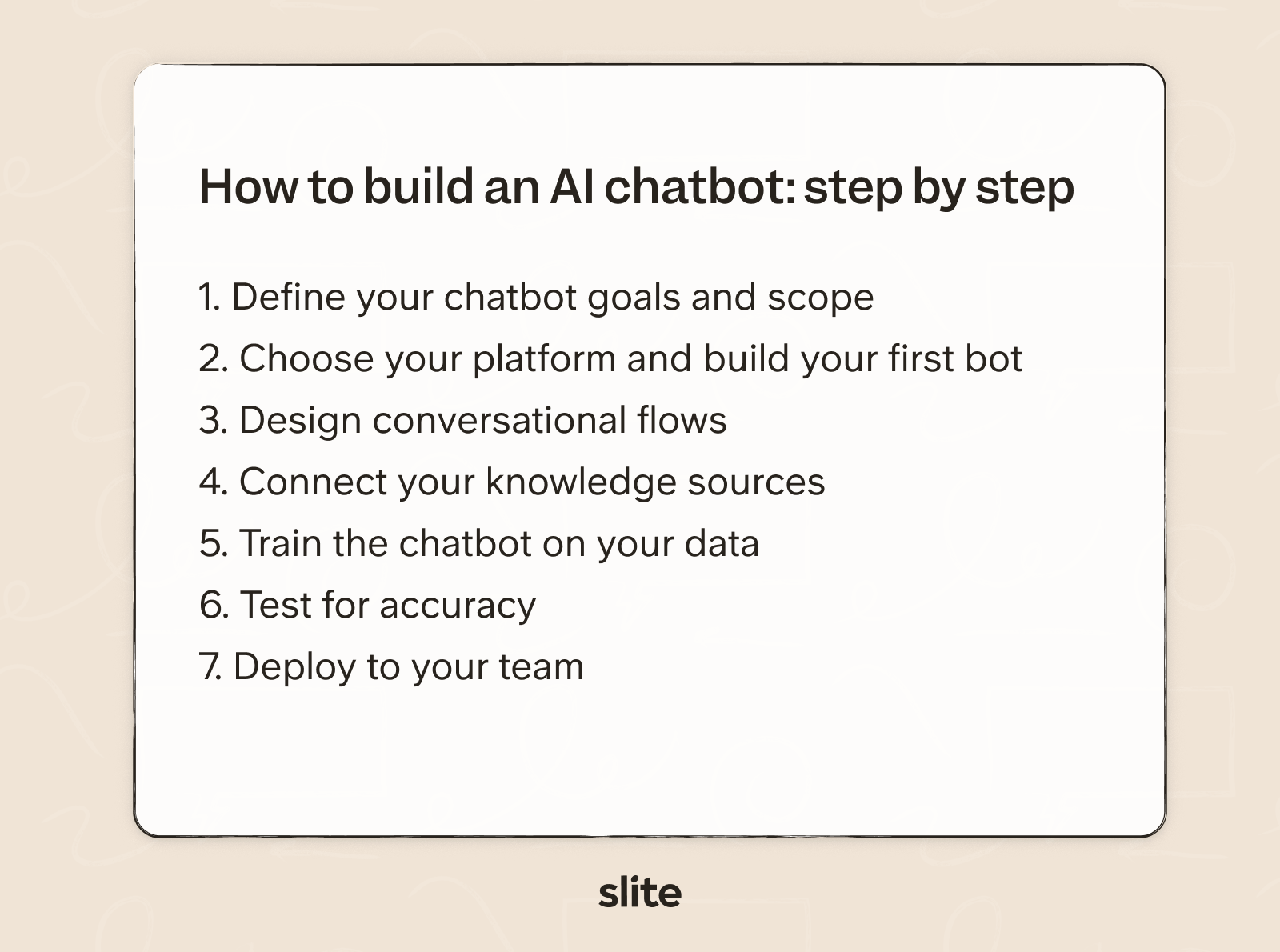
Step 1. Define your chatbot goals and scope
Start with the problem your team actually has. Are people asking the same questions repeatedly? Are new hires struggling to find basic info? Is product or process knowledge hard to surface quickly?
Then define what the chatbot should cover (HR policies, IT help, product docs) and what is explicitly out of scope (legal advice, performance reviews).
Common internal use cases:
- Internal help desk (IT, HR, and policy FAQs without creating more tickets)
- Product knowledge (support and sales teams find accurate feature info fast)
- Onboarding assistant (guides new hires through tools, processes, and norms)
Clear scope shapes every decision that follows: data structure, platform choice, and complexity.
Step 2. Choose your platform and build your first bot
Your platform choice affects how fast you can launch, how much you can customize, and how much you will spend maintaining it. Three paths cover most use cases.
Option A: No-code chatbot (fastest start)
Best for teams that need results today and have no developer resources. You can build a basic bot with Tidio in about 15 minutes:
- Sign up for Tidio (free tier available).
- Use the visual drag-and-drop builder to create conversation flows.
- Connect your knowledge base by uploading FAQs, linking help center articles, or pasting company docs.
- Set the bot's tone, greeting, and fallback replies.
- Deploy via a single line of code to your website, Slack, Facebook Messenger, or Instagram.
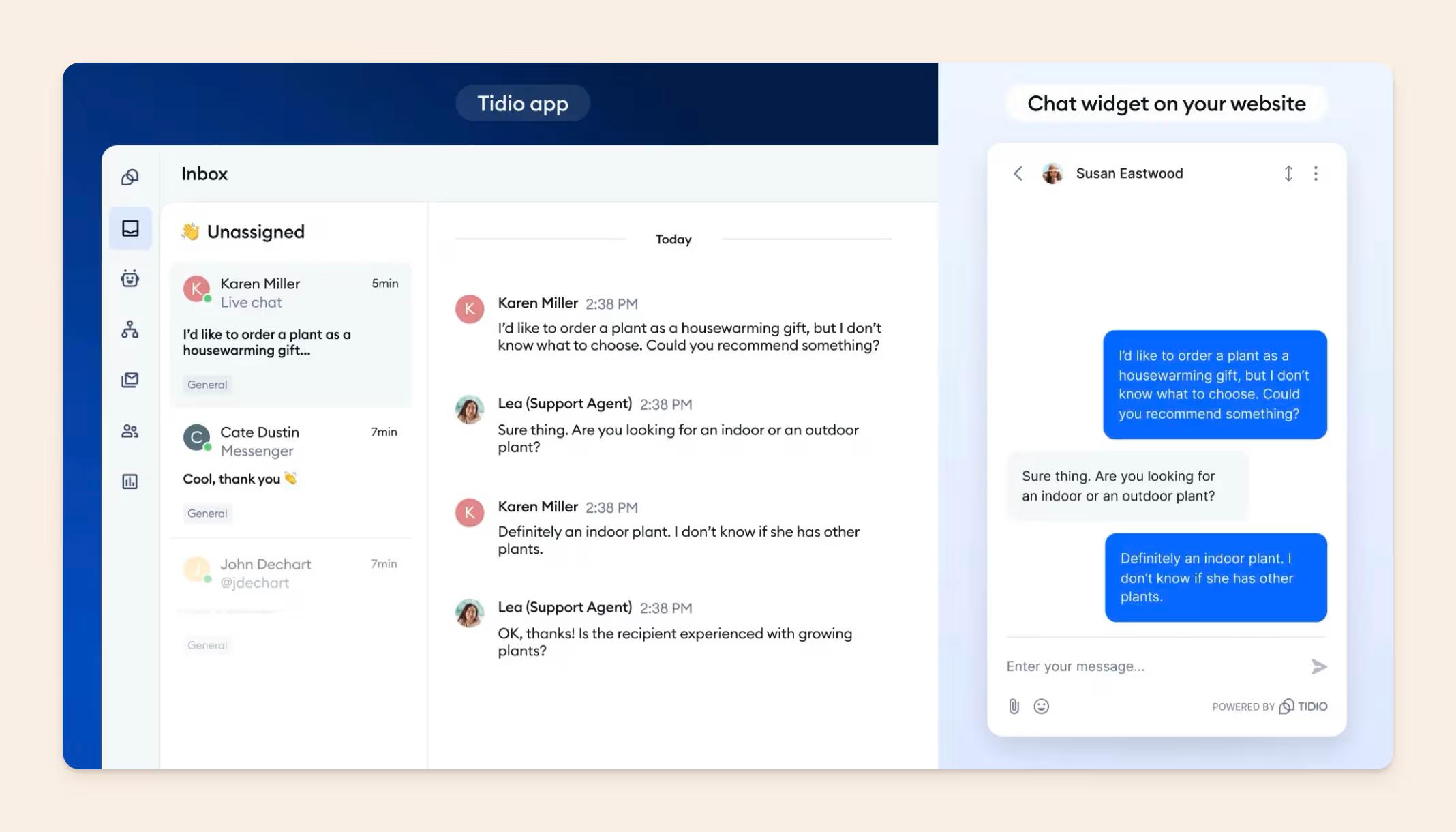
What you can build: a customer support bot, a lead qualification bot for sales, or an internal HR assistant for policy questions. For a customer-facing support example built directly on your knowledge base, see how teams deploy Fin AI.
Other no-code options worth exploring: ManyChat for marketing automation, Chatfuel for Facebook Messenger bots, and Landbot for visual flow-based bots.
Option B: AI agent platform (more control, built for customer support and lead qualification)
Best for teams that need a chatbot to actually resolve support tickets or qualify leads, not just answer internal FAQs. Botpress is a common choice here, with a first agent up and running in one to two hours:
- Create a free Botpress account (no credit card required).
- Build your agent in natural language instead of a rigid flow chart. You describe what it should do, and Botpress configures the logic.
- Connect it to your knowledge base, help center articles, and product docs so it answers from real, up-to-date sources.
- Give it permission to take action: issue a refund, update an account, qualify a lead and push it to your CRM, or trigger a multi-step workflow across your existing tools.
- Set escalation rules so it hands off to a human with the full conversation history when a ticket needs judgment.
- Deploy on top of your existing helpdesk (Zendesk, Intercom, etc.) in minutes, or use Botpress Desk as a standalone ticketing system if you don't have one yet.
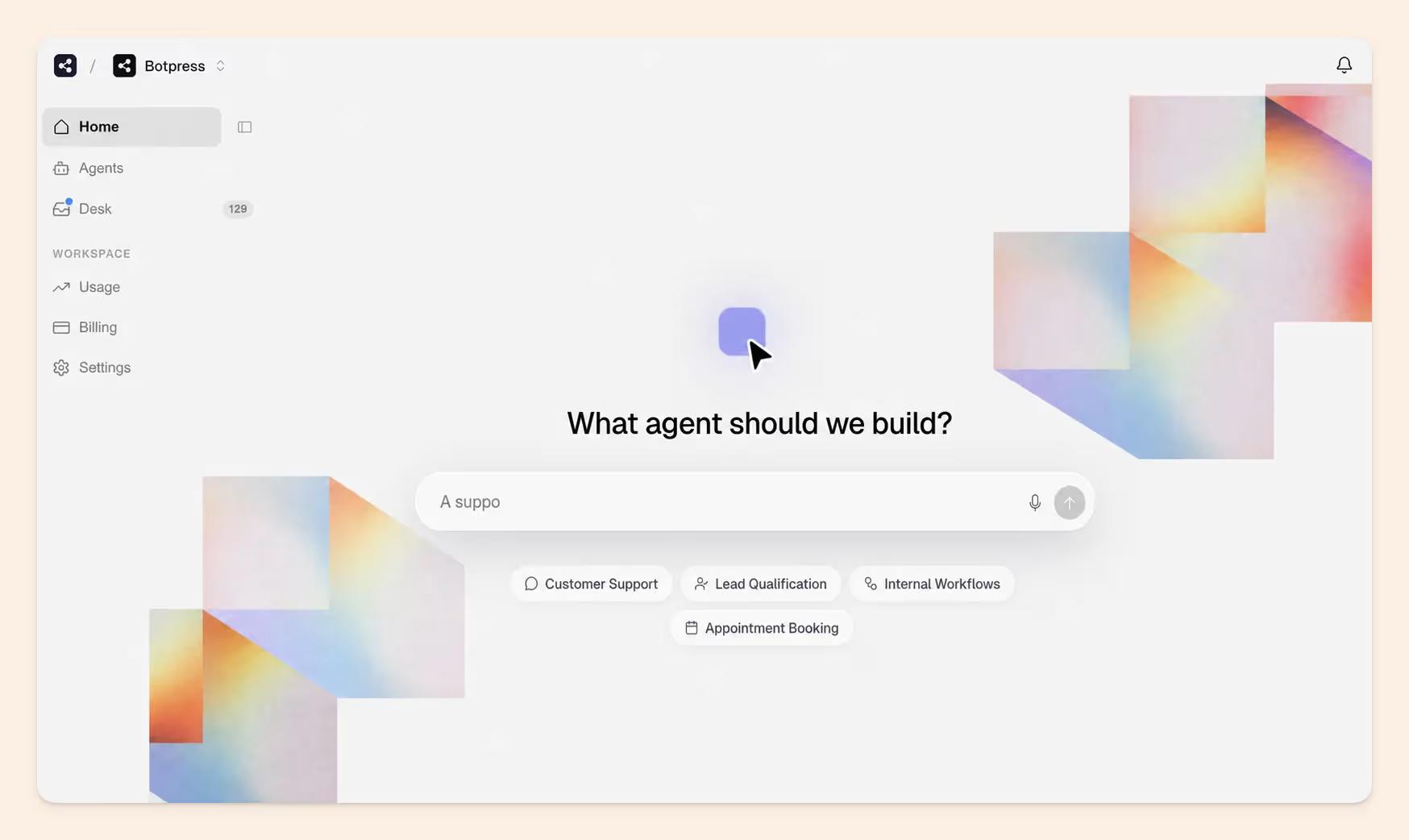
What you can build: a support agent that resolves refunds and order issues end to end, a lead-qualification bot that captures and routes prospects to your sales team, or an internal agent that pulls answers from multiple systems. Unlike most AI support tools, Botpress is built to hold up on the complicated tickets instead of falling back to a human by default, and it charges no per-seat fees, so usage grows without your software bill growing alongside it.
Other low-code options: Voiceflow for team-collaborative bot design, and Dialogflow for Google's natural language platform.
Option C: Custom Python chatbot (maximum control)
Best for teams with developer resources or very specific requirements. With Python and the OpenAI API , you can build a basic chatbot in a few hours, then extend it over time. A typical setup:
- Install dependencies like
openaiandpython-dotenv. - Set up your API key and environment.
- Write a function to send messages to a language model.
- Maintain conversation context so the bot remembers what was said.
- Define a system prompt to control tone and behavior.
To make the chatbot useful with team knowledge, add document search using LangChain : load company documents (PDFs, markdown, text), split content into chunks, create embeddings, and implement retrieval-augmented generation (RAG) so the bot pulls relevant content and cites sources. From there, you can deploy into Slack using the Slack Bolt framework and a slash command.
This approach gives full control over behavior, security, and integrations. The trade-off is time and maintenance. API costs grow with usage; some teams reduce costs by running open-source models like Llama or Mistral instead.
Which option should you choose?
Choose based on your team's actual situation, not the most technically impressive option.
- Go for no-code if: you need results today, have no developer support, and want to validate the concept with minimal effort.
- Go for low-code if: your team has basic technical skills and wants more control over logic, integrations, or data sources without taking on full build-and-maintain responsibility.
- Go for custom if: you need full control, have strict security requirements, want to deeply customize behavior, or have developer capacity to sustain it.
When unsure, start simple. A no-code chatbot that ships today and gets used beats a perfect system that stays in planning. You can always migrate to a more custom setup later using real usage data to guide decisions.
Step 3. Design conversational flows
You do not need to script every possible question. You do need to plan the key paths users will take.
- Greeting: set expectations clearly about what the bot can and cannot do.
- Common questions: map typical intents to direct answers or short guided flows.
- Fallbacks: what the bot says when it does not know the answer.
- Escalation: how and when to hand off to a human.
A critical design choice is teaching the bot to say "I don't know" instead of guessing. One healthcare team saw trust improve significantly after they added explicit fallback responses. Earlier versions always tried to answer, even when wrong.
Good fallback behavior looks like: "I don't have information about that yet." Offer related topics. Provide a clear path to a human.
Step 4. Connect your knowledge sources
Start with the sources your team already trusts and uses most, rather than dumping everything in at once.
Typical sources:
- internal docs and wikis,
- process documentation,
- help centers and FAQs,
- code repositories and issue trackers,
- cloud storage (Google Drive, Notion, Confluence).
The Taranis example. Taranis built an internal developer chatbot to reduce the time engineers spent searching across documentation and repositories. Their setup:
- Sources: Confluence documentation + GitHub repositories
- Tech: LangChain + Retrieval Augmented Generation (RAG), using the open-source RAG-Chatbot-with-Confluence project
- Access point: Slack slash command (
/devask) - Outcome: Less time searching docs, more time writing code
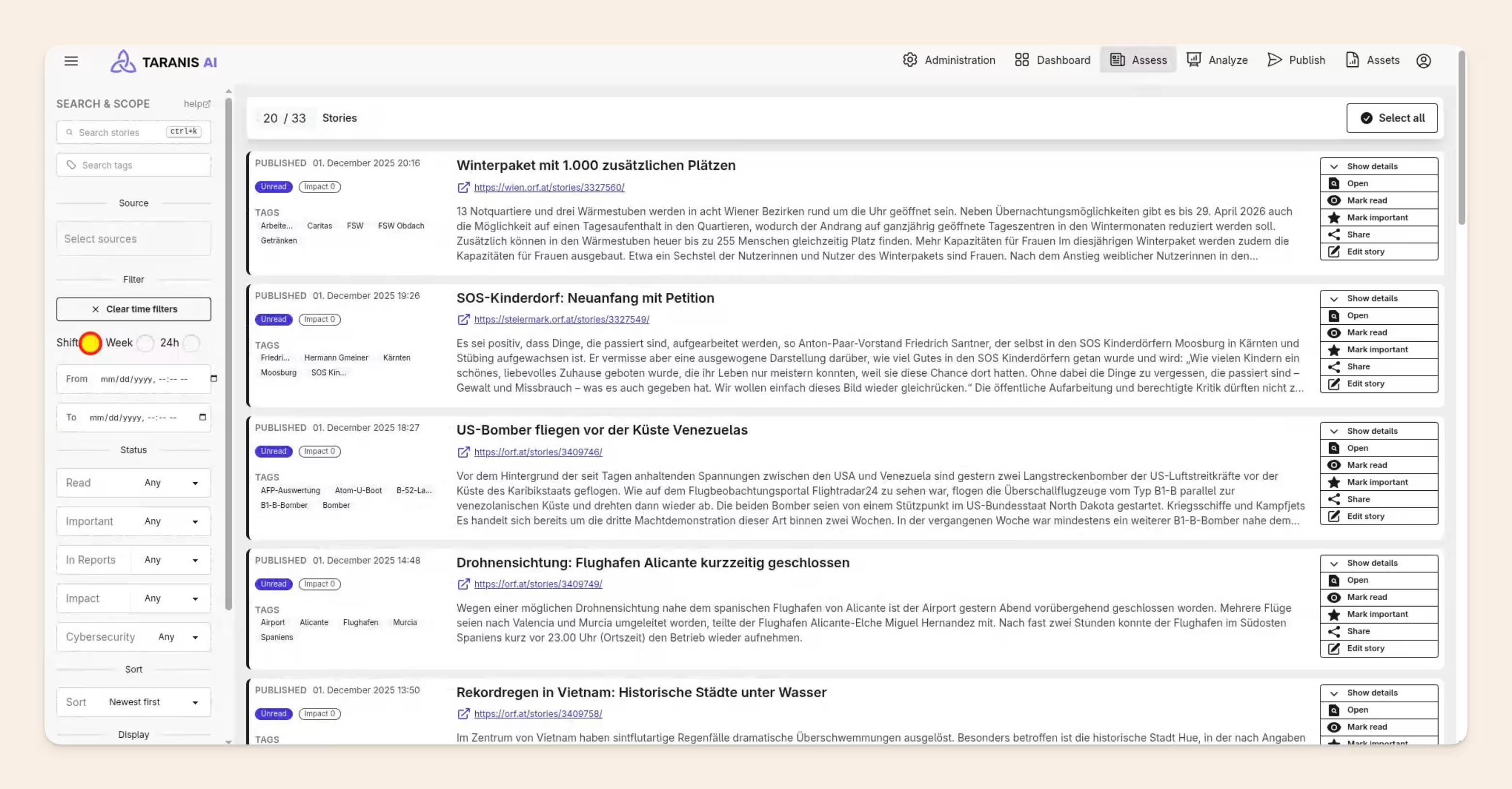
By wiring Confluence and GitHub into Slack, asking a question became faster than opening the wiki. If your team already lives in Slack, AI for Slack brings the same answer-in-chat experience to everyday knowledge sharing.
The quality of your knowledge base matters more than most teams expect. Tools like Slite, with clear ownership, verification workflows, and structured docs, give your chatbot a reliable and trustworthy foundation. When your knowledge stays current and well organized, your chatbot's answers do too.
Step 5. Train the chatbot on your data
Training is about behavior, not just data. You are defining how the chatbot sounds, what it answers, and what it does when it does not know something.
Key elements to configure:
- Tone: "Helpful, concise, and friendly. Avoid jargon unless the user uses it first."
- Scope and limits: "Answer only about company policies, IT, and benefits. For legal or HR-sensitive issues, direct users to HR."
- Example responses: include ideal answer length, structure, and formatting.
- Fallbacks: "I don't have information about that yet. You can try searching the HR handbook or ask #people-ops."
- Citations: "Always cite the document name and link where the answer comes from."
In no-code tools, you configure this through settings panels and Q&A pairs. In custom setups, you encode it in system prompts:
You are a helpful internal assistant for Acme Corp. Answer questions about company policies, IT support, and benefits. Always cite the specific document or page where you found the answer. If you don't know, say 'I don't have information about that' instead of guessing.
Step 6. Test for accuracy
Trust hinges on accuracy. A few confidently wrong answers can kill adoption entirely.
1. Build a question bank using real questions from your team, at different difficulty levels:
- Easy: "What's our PTO policy?" / "How do I reset my password?"
- Medium: "How do I configure SSO for new team members?"
- Hard: "What's the approval process for hiring contractors across multiple countries?"
2. Grade each response on:
- Accurate: Is the information correct?
- Complete: Does it fully answer the question?
- Sourced: Are citations present and appropriate?
- Clear: Is it easy to understand?
- Timely: Is the response fast enough?
3. Iterate. Track failures and partial answers. Improve documentation where gaps appear. Refine prompts and training examples. Over time, this feedback loop is what turns the chatbot into a dependable daily tool.
Step 7. Deploy to your team
Deployment is a product decision. The chatbot should be easier to use than searching a doc or pinging a colleague.
Common channels:
- Slack and team messaging: slash commands (like
/devask) or direct messages to a bot. Ideal for internal Q&A. - Web apps and browser extensions: standalone UI or Chrome extension for quick access across tools.
- Embedded widgets: chat built directly into existing tools or intranet pages, so help appears in context.
Most teams launch a basic internal chatbot in about a week. Complex enterprise setups can take up to a month. Start small: handle FAQs and basic support first. Once live, use real usage data to decide what to automate next.
Build vs. buy: when to use a ready-made solution
Before you invest months of engineering time building a custom chatbot, ask whether buying an existing solution makes more sense. Building often sounds straightforward, but the real costs appear only after the first version ships and people start relying on it every day.
The reality of building your own chatbot
Uscreen's Co-Founder and CTO, Nick, spent nights building a Slack bot that connected to Google Drive and their help center. Before that, the team had tried Guru (too complex), Intercom's knowledge base (outgrown it), and a homegrown AI tool. None of them stuck.
According to Mark Weisberg, Senior Manager of Technical Services, the hidden costs of building included:
- Ongoing maintenance: custom tools often require more time to maintain than to build initially
- Data complexity: company knowledge is fragmented and contradictory across platforms, requiring sophisticated filtering and conflict handling
- UX problems: chat interfaces can bury sources in conversation flows, making answers hard to verify
- Hallucination issues: custom bots confidently provide wrong answers instead of saying "I don't know"
- Developer opportunity cost: Nick was building at night because this was not the highest-value use of engineering time
When building still makes sense
Building your own chatbot is the right call when:
- Search is a core product feature that drives revenue
- Requirements are highly unique and not covered by commercial tools
- You have dedicated AI/ML capacity with no higher-priority work
- You are prepared for 12+ months of development and ongoing maintenance
For most internal knowledge chatbots, buying a solution like Slite Agent delivers value faster and avoids long-term engineering overhead.
Build an AI chatbot on your team's knowledge today
The best chatbot is the one your team actually uses. Focus on removing friction, not adding complexity. Once people trust the answers and form the habit, you can expand scope and capabilities with confidence.
For teams that want AI-powered search and answers without spending months building infrastructure, book a demo of Slite to see how Slite Agent connects all your tools and delivers reliable, sourced answers right away.
If you are building the documentation foundation that makes chatbots genuinely useful, start a 14-day trial of Slite and put the structure in place that your AI will rely on every day.
FAQ
What is the difference between AI chatbots and rule-based chatbots?
AI chatbots use large language models to understand context, intent, and meaning, allowing them to generate flexible, conversational responses and handle open-ended questions. Rule-based chatbots rely on predefined decision trees and scripted paths. They can only respond to specific inputs they have been programmed for, which makes them predictable but limited and often frustrating outside narrow use cases.
How much does it cost to build an AI chatbot?
Costs vary widely depending on your approach. No-code platforms often offer free tiers, with paid plans typically starting around $15 to $50 per month. Low-code tools usually fall into a similar range. Custom Python implementations require significant developer time (often weeks to months) plus ongoing API costs for language models from providers like OpenAI, which increase with usage. Some teams reduce ongoing costs by running open-source models like Llama or Mistral instead.
What programming language is best for building chatbots?
Python is the most popular choice for custom chatbot development, due to its strong ecosystem of AI, machine learning, and natural language processing libraries. Many teams successfully build and deploy chatbots without writing any code at all by using modern no-code and low-code platforms.
How long does it take to build a functional AI chatbot?
With no-code tools, you can often have a basic chatbot running in a few hours or days. More sophisticated implementations with integrations, document search, and testing usually take a few weeks. Fully custom-coded solutions tend to take weeks to months, depending on scope.
How do I keep my chatbot secure when using sensitive company data?
Choose platforms that support role-based permissions and encrypt data in transit and at rest. Review how your provider stores, processes, and accesses information, especially for internal or regulated data. Most enterprise-grade tools include security controls designed for sensitive company knowledge. If maximum control is required, self-hosted or open-source solutions can be a good option, though they come with added maintenance responsibility.