Self-maintaining documentation: keep your company knowledge up-to-date
The Slite Agent spots outdated knowledge across your tools, proposes the fix, and alerts the owner. With one-click triage, your team verifies the change and keeps your shared context accurate.
Docs go stale the moment work moves on. The real damage happens because nobody catches it in time.
A teammate might sense a document looks off and ask around. An AI agent will not. It will take the stale doc as truth, act on it, and pass the error to the next agent downstream.
Slite checks each document against the tools where your work actually happens, flagging drift before a person, or another agent, builds on it.
What is self-maintaining documentation?
Self-maintaining documentation happens in a knowledge base that keeps itself up to date. On a schedule you choose, an AI agent fact-checks every page against your live tools, flags what has drifted from reality, and proposes the fix for a human to approve.
The difference from a normal wiki is who does the catching. Instead of waiting for someone to notice a wrong answer, self-updating documentation surfaces the drift on its own, every week.
How it works
Starting with self-maintaining documention is as easy as changing the document status:
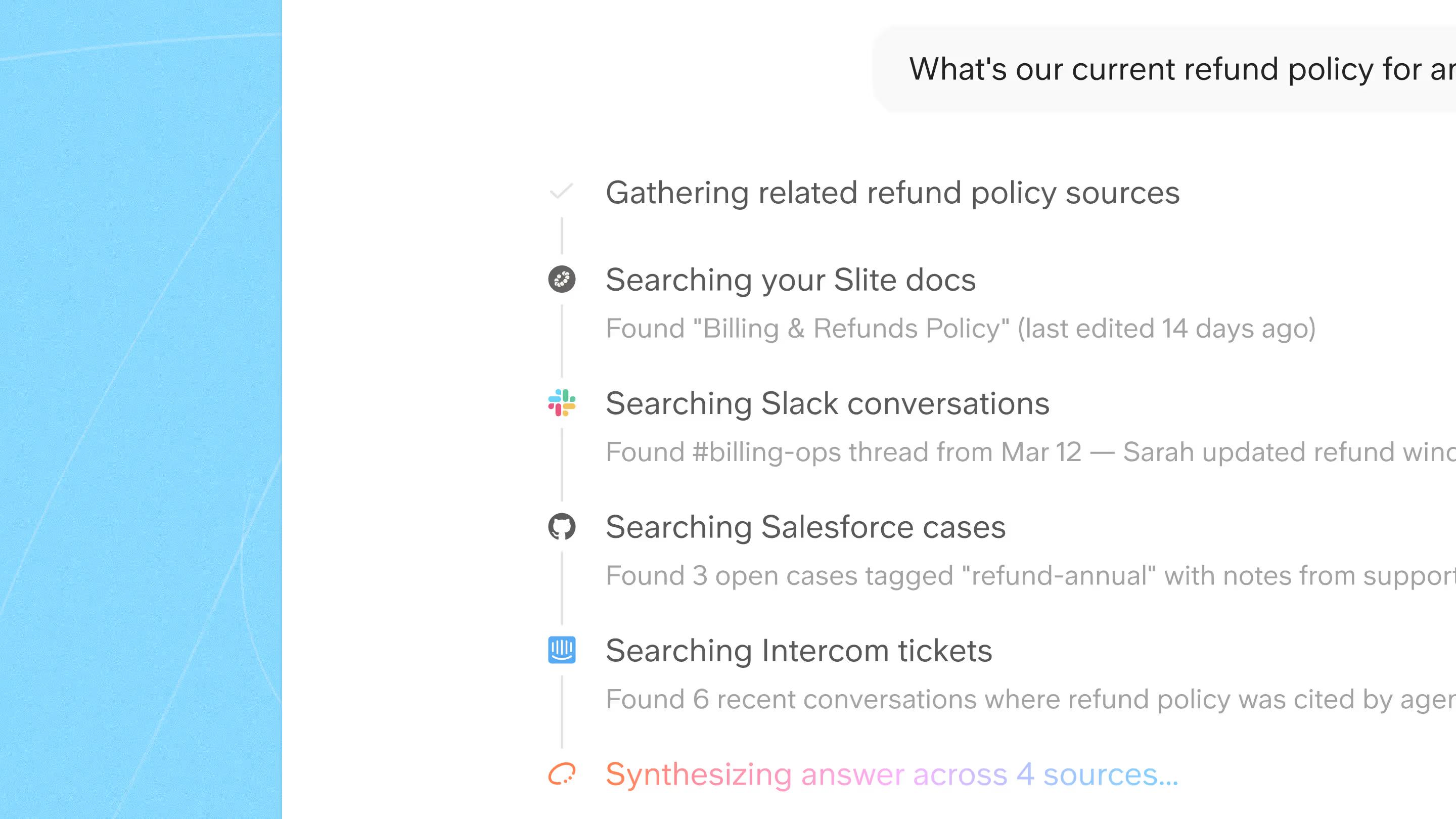
Fact-check against live sources
Connect Slite to your tools, including GitHub, Slack, and Linear. Open the Slite Agent on any document and ask it to fact-check the content. The Agent analyzes your live sources to verify your documentation claim by claim.
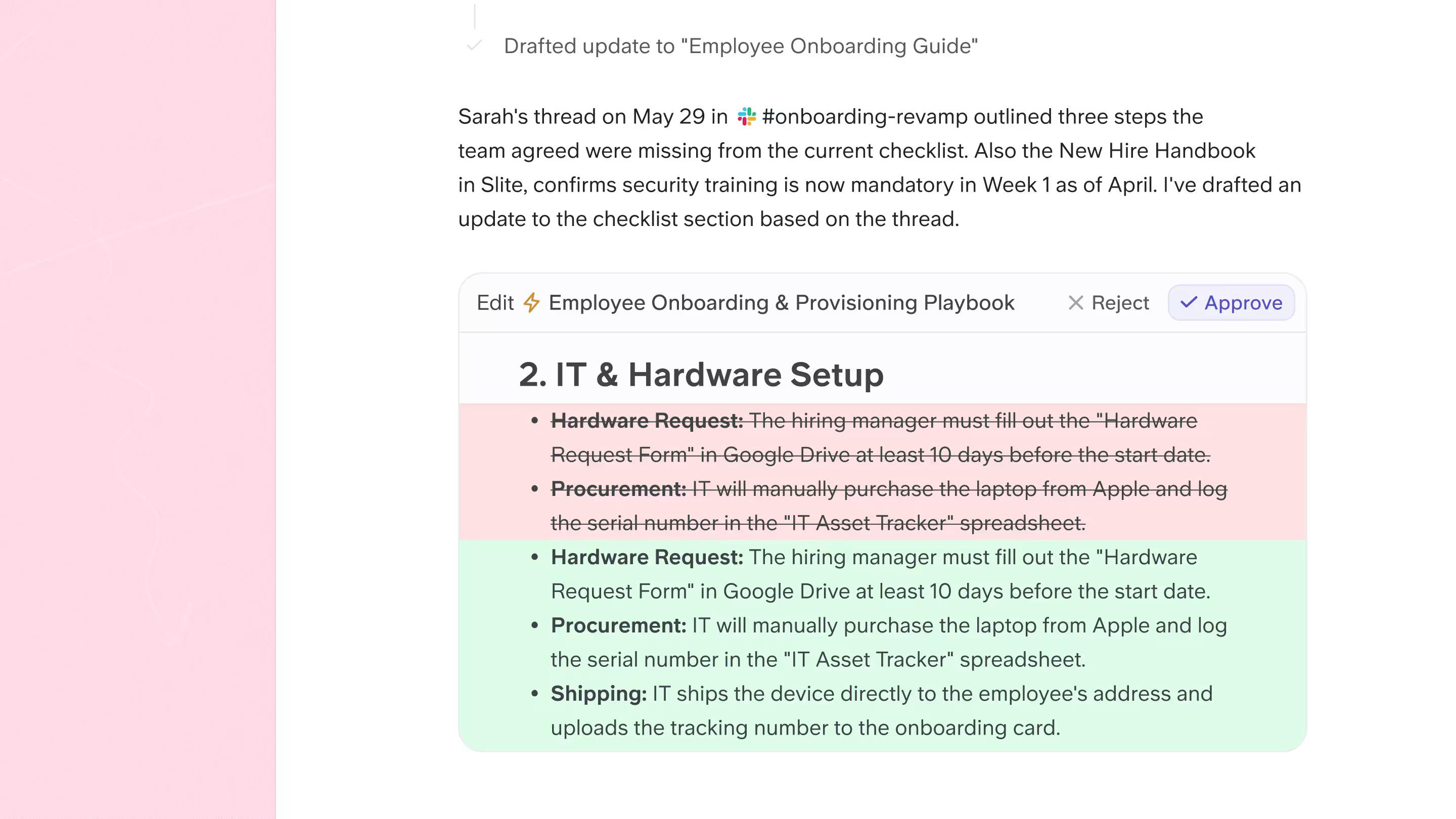
Review verdict by verdict
The Agent presents its findings as clear, color-coded cards. It highlights outdated information in red, suggests the exact fix in green, and leaves accurate text untouched. You scan the reasoning and accept or reject each change. The Agent makes the case, but you make the call.
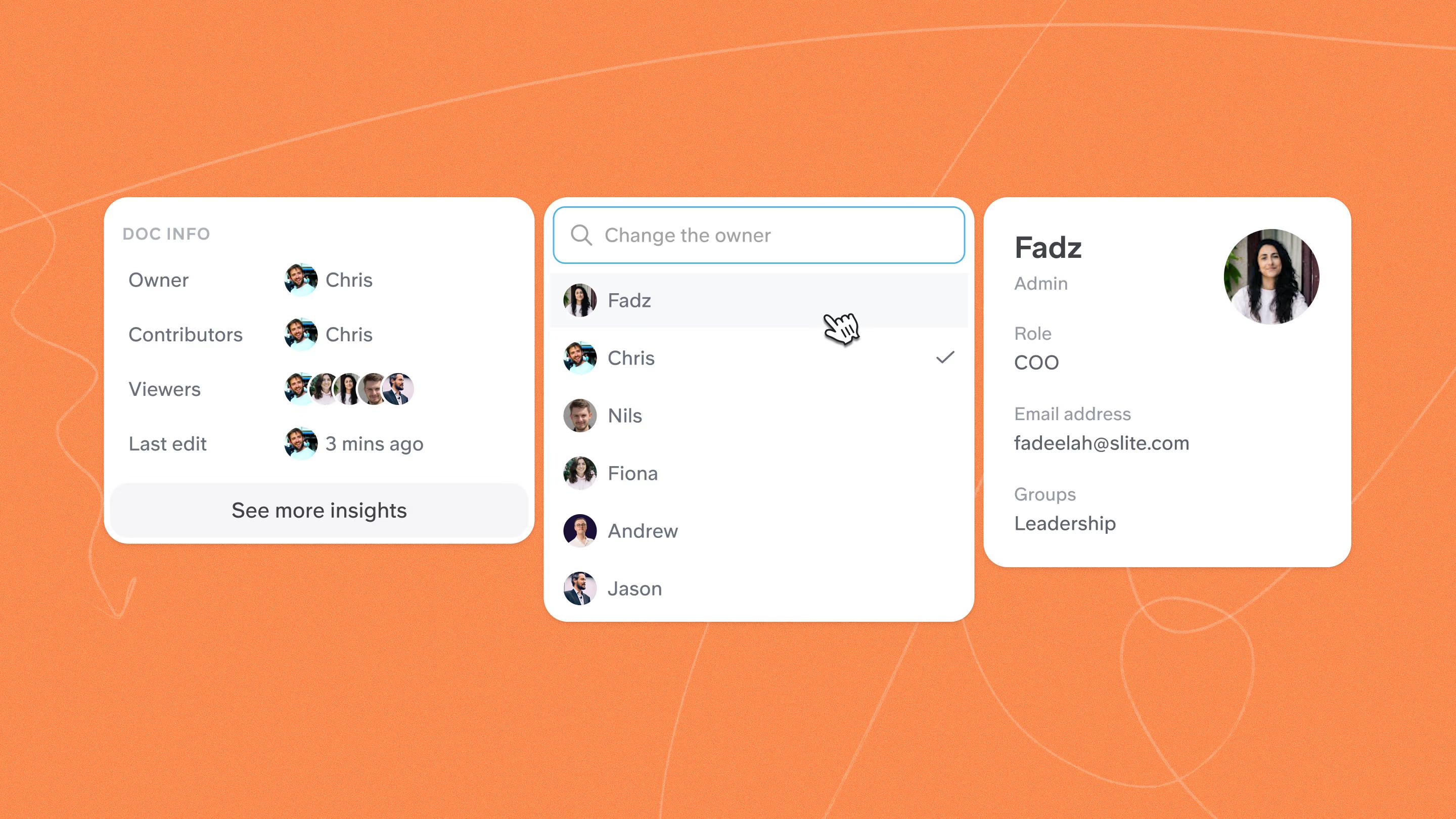
Assign the right owner
Ask the Agent who should own the document. By analyzing activity across your connected tools, the Agent suggests the teammate closest to the topic. They receive a notification to review the changes and mark the document as verified.
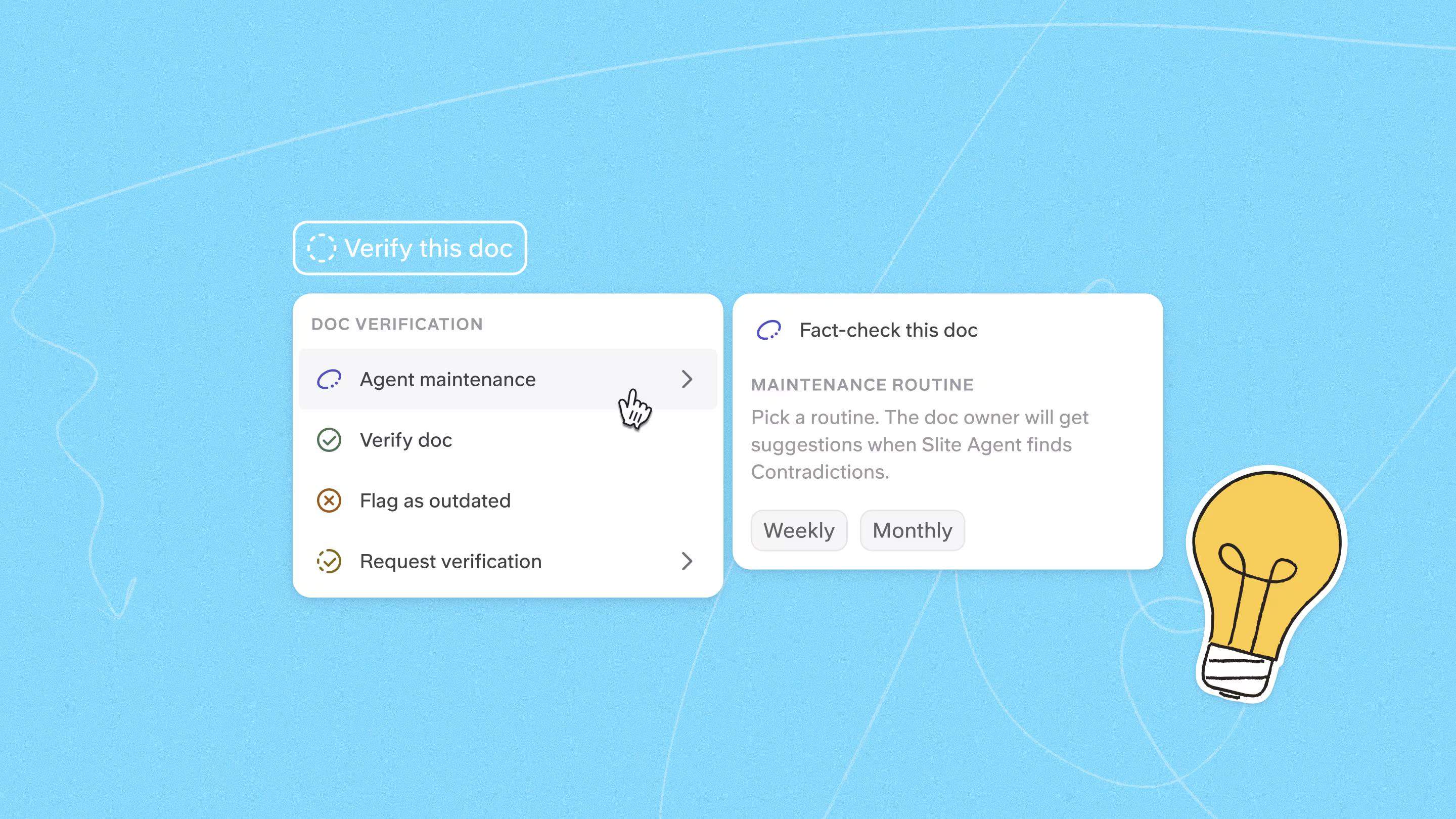
Switch on self-maintenance
Choose a weekly or monthly cadence to keep your document fresh. The Agent automatically re-checks the content on your cadence. When live work drifts from the text, the owner gets a proposed update in their approval queue to review, accept, and re-verify.
What kinds of docs stay fresh?
Any page whose source of truth lives in a connected tool:
- Engineering and API docs. Checked against GitHub and Linear, so the wiki keeps documentation in sync with the codebase.
- Support policies. When your refund policy changes in Intercom macros or a Slack decision, the published policy page gets flagged the same week.
- HR and ops policies. Benefits, expense rules, and processes that quietly change in Drive files get caught before a new joiner reads the old version.
- Onboarding guides. The pages people trust least in most wikis become the pages that are re-verified most often.
Go further
Set up an automated routine that runs overnight, calling the Slite Agent to audit your entire workspace document by document.
You wake up to find every proposed update waiting in your queue as a clean approval card, leaving you with nothing to do but triage.
What changes for your team
- Documentation that people and agents can trust. Because every page is continuously verified against your real-world tools, your team stops routing around docs to ask questions in Slack. Both your teammates and your AI agents can query your wiki with absolute confidence, knowing the answers are accurate, cited, and verified.
- Knowledge that keeps pace with work. Important decisions and technical updates no longer get trapped in private DMs or closed issues. Your central source of truth automatically keeps up with the speed of your engineering and product teams.
- Maintenance without the manual chore. You no longer need to schedule manual doc-cleanup days. The Slite Agent handles the heavy lifting of research and drift detection on a schedule, leaving your experts to simply make the final call.
The fastest way to see it is on a doc you already suspect is stale. Book a demo and we'll run it on your real docs together.
FAQ
How does Slite keep documentation up to date?
On your chosen cadence, weekly or monthly, the Slite Agent goes through each doc claim by claim and compares it to your connected tools. Accurate text is left untouched, drifted claims are flagged with a suggested fix, and the owner accepts or rejects each change from their approval queue.
How is this different from automated documentation?
They cover two ends of the same lifecycle. Automated documentation is about creation: drafting a doc set from scratch using the context in Slack, Intercom, and Google Drive. Self-maintaining documentation is about upkeep: keeping those docs accurate once they exist. Most teams use both, scaffold first, then switch on maintenance. Read how automated documentation works →