Your best people already keep a second brain. An engineer has an Obsidian vault with a write-up of every incident she has ever debugged. A product manager keeps a notes app full of customer calls, half-written specs and the reasons behind last quarter's decisions.
That habit is one of the best things that can happen to a company's knowledge. The open question is whether any of it ever reaches the rest of the team.
When people have a private place for their notes inside the work tool, sharing a note is one step. When they don't, the notes live in a personal app and the knowledge stays with one person.
Key takeaways
- A second brain is a habit of capturing, organizing and reusing what you know. Personal knowledge management (PKM) is the wider practice, and most knowledge workers already do some version of it.
- People who keep notes have something ready to hand over, which makes knowledge transfer easier.
- More work tools now make room for personal notes next to shared work.
- If you don't give people a place for their second brain at work, they keep it in personal apps. That's fine, but it's harder to share.
- Encourage the habit with a private space at work, a light method and one-step sharing.
What is a second brain?
A second brain is a personal system for capturing, organizing and reusing what you know: the context, decisions and references behind your work, kept in notes instead of your head. Tiago Forte popularized the term with two methods: CODE (capture, organize, distill, express) for working with notes, and PARA (projects, areas, resources, archives) for filing them.
A second brain is a habit first and an app second. When you work something out, a decision, a process, a customer detail, write it down somewhere you'll find it again, then reuse it the next time it comes up.
Forte outlined the idea in 2016 and published Building a Second Brain in 2022.
Personal knowledge management is the umbrella term for all of it: the methods, the tools and the habit of keeping your own notes.
It's a knowledge worker's habit: engineers, product managers, researchers, consultants, writers, anyone whose job runs on information they'll need to find again.
Choosing a second brain app
The apps came in waves. Early note apps like OneNote and Evernote came first. Notion and Obsidian came later and now define how most people picture building a second brain: a Notion second brain runs on databases and templates, while an Obsidian second brain runs on local Markdown files and links between notes.
If you're choosing between them, our Obsidian vs Notion comparison covers the trade-offs.
The best second brain app for work is the one that sits next to your team's docs, because that is what makes the next step, sharing a note, a single move instead of a copy and paste.
Personal vs company knowledge management
Personal and company knowledge management are two stages of the same knowledge. Personal comes first, when one person writes down what they know, and company comes after, when that note is shared and someone keeps it right.
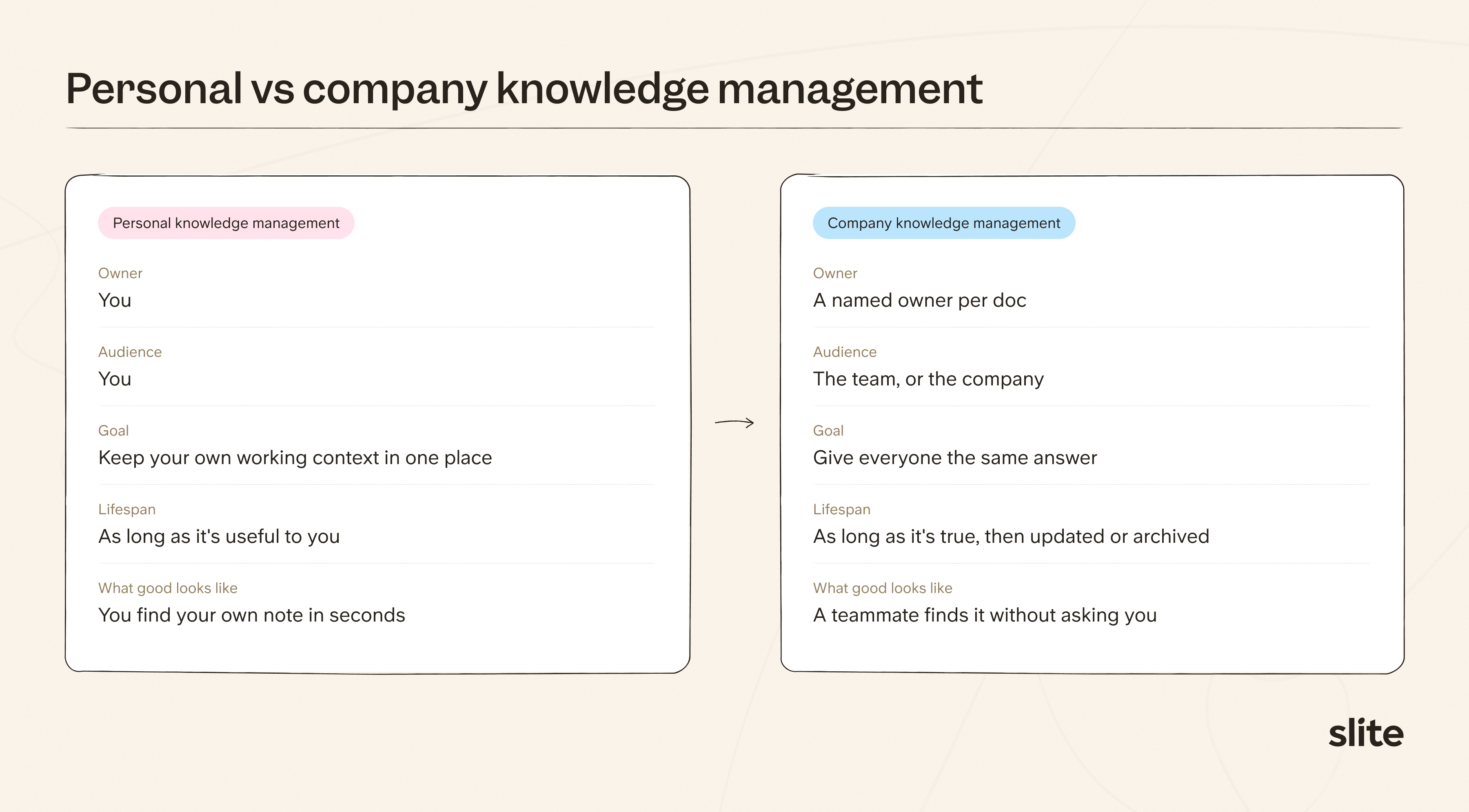
The note is often the same document at two points in its life, so the question for a company is how easily it crosses from the left column to the right.
How keeping a second brain helps company knowledge transfer
When knowledge workers keep their own notes on the work, they have something ready to hand over. Onboarding a teammate, writing a process doc or answering a question takes minutes instead of a meeting, because the raw material already exists in writing.
Personal notes are the raw material of team knowledge. A second brain makes the handover easier because the hard part, turning an experience into words, has already happened.
Notes turn into team docs with little extra work. A meeting note becomes a how-to once two more people need the same steps, and a research note becomes a decision doc once the decision is made.
Handovers, onboarding and departures go smoother when the knowledge already exists in writing. Most tribal knowledge is knowledge that someone held in their head and never wrote down, and a second brain is the habit that writes it down.
Harold Jarche's seek, sense, share framing makes the same point: company knowledge management depends on people doing their own knowledge management first, and the sharing step is where one becomes the other.
The second brain practice now has a seat in many work tools
More work tools now give people a private space next to shared work, which treats personal notes as part of the job. A doc starts private to its author and gets shared when it's ready, inside the same tool the team already uses.
The second brain habit is moving into work tools, and the examples are recent.
- Claude Docs, launched in September 2026, starts every doc private to the person who wrote it, with sharing as a later step.
- Linear's private teams list "a personal team" as one of their intended uses, a place for one person's issues and notes next to the team's work.
- In Slite, private channels have always lived next to team channels in the same sidebar.
People use these spaces as soon as they exist.
At Plaid, 36% of Slite users created at least one doc in a personal space in their first six months of usage for different reasons:
- second brain notes,
- durable context for AI agents,
- and as a replacement for a separate docs tool.
Plaid's engineering lead called it "an outcome we never planned for."
Nobody told those users to keep a second brain at work. They did it because the space was there.
What happens when you don't give employees a place for their second brain
People keep taking notes anyway, just in personal apps, or in awkward places like Apple Notes, a Figma file or a stray Google Doc. None of those make it easy to share with the whole team later, so the knowledge stays where it was written.
Without a place at work, notes end up in an Obsidian vault on a laptop or a notes app on a phone, outside the team's reach. Search can't see them, so a question one person already answered in their notes gets asked again in a channel.
Sharing from a personal app means copy, paste and reformat, and the note has to be rewritten for people who don't share the author's shorthand. Most of the time it doesn't happen.
When someone leaves, their notes leave with them. Everything they knew about a customer, a system or a process goes out the door in a vault nobody else can open, and the team is back to tribal knowledge.
How to encourage building a second brain at work
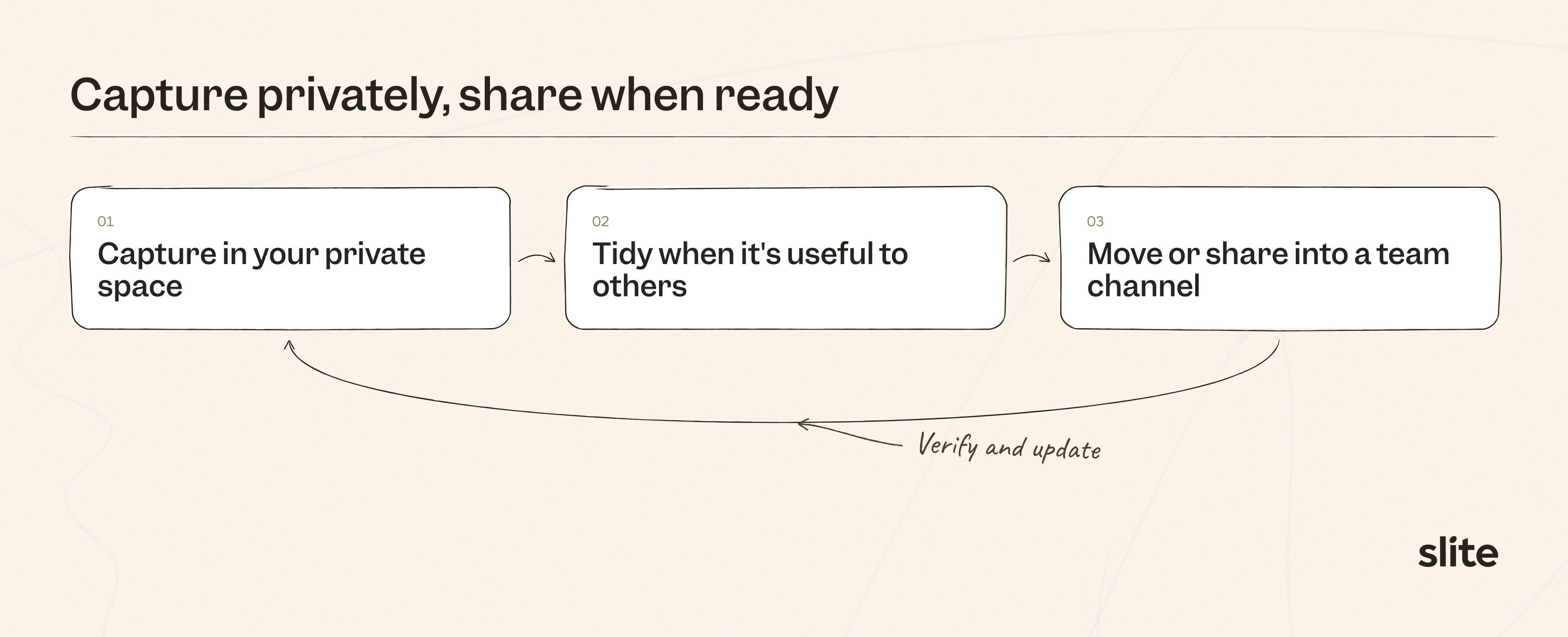
Give everyone a private space in the company's own tool, teach a light method like PARA, make sharing a note one step, and recognize people who share what they know. The goal is a habit people keep because it helps them, with sharing as the easy next move.
Treat the habit as something the company supports on purpose.
Offer a private space in your work tool
People need a place that's theirs before they'll write honestly in it. A note that says "I don't understand how billing works yet" is what a second brain is made of, and it won't get written in a shared folder.
Give every person a private space in the tool where the team's docs already live, and say out loud that nobody else can read it.
Teach a light method, CODE or PARA
A method helps people start, and a mandate makes them stop. Show CODE and PARA once, in a short onboarding session or a page in the handbook, as options rather than rules.
PARA is the easier one to adopt at work because it maps onto how work is already organized: projects, areas of responsibility, resources, and an archive for the rest. Leave the structure up to each person. The only rule worth keeping is that notes get written.
Make "share when ready" the norm
Sharing should be one step, and it should be expected. A note moves from a private space into a team channel when it would help someone else, with no rewrite and no approval meeting.
Set the expectation in plain words: your notes are yours until you decide they're useful to the team, and then moving them is the whole job. Once a note is shared, it needs an owner and a check-in date so it stays true.
Recognize people who share
The people who share their notes are doing knowledge transfer for the whole team, so treat it that way. Mention the shared how-to in the team meeting, and ask new hires which shared notes helped most, then tell the authors.
Recognition costs nothing and tells everyone else that sharing is part of the habit.
How to build a second brain for your team in Slite
In Slite, keep notes in your private channel, then move or share a doc into a team channel when it's ready. Search and Slite Agent respect permissions, so private notes help your own answers without leaking to anyone else.
Slite is one tool for private notes and team knowledge, with one step between them.
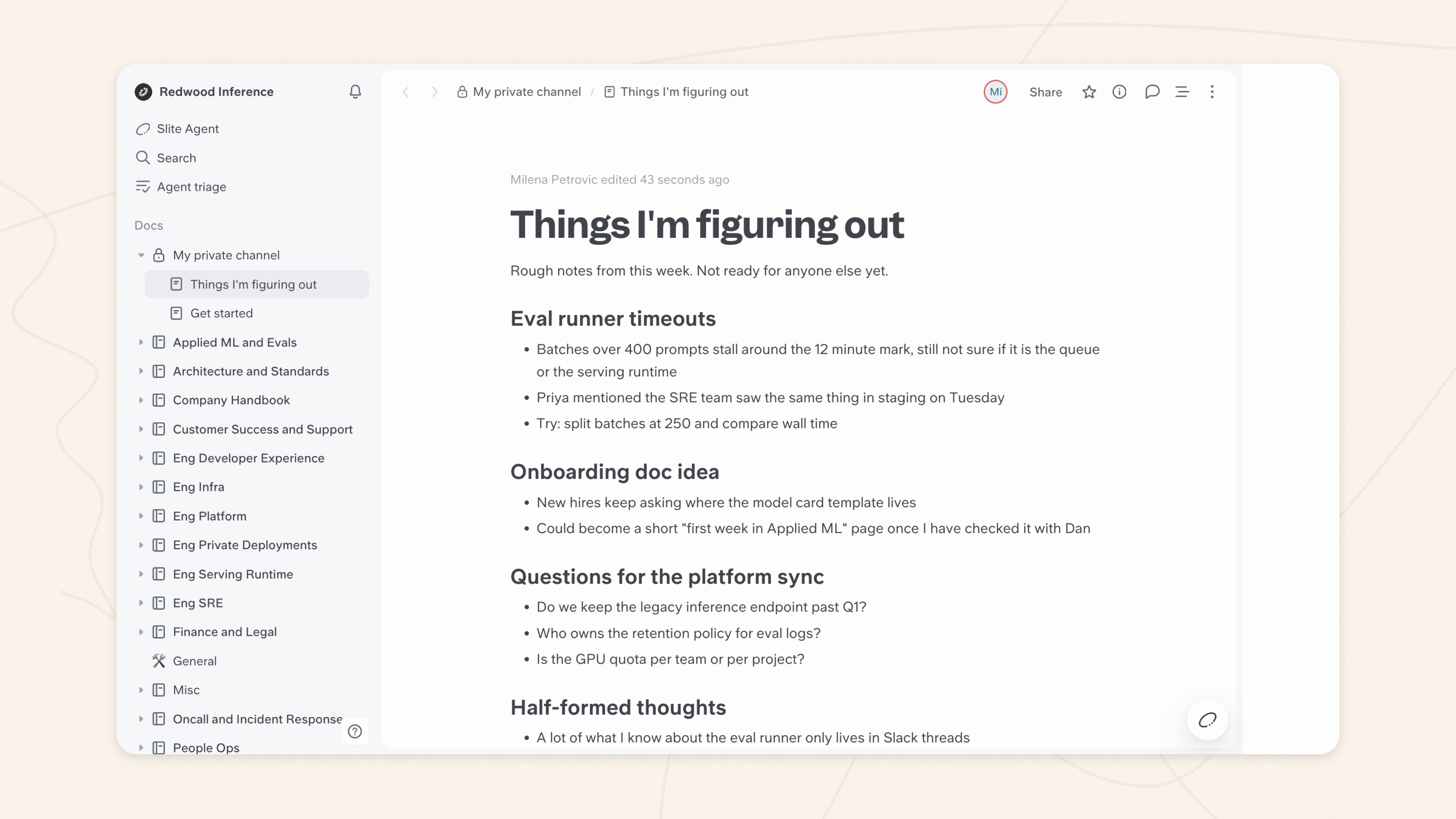
Your private channel is yours. Only the people you invite can see a private channel, and admins can never access "My private channel", so it's a sanctioned place for rough notes, meeting write-ups and the questions you're still working out.
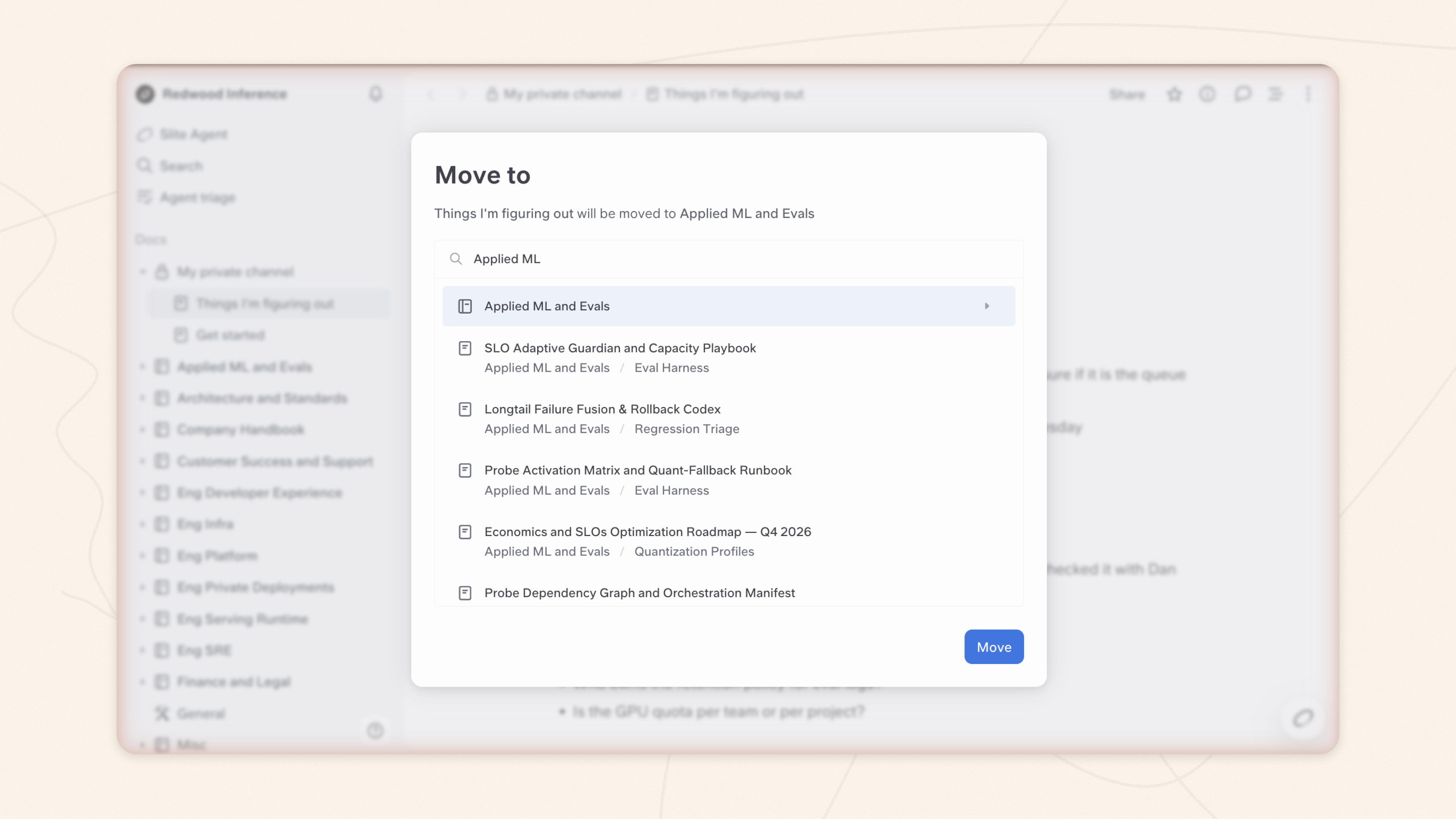
Moving a note to the team is one step. When a doc is ready, move it into a team channel or share it with specific people from the Share menu. A moved doc takes on the permissions of its new channel, so check the Share menu after moving to confirm who can see it.
Search and Slite Agent respect your permissions. Ask a question and the answer is built only from docs you can access, checked in real time. Your private notes make your own answers better, and they stay invisible to everyone else.
Your private space works as context for other AI tools too. Slite's remote MCP server connects Claude, Cursor and other agents to your docs within your own permissions, so an agent can read your notes about a project before it drafts anything.
Once a note is shared, give it an owner and a verification cycle. The owner gets a reminder when the doc is due for review, and readers can see whether a page is verified or outdated. Our guide to a self-maintaining knowledge base covers how to keep shared docs current from there.
If your second brain already exists as a folder of Markdown files, bulk import brings them into a new private channel, so you can start in Slite with the notes you already have.
GraphXSource moved to Slite from a mix of Obsidian and Notion. Obsidian had worked well for personal notes, but the team needed a place where the same notes could be shared and found across time zones.
Conclusion
The second brain habit is good for the knowledge workers who keep it and for the teams they're on. A person who writes down what they know has something to hand over, and a team that makes handing over easy keeps the knowledge when people move on.
If the habit is easy at work, personal knowledge turns into team knowledge with one step. That shared layer, kept current and findable, is what a company brain is made of.
If you'd like to try it, start Slite with a private channel for your own notes, and share the first one when it would save a teammate a question.
FAQ
Is a second brain worth it?
Yes, for any knowledge worker who has to find the same information twice. Keep the method light enough that you write the note in the first place.
Can a team have a second brain?
A team's version is shared knowledge fed by personal notes, kept current by named owners. Slite calls that layer a company brain: everything the team knows, in one place, maintained so it stays true.
Should I keep my second brain in a work tool or a personal app?
Keep work notes in a private space inside the work tool, and personal life in a personal app. Work notes in the work tool are one step from being shared, and they stay with the team if you move on.
Can AI use my second brain?
Yes. Through Slite's MCP server, agents like Claude read your private notes as context, within the permissions you already have, so nothing in your private space reaches anyone else.