Every prospect we talk to says some version of the same thing: our docs are outdated and messy.
The rest of the conversation is almost always identical: a senior person left, now there is a guide nobody updated, only an answer buried in a Slack thread from 3 years ago.
There is a 2026 twist to this, though. This knowledge problem before resulted only in a stale doc that use to waste one new hire's afternoon, trying to hunt down the person who actually knows the answer but didn’t update the wiki.
Now this stale wiki gets piped into an AI agent, the agent acts on it confidently, and the error cascades through every downstream workflow that touches it.
Worst part, the customer often finds out before anyone internal does.
The good news is that you can systematically capture, verify, and maintain the knowledge inside your team's heads.
In this guide I will walk through what tribal knowledge actually is, the five symptoms that flag it as a problem, the one diagnostic question every leader should run, and a five-step capture loop you can put to work this quarter.
Key takeaways:
- Tribal knowledge is the undocumented expertise sitting in employees' heads, Slack DMs, and hallway conversations.
- The 2026 stakes are different. AI agents act on stale docs the same way humans do, and errors cascade downstream.
- Five symptoms reveal a tribal-knowledge problem already at work: the departure cliff, the onboarding bottleneck, the "ask a person" loop, tool sprawl, and audit risk.
- Fixing tribal knowledge is a loop, not a sprint. Identify, extract, verify, maintain, retrieve.
- Verifying that documented knowledge is still accurate, not the act of writing it in the first place, is what makes the system trustworthy.
Looking for a way to capture tribal knowledge? Slite is the AI Knowledge Base that does the work you put off
What is tribal knowledge?
Tribal knowledge is the undocumented expertise that lives in employees' heads, Slack DMs, and hallway conversations.
That means the workflows, decisions, and shortcuts that keep a company running but were never written down. It is valuable while it is there and invisible until somebody leaves. Most teams only price it the week a senior person resigns. The concentration runs deep: our data shows the top 1% of contributors create 47% of all knowledge base content, which is why losing one person removes a disproportionate slice of what the team knows.
A few adjacent terms when it comes to types of knowledge get used interchangeably, and they should not be. Let's go through them:
- Tacit knowledge is the academic expression that relates to deeply personal, internalized know-how, intuition, the things experts know but cannot easily articulate.
- Institutional knowledge includes both documented and undocumented know-how that your company has accumulated over time.
- Legacy knowledge is time-specific. Old systems, deprecated tools, the stuff somebody figured out three rebuilds ago.
- Tribal knowledge is the slice of all of the above that is undocumented and not widely shared.
Before we move on, I do want to offer a clarification, because I get this on almost every kickoff: tribal knowledge is not inherently bad.
Institutional memory and seasoned judgment have real value. The risk is not that this knowledge exists. The risk is that it has never been captured anywhere a new hire, a teammate, or an agent can reach.
The example I use most often is the senior PM who knows which 2022 product decisions were reversed and why. The reasoning never made it into the doc, so every new PM re-litigates the same debate eighteen months later. That cost is real. It just gets paid in meetings and Slack threads instead of on an invoice.
Why tribal knowledge is a bigger risk in 2026 than ever before
In the AI-agent era, undocumented knowledge stops being a human inconvenience and becomes infrastructure risk. Agents read your docs, your Slack threads, and your CRM the same way humans do, and they act on whatever they find.
A stale doc no longer wastes one person's afternoon. It feeds every downstream workflow that touches it, and the errors compound silently.
Cognitive debt, the cost a team accrues when decisions, context, and shortcuts go undocumented, builds up quietly and only gets paid back when somebody new tries to do the work. It used to live inside a person's head, where the cost was at least contained to onboarding.
Now it lives inside a retrieval pipeline of a RAG search.
Every undocumented decision, every contradiction between two guides, every Slack thread where the senior engineer corrected the doc but never edited it, all of that breaks AI training the same way it breaks new-hire ramp. Just faster, and at higher volume.
The pushback I hear from buyers is usually some version of: we already do annual KB audits, isn't that enough?
My answer? It used to be.
Maintenance work scales linearly: one audit per year, one owner per page.
Knowledge creation scales exponentially, and AI consumption of that knowledge scales faster still. The old playbook breaks at AI speed.
Chris, our CEO, put it more cleanly than I can:
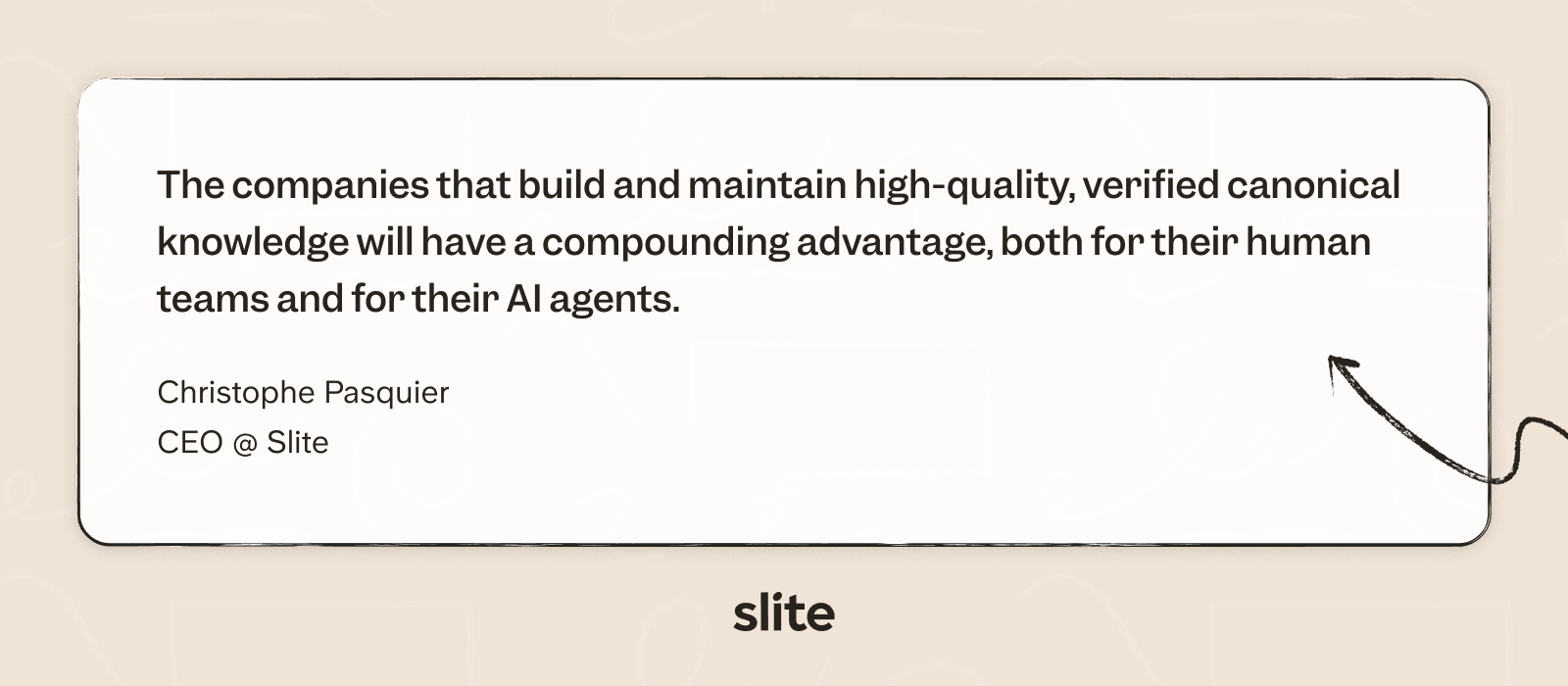
That sentence is the entire thesis of this piece. The rest of the article is operational advice for getting there.
Five symptoms of a tribal-knowledge problem
If a team recognizes two or more of these, tribal knowledge is already an active problem, just one that hasn't been priced yet.
The five symptoms are:
- the departure cliff,
- the onboarding bottleneck,
- the "ask a person" loop,
- tool sprawl,
- and audit exposure.
Each shows up as small daily friction long before it shows up as a crisis, which is exactly why teams under-react.
The departure cliff
Somebody senior leaves and a decade of context goes with them.
A large North American utility company we work with described the pattern in their compliance team:
Institutional knowledge walks out the door as experienced workers retire, stretching compliance teams and making audits more painful.
The same shape repeats across customers I've worked with in finance, healthcare, and ops-heavy industries.
That said, the exit interview is the most expensive knowledge-extraction tool in the world, and somehow also the worst-designed one.
It leaves a company with two weeks of notice, a single one-hour conversation, and a successor who has not been hired yet.
The departing expert spends most of their final week clearing their inbox, not writing down the workflows nobody else can run.
Whatever doesn't make it into the wiki by their last Friday goes with them, and nobody has the bandwidth to chase the gaps until something breaks.
By the time the gap is visible, the person who could have filled it is three months into a new job somewhere else.
The onboarding bottleneck
This bottleneck happens because new hires cannot ramp since nothing (or not nearly everything important) is written down.
A US medical equipment supplier with 600 employees we spoke with runs largely on memorization. The answer to how do new hires learn this? was, mostly, they shadow somebody.
In another case the Head of People at a US fintech company described it more diplomatically: Employees have been giving frequent feedback about difficulty finding information, especially new hires during onboarding.
Their team's knowledge sits across a wiki tool, a drive tool, and a chat tool with a 3-month auto-archive.
By month four, a new hire is asking somebody to re-explain something that used to live in a thread that no longer exists.
The "ask a person" loop
Every repeated question is a tax on the same knowledge, paid over and over.
An early-stage product founder we spoke with put it bluntly:
I need something that people can just ask in Slack to get back product questions and answers that I have answered thousands of times.
It is the same pattern across most teams without a verified knowledge base.
The entire business runs through a few key people in chat, while the ops lead spends their week fielding repetitive questions instead of doing their actual job.
When senior people spend more than a couple of hours a week answering the same things (which our research has heavily shown), the company is no longer running a knowledge base. It is running a help desk powered by burnout.
Tool sprawl
Knowledge gets scattered across categories of tools that were never meant to talk to each other.
A wiki tool here, a doc tool there, a chat tool everywhere, plus a ticketing tool, a couple of drives, and a CRM full of customer notes nobody else can find.
This is what most teams mean when they describe their tool fragmentation problem, and it is the symptom that makes every other one worse.
A major animation studio we work with runs across seven different tools daily, with a wiki backlog that goes back decades and a heavy second layer in a doc tool. The doc usually exists, somewhere. However, nobody trusts it.
Looking to introduce a knowledge base tool? Here’s our 2026 rundown of best KB tools on the market.
Compliance and audit risk
In regulated industries, undocumented knowledge becomes an audit liability.
Auditors do not care that the right answer lives in someone's head or in a Slack thread with a former employee.
They want robust documentation of compliance workflows (KYC/KYB processes, change management, access reviews), version control and verification status on regulatory policies, and a clear audit trail of who changed what and when.
Picture an auditor asking how a software change was validated and the only evidence being a Slack thread with somebody who left last year.
That is the scenario regulated teams need to protect against, and it is exactly the scenario that tribal knowledge produces by default.
The one question every leader should ask: what happens when a team member leaves?
Pick the highest-leverage person on the team. If they quit Friday, how much of their work is recoverable by Monday? A week later? A month? The size of that gap is the size of your tribal-knowledge debt.
People sometimes call this the bus factor: the number of teammates who would need to disappear before a critical workflow stops working. (The morbid version assumes a literal bus. The realistic version is somebody giving notice on a Tuesday.)
A consultant we work with told Chris, our CEO, on a call that her clients' subject-matter experts have legacy workflows, invisible work, and entire processes that consist of forwarding an email to their employees and expecting something to get done.
No data trail. No way to onboard a successor. No way to audit it. And the volume factor makes the problem worse.
A senior knowledge ops lead at a major fintech told us his team manages 500 documents and a sister team manages 700. If it takes me 15 minutes to review one document, it will take me months to go through the whole thing. That is one org. Multiply across the company.
So, if you’re a team leader and worried about the knowledge trail, I’m going to sum up again the three diagnostics I believe you should run this quarter:
- Bus-factor audit. For each critical process, ask how many people could pick it up tomorrow. If the answer is one, that is an exposure.
- Offboarding stress test. Walk through a senior IC's offboarding on paper before they actually give notice. Where are the gaps?
- New-hire week-one simulation. Take the top 10 onboarding questions and try to answer them using only the KB. No humans. Note every place the team got stuck.
If only three things get done this year that are related to your knowledge management system, do these.
How to capture tribal knowledge in five steps
Capturing tribal knowledge is not a one-time documentation sprint. It is a closed loop of:
- identifying,
- extracting,
- verifying,
- maintaining,
- and retrieving.
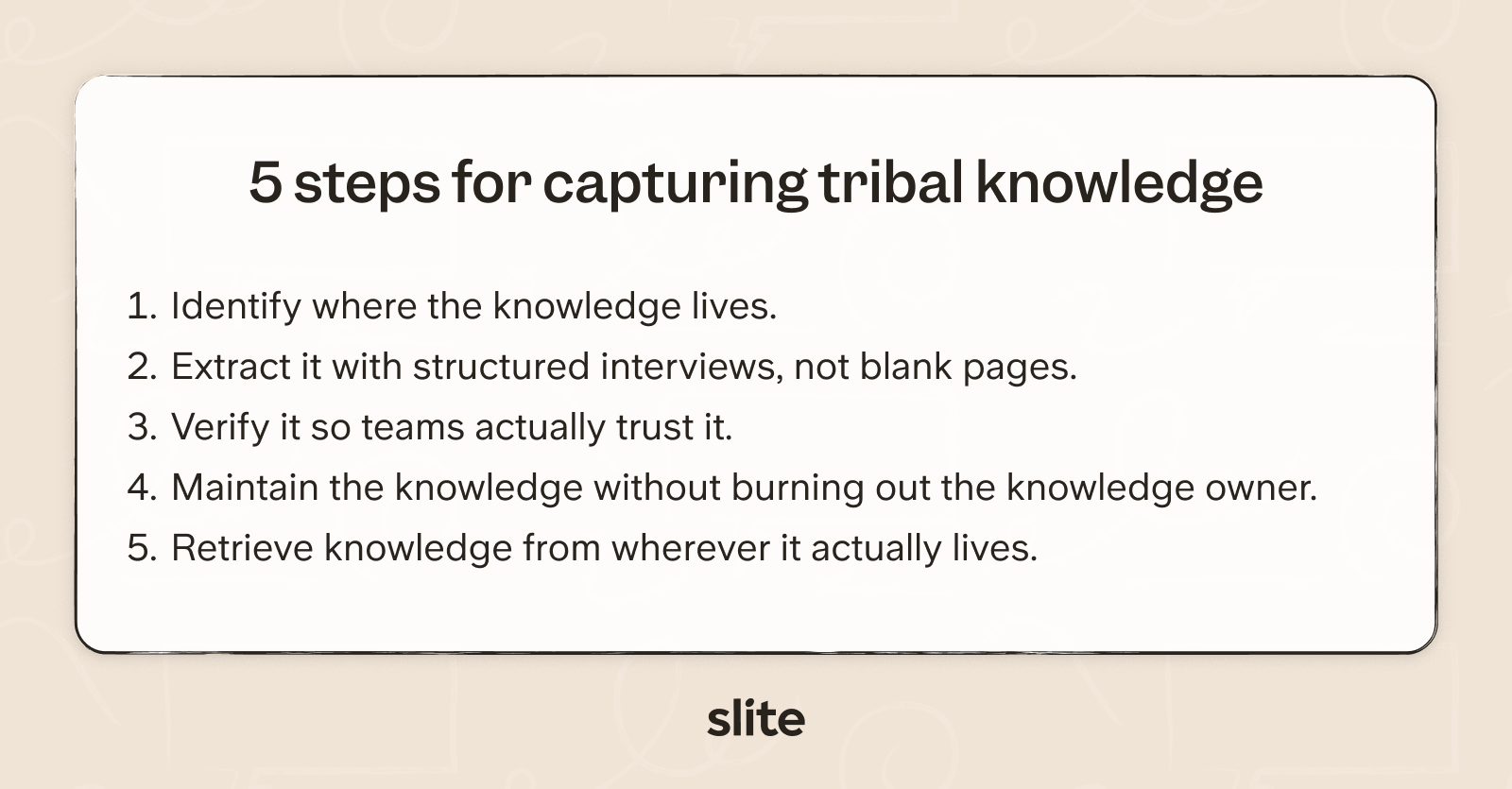
This means you have to start is to interview your experts". But after that, you cannot skip verification, or your team will not trust the docs; skip maintenance, and the docs decay back into noise within a year.
Identify where the knowledge lives
Map your knowledge holders, channels (chat, email, transcripts, drives), and scattered tools before you write a single new doc.
The first instinct is to start typing. Resist it. You will end up duplicating what already exists somewhere else.
This is where the Slite Knowledge Management Panel earns its keep. It lets you filter your existing docs by owner, channel, verification status, and review state, with templates for my outdated docs, my verification expired docs, and my empty docs.
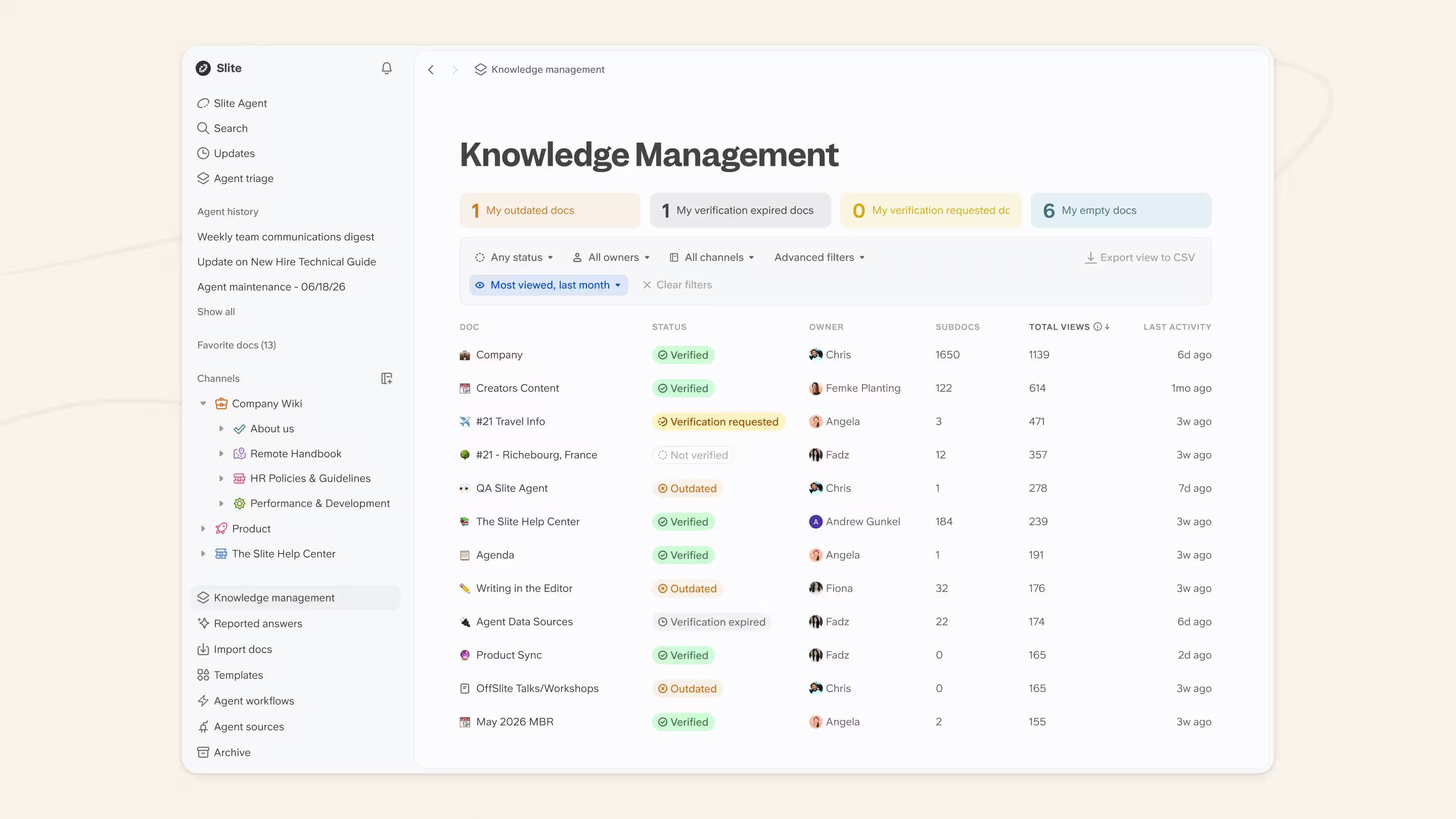
The panel turns a vague feeling of "our wiki is messy" into a concrete, sortable list of things to fix.
A large European bank we work with insisted on this step before adopting any KB. They asked specifically for the ability to determine clear organization and governance, before content, before search, before anything else. They were right.
Extract it with structured interviews, not blank pages
Experts do not know what they know, so to start interviewing them, you need to have a rough idea where to start.
At this point offering your expert blank-page docs fail because you need to give the outline so they can start writing.
The best advice I’ve seen from some of the knowledge managers we’ve worked with at Slite? Pull doc outlines from the questions people actually ask.
Most teams default to recording walkthroughs and dumping them in a drive somewhere. The result is unsearchable, hard to reuse, and useless to an AI layer. A modern KB closes that loop.
Inside Slite, an expert make a recorded walkthrough and embed it directly into a doc with our Loom integration . The recording stays alongside structured interview templates (decisions and reasoning, edge cases, what broke last quarter, who owns what), so the captured knowledge is searchable, verifiable, and ready to feed an agentic workflow downstream.
Capture once, retrieve forever, with the source video sitting next to the written context.
The objection I get most often I will quote almost verbatim from a customer call: people are lazy when it comes to updating their knowledge base.
My hot take is: they are not lazy. They are busy.
The fix is to make capture a byproduct of work, not a separate task.
A senior leader at an enterprise infrastructure company put it more sharply: some teams, some individuals, are better at maintaining the actual KB. Others are not as much.
Our hot take? Design your knowledge management processes for the second group.
Verify it so teams actually trust it
Undocumented knowledge is one problem. Documented-but-stale knowledge is worse, because people act on it.
At Slite we have an extensive methodology around document verification.
Slite's verification system is built around four states:
- Verified,
- Verification expired,
- Outdated,
- Verification requested
- plus a no-status default.
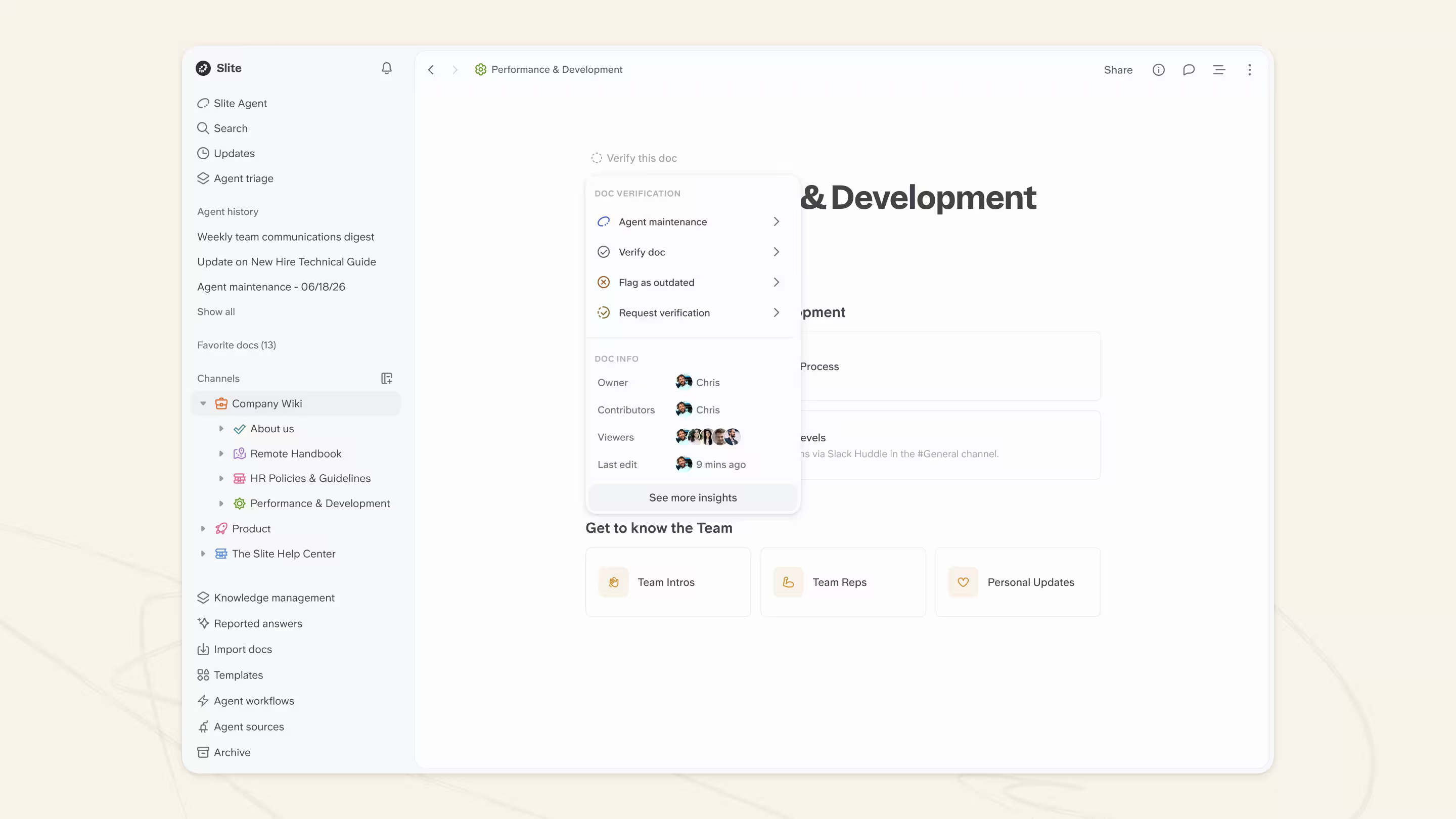
Owners set a review cadence on each doc, and the system prompts them when re-verification is due.
On top of that, we offer two types of AI search in our tools that the verification system affects: Ask, our integrated AI search, and Slite Agent, our premium AI search assistant.
Outdated docs get excluded from retrieval in Slite Agent and deprioritized in Ask answers.
This means verification is no longer just an HR signal. It is a first-class signal for the AI layer.
A senior knowledge ops lead at a major fintech said this better than I can:
The value of something that is verified is actually quite high. If it's verified, somebody at least skimmed through it. They know it's recent and accurate enough.
If your KB has no verification metadata at all, the AI layer has no way to tell trustworthy docs from rotten ones, and neither do your people.
Maintain the knowledge without burning out the knowledge owner
The old model is one "docs owner" slowly drowning in stale pages.
The new model, the one we are building toward with Slite Agent (coming June 2026), is an agent that handles the writing, reorganizing, and updating, with a human approving every change before it goes live.
That is what a self-maintaining knowledge base actually means in practice.
You don't need an agent to start running this loop today.
The teams I see succeed with Slite right now distribute the work across four habits, and any KB tool worth its salt should support them.
| What you need to do | How to approach it |
|---|---|
| Distribute the maintenance burden by ownership, not by job title | Every critical doc gets one named owner who is responsible for keeping it accurate. The "docs admin" stops being the single point of failure and becomes a coordinator instead, nudging owners when something is overdue. |
| Use the verification cadence as a forcing function. | Every doc owner sets a review schedule (monthly, quarterly, twice a year) that fits the doc's volatility. The system pings the owner when re-verification is due, so maintenance becomes a recurring small task instead of a quarterly clean-up project. |
| Treat the Knowledge Management Panel as your weekly to-do list. | Filter to my outdated docs and my verification expired docs once a week. Five minutes per doc, not five hours per quarter. Fewer trustworthy docs beat more "maybe-current" ones every time. |
| Prune mercilessly. | Empty docs and stale duplicates are a maintenance tax you pay on every search. Archive aggressively. The goal is a smaller, sharper KB, not a bigger one. |
Even before any agent enters the picture, the four habits above turn that "we should fix this someday" feeling into a queue with five items on it this week.
Retrieve knowledge from wherever it actually lives
Even with a great KB, some knowledge will live in chat, ticketing, drives, and code repos. That is fine. The requirement is that it is searchable from one place and that every answer points back to a verified source of truth.
The is the most common ask we get? We are looking for a tool that can centralize all of our knowledge from different apps such as a chat tool, a design tool, a code repo, and a drive tool.
Slite Agent, our AI retrieval layer, indexes 20+ sources and stitches them into one search surface. Slite is the verified system of record the answers point back to.
That pairing is what lets you keep using all of your other tools without your knowledge drifting across them.
What the best teams do differently
Teams that win at keeping tribal knowledge at bay do not have better writers.
They have better systems, clearer ownership, and a cultural allergy to the "ask a person" loop.
The pattern is simple:
- one owner per doc,
- capture happens at the moment of decision (not six months later),
- and the success metric is whether the system can answer a question without a human in the chain.
Ownership is singular, not shared.
Five co-owners on a doc means nobody owns it.
Katerina, our senior account executive, brings this up in almost every buyer conversation, and the teams who get it right pick a single name per page. No committees.
Capture happens at the moment the knowledge is created.
The PM's decision doc is written when the decision is made, not six months later when somebody asks.
If you have to choose between perfectly polished and captured at all, captured wins, every time.
"Ask a person" becomes "ask the system."
When a team's first instinct is to query the KB instead of pinging Steve, the system is working. The goal is to retire the human-in-the-loop for routine questions and reserve expert time for novel ones.
This way, senior people stop running a help desk. New hires stop blocking on availability.
Practical next step
If you only do one thing this quarter, run the bus-factor audit on your three highest-leverage people. That single exercise reveals more tribal-knowledge debt than any tool migration.
Then assign one owner per critical doc, set a verification cadence, and pick a single home where verified answers live. Tools come later. Clarity comes first.
The compressed checklist:
- Bus-factor audit on your three highest-leverage people.
- Singular owners on every critical doc.
- A verification cadence the owner actually accepts.
- One verified home where answers live.
- A retrieval layer that searches across the rest of your tool sprawl.
If your wiki has thousands of docs and no idea which ones are current, that is exactly the problem we built Slite to solve. Book a demo and we will walk through it together.
Final thoughts
Tribal knowledge is unavoidable. Uncaptured tribal knowledge is a choice, and in the agentic era it is an increasingly expensive one.
The cultural one-liner I use with our customers: the goal is not to eliminate tribal knowledge. You cannot. The goal is to make tribal knowledge the smallest, most contained, most intentional category of knowledge in your company.
FAQ
Is "tribal knowledge" politically correct?
The term originates with Margaret Mead in the 1940s and is still in mainstream business use, but some teams have moved to "undocumented knowledge" or "institutional know-how" out of cultural sensitivity. Either is fine. Pick the label your team finds respectful and use it consistently. The operational problem is the same regardless of what you call it.
What is the tribal knowledge paradox?
The tribal-knowledge paradox is the observation that the people who hold the most tribal knowledge are also the busiest, which means they have the least time to document it and the highest cost when they leave. It is why "document as you go" rarely works on its own. The senior expert always has more urgent work in front of them.
How do you capture tribal knowledge from somebody who's leaving in two weeks?
You cannot fully, which is why triage matters. Rank their work by leverage, schedule structured interviews on the top three areas, record everything (call recordings or video walkthroughs), and use AI to draft initial docs from the recordings for the team to review. Then assign a successor as the verification owner so the docs do not decay the moment the original expert is gone.
Why does tribal knowledge matter more in regulated industries?
In fintech, healthcare, and energy, undocumented knowledge becomes an audit failure waiting to happen. If a regulator asks how you validated a process and your only evidence is a Slack thread with a former employee, you have a finding. Verified, owned, audit-trailed documentation is the cheapest insurance against that scenario.