If you are reading this, here is a short story from Reddit that might feel familiar:
"A new developer joined last week and spent two days following our setup documentation before realizing that a large portion of it no longer applies. Some of the tools we reference were deprecated in 2023, yet the docs still instruct people to install them. Documentation inevitably gets stale, but at this point ours is actively harmful."
For many growing teams, that is the quiet danger of a failing knowledge base.
We see the same pattern in customer conversations. Teams describe their knowledge base as "the continuous pile," a "document dump," or a collection of "orphan things" nobody knows how to clean up. Sometimes the language changes, but the underlying issue is almost always the same: company knowledge keeps changing while the maintenance system falls behind.
We also find that most teams rely on busy humans to remember which docs changed, which owners left, and which answers should no longer be trusted. As the company grows, that model breaks. It breaks even faster when AI agents start treating the same stale knowledge as context.
In this article, we will look at knowledge base challenges, how to spot the failure early, and what it takes to build a knowledge base that stays useful for humans and AI agents.
Key takeaways
- Knowledge bases fail when maintenance depends on humans manually keeping fast-changing company knowledge current.
- Search can help people find answers, but it cannot tell them which answer is current, approved, or safe to use.
- The common signs of a failing knowledge base include orphan docs, duplicate answers, Slack fallback, unclear ownership, low contribution, and AI answers that cite untrusted content.
- The fix for a failing knowledge base is to move maintenance into the system through ownership, verification, upstream signals, permission-aware search, and human-reviewed agent updates.
Why knowledge bases fail
Across the teams we speak with, the failure usually starts before AI enters the picture. People stop trusting the knowledge base, maintenance becomes thankless work, and the same few contributors end up carrying most of the system.
Maintenance is invisible work
Knowledge base maintenance is a lot like dusting the house. Everyone knows it should be done. When things get messy, everyone notices. But when someone actually does the work, the result is easy to miss because the room simply looks the way it was supposed to look.
Docs have the same problem. Updating an old process, merging duplicates, or cleaning up an outdated page takes time and focus. But the reward is quiet. Nothing launches. No big metric moves on the dashboard. The team only notices when the work does not happen and someone follows the wrong answer later.
So the knowledge base keeps depending on work that everyone values in theory, but few people have time or incentive to do consistently.
Ownership decays
Docs become ownerless in the normal course of company growth. Someone writes the first version, then moves teams, gets promoted, leaves, or hands the workflow to someone else. The page stays live, but the responsibility behind it gets weaker with every handoff.
At that point, the knowledge base has become what one customer called a collection of "orphan things." The content remains, but the accountability is gone. Nobody wants to delete the page because it might still matter, but nobody wants to verify it either because they are no longer sure who owns the answer.
Docs drift faster than teams can review them
Every project, process change, customer issue, product release, and AI-generated summary adds more content to the system. However, the number of people with enough context to verify that content does not grow at the same pace.
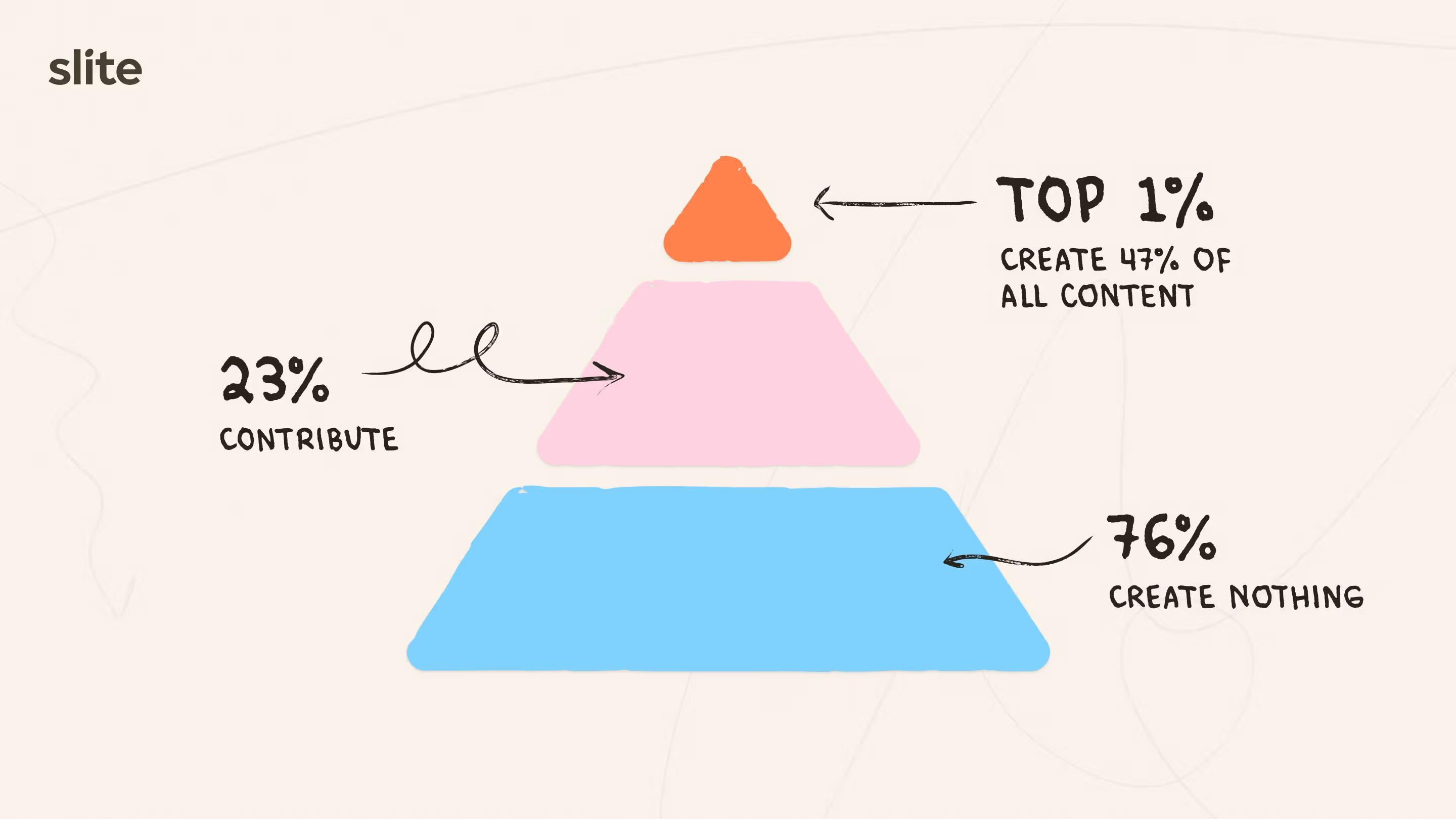
Our research shows the shape of that problem. More than 94% of active knowledge base content sat untouched in a given month, while fewer than 6% of docs were updated. Contribution was just as uneven: 76% of registered users never created a document, while the top 1% created about 47% of all content.
That is what we call "the contributor pyramid." A small group creates and maintains most of the knowledge, while a much larger group depends on it. When that small group gets busy, changes roles, or leaves, the review system falls behind.
Trust collapses after one bad answer
A teammate follows an outdated guide, loses time, and learns that asking a person feels safer than checking the docs.
Then the next answer happens in a thread, direct message, meeting, or private note instead of going back into the knowledge base. This is how information silos reappear, even in companies that built a knowledge base to centralize answers: the official page goes stale, while the usable answer moves into Slack, calls, tickets, and people's heads.
According to someone on Reddit:
Over time, fewer people visit the knowledge base, so fewer people notice what is stale. The knowledge base becomes less trustworthy because the team has stopped using it enough to keep it current.
Search makes stale knowledge look trustworthy
Search helps people find answers, but it does not tell them which answer is current, approved, or safe to use. In a failing knowledge base, that creates a different problem: the wrong answer becomes easier to find.
Search can return an old policy, a duplicate playbook, an unowned onboarding guide, or a document that has not been verified in a year. If the page looks official and appears as the top result, the reader is likely to trust it.
How knowledge base failures create agentic failures
A stale doc used to mislead one person at a time. Now it can feed an internal assistant, a support bot, or a workflow agent that treats company knowledge as context.
In Slite's research on stale documentation, more than three in four founders, operators, and engineers said they had seen an AI tool surface an outdated doc and confidently produce an incorrect answer. That is the agentic version of knowledge-base failure: the doc is already wrong, but AI removes the hesitation that might otherwise catch it.
Matt Erhard, managing partner at Summit Search Group, saw the risk firsthand. His team's internal assistant pulled salary data from a 2021 benchmark doc and recommended a pay range 15 to 20% below the current market. A recruiter used the range with a client before anyone caught that the source was years out of date.
That is the risk with agentic knowledge work. The model may look like the problem, but the deeper issue is the knowledge environment around it. If stale or unverified docs are available as context, agents can use them to generate confident answers and trigger real actions.
This is also why knowledge base security now has to include freshness and permissions. It is not enough for an agent to retrieve an answer. The system needs to know whether that answer is current, verified, and safe for that person or agent to use.
How to detect a failing knowledge base
A failing knowledge base usually shows up as repeated behavior before anyone declares it broken.
Here are the signs I would look for first:
| Signal | What it usually means |
|---|---|
| People ask Slack before checking the knowledge base | The team no longer trusts the knowledge base as the first place to look. |
| Search returns duplicate, old, or conflicting docs | The knowledge base has no reliable authority or freshness layer. |
| Docs have no clear owner | Review becomes easy to ignore because no one is accountable for the page. |
| A few power users maintain almost everything | The system depends on a small group that can get busy, leave, or burn out. |
| Old docs show up in AI answers | The AI layer is reading the same stale knowledge humans stopped trusting. |
| Nobody knows where cleanup should start | The knowledge base has become an abandoned pile of migrated, empty, inactive, or low-value content. |
The common knowledge management challenges behind knowledge base failure
Most failing knowledge bases have some mix of these knowledge management challenges:
- Information silos: Source knowledge lives in Slack, tickets, drives, calls, and people's heads instead of the place where the team searches. Over time, those scattered answers become tribal knowledge.
- Tool sprawl: One answer has five possible homes, so nobody knows which version to trust.
- Information overload: Useful pages sit beside abandoned docs, empty pages, duplicates, and outdated policies.
- Weak buy-in: Contribution feels optional, so the same few people carry most of the maintenance work.
- Tacit knowledge: Important context leaves with the people who never wrote it down.
- Poor content quality: Old, duplicate, or incomplete docs make the knowledge base feel risky to use.
- Access-control challenges: Sensitive knowledge gets locked away, while useful answers become harder for the right people and agents to find.
How to fix knowledge base failure with Slite
With Slite, humans still decide what is true. They do not carry the entire burden of finding drift, remembering review dates, cleaning piles, and rewriting every update from scratch.
Look upstream of the wiki
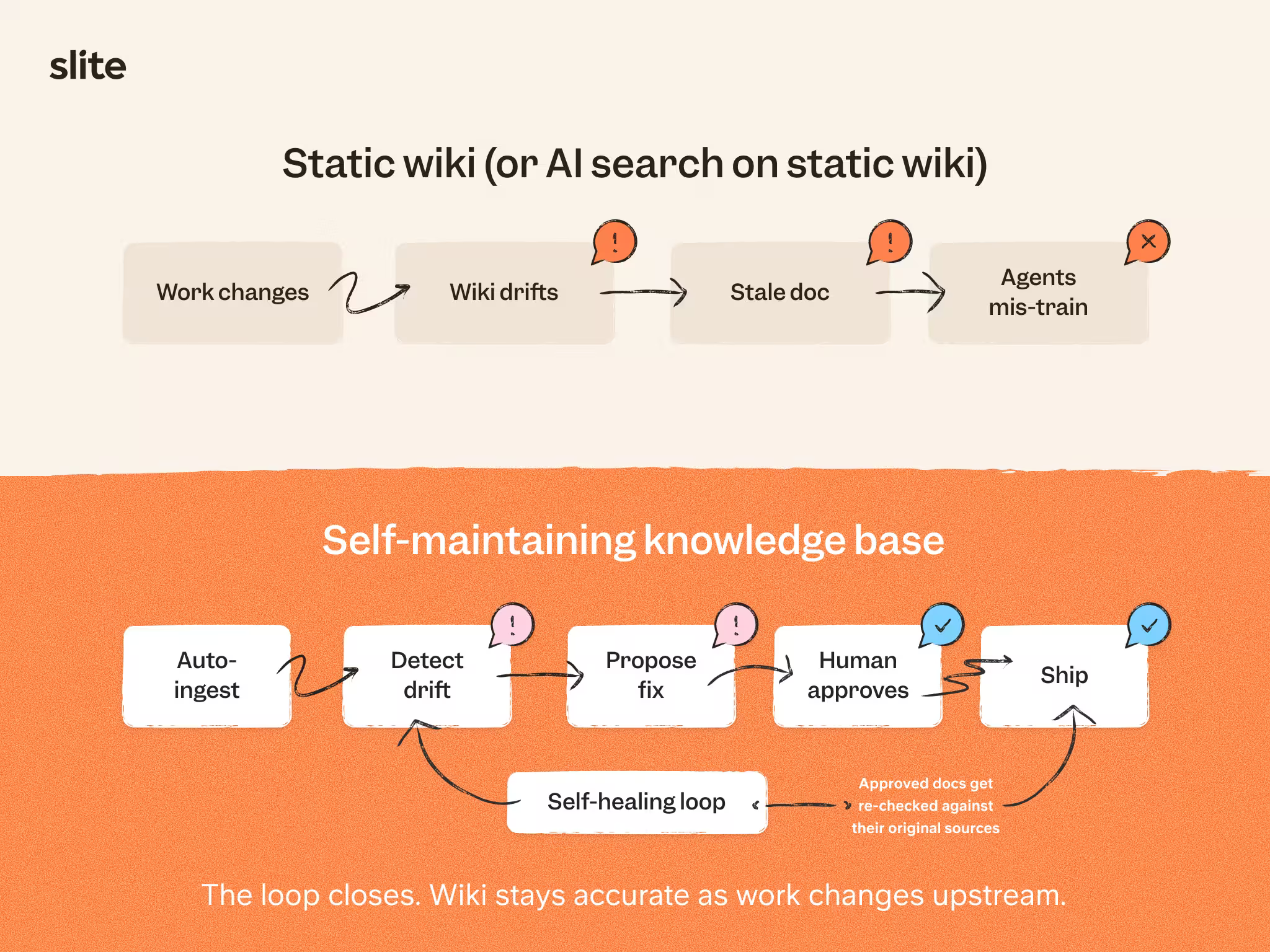
In 2026 we can use latest AI breakthrough to offload the maintenance of the knowledge base by having agents check the original systems of record to update the knowledge base by themselves.
Such a self-maintaining knowledge base has to look upstream of itself. Otherwise, the wiki becomes the last place where changes show up.
Slite Agent is built around that upstream view. It cross-references docs against connected tools, flags potential drift, drafts the likely fix, and routes the change through human review. Slite spots the change closer to where it happened instead of waiting for someone to notice the old page months later.
Give every important doc an owner and status
Ownership should be visible inside the document, and not hidden in someone's memory.
In Slite, Doc Verification gives important pages a lifecycle: Verified, Verification expired, Outdated, Verification requested, or No status. Owners can set a review cadence so a page does not stay trusted forever by accident.
That trust signal is essential for readers because they need to know whether a doc is safe to use before they act on it. The same goes for agents.
Let agents detect drift, but keep humans in control
Slite Agent can detect likely drift, draft the update, and send the proposed change to Triage. The owner can compare the proposed update with the current doc, see exactly what changed, and accept or dismiss it.
The agent handles the busywork of finding drift and drafting updates. The owner still makes the final call on whether each change belongs in the source of truth.
| Traditional wiki | Self-maintaining knowledge base |
|---|---|
| Quarterly reviews that nobody finishes. | Active ownership cycles and automated freshness tracking. |
| A collaboration sandbox that becomes a dumping ground. | Upstream ingestion that watches where knowledge actually changes. |
| Busy employees must write every update themselves. | Agents draft targeted fixes and humans approve or reject them. |
| Search retrieves whatever looks relevant. | Search and AI answers use freshness, ownership, verification, and permissions as trust signals. |
Use the Knowledge Management Panel to clean up the pile
Once a knowledge base becomes a "continuous pile of stale docs," teams need visibility before they can fix it.
You can use the knowledge management panel in Slite to find empty, inactive, outdated, or unowned docs and take action in one place.
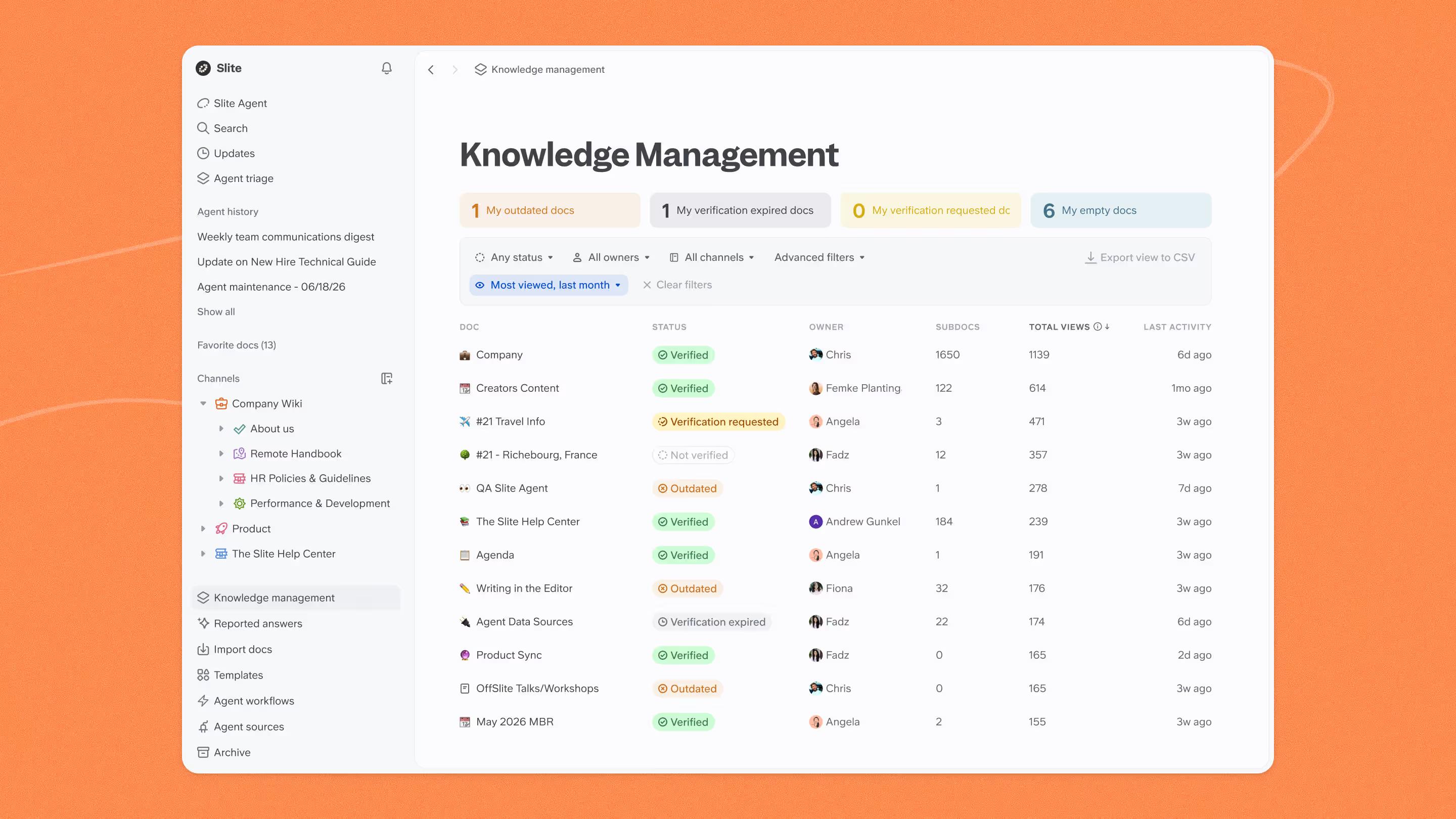
Teams can review what needs attention, then take action by reassigning owners, archiving stale pages, running bulk actions, or bringing important docs back into review.
Keep permissions intact for search and AI
Some silos are justified. HR, payroll, legal, regulated work, and sensitive internal projects need boundaries. A useful knowledge system respects those boundaries instead of treating every document as equally retrievable by every person or agent.
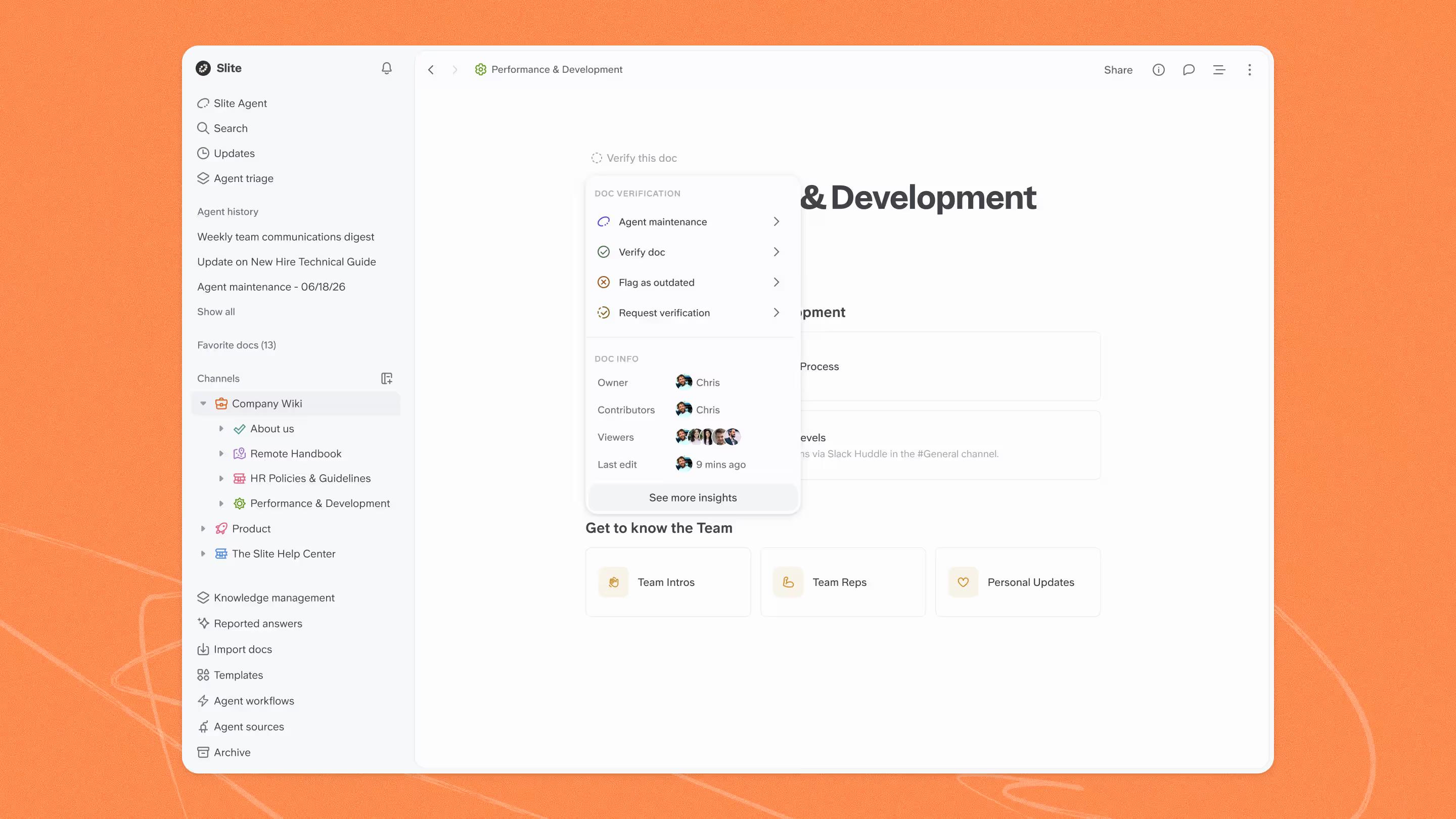
Slite's permission-aware search respects the access rules of the underlying knowledge. If a teammate should not access a source, their AI answer would not retrieve from it.
Final thoughts
A simple stress test for any knowledge base is whether the answer is current, owned, verified, and safe to use. If the team cannot tell, the knowledge base has already started to fail.
That test carries more weight now that company knowledge feeds both humans and agents. A stale onboarding guide can waste someone's day. But a stale policy, support answer, or procedure can shape what an AI assistant tells everyone who asks.
At Slite, we think the next generation of knowledge bases should help keep knowledge current, verify what can be trusted, surface what needs attention, and let agents propose fixes without removing human judgment.
That is the direction we are building toward with Slite. Book a demo to see how it works.
FAQ
What are the failure factors of knowledge management?
Knowledge management usually fails because ownership is unclear, content gets stale, knowledge lives across too many tools, employees do not trust the system, and maintenance is not built into daily work.
Why do employees stop using a knowledge base?
Employees stop using a knowledge base when it gives them old, duplicate, or unreliable answers. After one or two bad experiences, asking a teammate feels safer.
What is a known error knowledge base?
A known error knowledge base stores known issues, root causes, workarounds, and fixes so information technology teams can resolve recurring incidents faster.
What is the difference between knowledge base failure and knowledge management failure?
Knowledge base failure is about the repository: stale docs, poor search, duplicate answers, and low usage. Knowledge management failure is broader. It includes the processes, ownership, incentives, and tools that decide whether knowledge stays useful.
Can AI fix a failing knowledge base?
AI can help, but only if the knowledge base is maintained. In Slite, AI can detect drift, draft updates, and route changes for human review, but the source of truth still needs owners, verification, and permissions.