We asked 143 founders, operators, and engineers for their worst stories about stale documentation.
More than three in four had watched an AI tool at their company surface an outdated doc and confidently produce a wrong answer.
The documents aren't what changed. AI is. It removed the one thing that used to contain the damage: human hesitation.
A person reading a stale doc pauses, notices the detail that looks off, asks a colleague. An AI assistant reads the same doc and acts on it, instantly and at scale.
This is what each one of them told us: why outdated docs turned dangerous the moment AI started reading them, what the damage actually costs, and how the teams who handle it well have changed their approach.
Key takeaways
- AI repeats a stale doc with full confidence and never flags that it might be wrong, which removes the human hesitation that used to contain the damage.
- The most dangerous documents are the best-formatted and highest-ranked ones, because polish and search position suppress scrutiny.
- Stale docs fail quietly. The cost usually surfaces weeks later, far from the document that caused it.
- The fixes that held: one named owner per doc, reviews tied to change events instead of the calendar, and pulling dead docs out of search rather than just archiving them.
The stale documentation problems are nothing new
Stale documentation has been a problem for as long as people have written down how something works and then changed how it works.
Christophe Pasquier, Slite's CEO, frames the whole history that way:
The history of documentation is the history of humans compensating for bad documentation.
Every generation has tried to solve it, with style guides, wikis, review cycles, a designated person who "owns" the handbook.
The problem never disappeared. It just stayed survivable, because a human was always in the loop to catch what had drifted. AI is what finally removed that human.
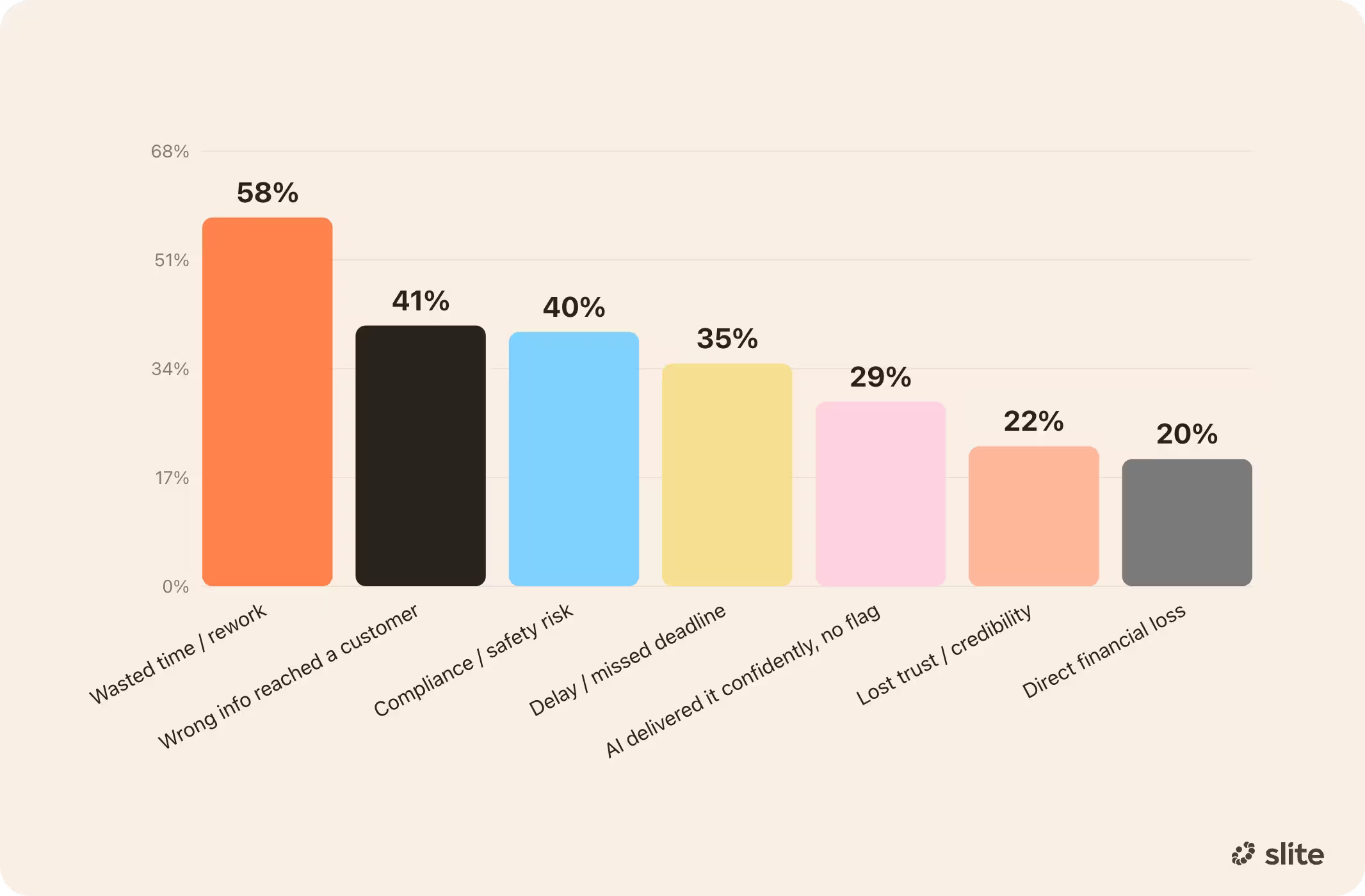
From our survey group, we’ve found that 76% had an AI tool surface a stale doc and produce a wrong answer.
Among them, the problems the stale documentation cause has been diverse:
- 58% reported wasted time or rework as a result
- 41% said that the wrong info has reached a customer
- In 40% of cases it created a compliance risk
- 35% has seen a delayed or missed deadline due to unupdated calendars
- 29% claim that there was no flag raised for a while, since AI delivered the responses so confidently
- For 22% of participants incidents have caused lost trust and credibility with their customers
- In 1 in 5 cases there’s even been a direct financial loss, too
Let’s go into the details of how each problem came to be and what you can do to avoid it.
AI repeats a stale doc with total confidence and never flags the error
Before AI, an outdated document only did damage when a human read it closely and acted on it. The reader's judgment was a filter. AI removes that filter, surfacing old content with the same confidence as current content and acting on it instantly, which turns one quiet error into a fast and scaled one.
The danger isn't a wrong answer. It's a confident wrong answer that nobody thinks to question.
Walt Carter, President of THG Advisors and a 30-year veteran of digital transformation at companies like Fidelity and Gannett, put the mechanism precisely:
AI doesn't caveat. It presents stale information with the same confidence as current information, and that symmetry is exactly what makes it dangerous.
The easy conclusion is that AI is the problem.
But the people we surveyed don't see it that way. As Tim Cakir, founder of the consultancy AI Operator, points out, the rot was always there.
AI doesn't make stale docs dangerous. Stale docs were always dangerous. AI just makes them confidently wrong at scale.
That distinction matters, because nearly everyone we heard from is an AI-forward operator. They run internal assistants on purpose, precisely because they don't think the model is at fault. The fault is in what they feed it.
The scale is the part most teams underestimate. Bad documentation used to fail quietly. Now it fails loudly and at scale, because one stale page can shape dozens of decisions a day instead of one.
Jennifer Bagley, CEO of the digital marketing firm CI Web Group, sees the same thing from the content side. AI gives old information with confidence, she says, which "makes a quiet documentation issue feel like an operational truth."
And reviewing AI output doesn't save you if the source is wrong.
Matt Erhard, managing partner at the recruiting firm Summit Search Group, watched an internal assistant pull salary data from a 2021 benchmark doc and recommend a pay range 15 to 20% below the current market. A recruiter used it with a client before anyone caught that the figure was years out of date.
Stale docs hide behind clean formatting and high search rank
Outdated documents are hardest to catch precisely when they look most trustworthy. The signals we use to judge a doc, polish and search position, are the signals that go stale last.
A clean, well-organized page invites less scrutiny, and the page that ranks first in internal search usually ranks there because it has been used for years.
Polished doc signals trust, so the cleanest docs get the least scrutiny
The polish we read as a sign of care is the same thing that waves us past the content.
The most dangerous technical file is the one that looks correct: the tolerances clean, the formatting current, and only the standards behind the numbers quietly changed.
If polish lowers scrutiny, prominence removes it.
In some cases, the worst docs aren't buried at all. They sit on homepages and onboarding portals, unchanged for years, because they looked polished enough that nobody questioned them.
Search relevance is not the same as truth
Peter Signore, CEO of the software studio Dynaris, learned this when a retrieval-powered assistant quoted a deprecated pricing tier to a prospect on a discovery call.
The doc had been superseded six months earlier but still scored as the most relevant chunk. His takeaway: "retrieval relevance has nothing to do with truth."
The reason is structural. A search engine ranks by relevance, and a doc that everyone used to open for years looks extremely relevant, even after it goes wrong.
For knowledge managers, the scary part isn’t the age. It is the discoverability.
Ranking on relevance is not enough
This is the failure mode we kept hitting ourselves, and it shaped how we built search at Slite.
Instead of ranking on relevance alone, Slite's company search treats verification and freshness as first-class signals.
- a doc marked outdated is dropped from AI answers entirely,
- an expired one is pushed down,
- and every cited source carries a trust badge, like "verified 3 days ago by Sarah,"
so the person reading the answer can see what it stands on. If you want to be strict, you can scope a query to verified docs only.
Grounding answers in a curated, current source also works better than pointing a model at raw search.
In a blind test across 41 real questions on our own company data, Slite's search agent returned a top-rated answer 83% of the time, against 24% for a setup that piped the most relevant chunks from each connected tool into an LLM.
Stale docs fail silently until something breaks
Most of these failures are invisible until the moment they aren't.
The lag between the mistake and the symptom is what makes them so hard to trace.
Pranith Jain, a security specialist at Qubit Capital, described an internal SOP pointing at an API endpoint that had been deprecated almost a year earlier. A new analyst followed it on a Friday, the sync failed silently, and nobody noticed for three days.
Stale documentation carries a measurable price tag
Joe Spisak, who runs the fulfillment company Fulfill.com, lost $47,000 in a single week because his warehouse manual still pointed to a shipping service that had been discontinued for eight months. The doc had been wrong for 237 days.
He only knows the exact number because he checked the file's metadata after the bill came in, and nobody had questioned the doc because it carried the company logo and sat in the main knowledge folder.
His story isn't an outlier.
The leaders we surveyed put hard numbers on stale docs again and again, and the pattern repeated: the document was wrong for months, looked legitimate the whole time, and the cost only surfaced once someone traced a visible problem back to its source.
| Company (sector) | What the doc said | How long it was wrong | Reported cost |
|---|---|---|---|
| Fulfill.com (fulfillment) | A discontinued carrier routing code | 237 days | $47,000 in one week |
| Insurance Panda (insurance) | A 2021 state compliance rule | ~2 years | ~$40,000 in carrier chargebacks |
| Nexus Homebuyers (real estate) | A stale neighborhood comp sheet | 14 months | ~$40,000 in lost net profit |
| Heat&Cool (HVAC ecommerce) | A 2021 rebate matrix | 18 months | ~$9,000 and 43 misquoted orders |
Sometimes the costly doc is the one you would never suspect. Jason Hennessey, CEO of Hennessey Digital, traced two weeks of mismatched funnel reporting to a one-page glossary whose lead-status definition no longer matched the CRM.
An AI note-generator kept citing the old definition, the glossary had been wrong for ten months, and untangling it took a 17-hour reporting audit. "We now retire docs aggressively instead of preserving them by default."
The macro data backs up the anecdotes. Gartner estimates that poor data quality costs organizations an average of $12.9 million a year.
Our own enterprise search survey found the day-to-day version of that number: employees spend an average of 3.2 hours a week just searching for information, and only about one in ten finds what they need on the first try.
The costs that don't show up on an invoice are often the worse ones. In one case, a stale onboarding doc led to a misconfigured client account, and the few thousand dollars in engineering time was the small part.
The real damage was the client losing confidence early in the relationship.
The most outdated docs still in active use
The artifacts leaders confessed to are almost funny, until you remember people and AI tools were actively following them.
They survive for one reason: they're discoverable and they look legitimate, not because anyone validated them.
| The artifact | How it survived | Surfaced by |
|---|---|---|
| A 2019 manual-SKU-entry SOP, printed and laminated | Taped up in the warehouse | Joe Spisak, Fulfill.com |
| A 2016 New York underwriting cheat sheet | Taped to an agent's monitor | James Shaffer, Insurance Panda |
| A "Twitter best practices" guide from before the platform became X | Still referenced for reach | Christopher Coussons, Visionary Marketing |
Outdated docs cross from nuisance into real liability
In regulated, clinical, and security contexts, a stale doc stops being inefficient and becomes dangerous. The same drift that wastes an afternoon in marketing causes patient risk, audit failures, and breach exposure here.
| Domain | The stale doc in play | What it put at risk |
|---|---|---|
| Healthcare | An 18-month-old wiki page with the wrong biomarker thresholds (Max Marchione, Superpower) | Re-running risk assessments across dozens of patient cases |
| Compliance & legal | An AI tool citing the old 180-day EEOC filing window after it became 300 (Ed Hones, Hones Law); superseded regulatory guidance still surfacing in internal search at a financial-claims firm | Teaching or applying rules that had already changed |
| Security | A pre-2016 policy that ignored multi-factor authentication, still cited during client expansions (Orrin Klopper, Netsurit) | A security control left switched off |
The failure mode shifts from cost to harm.
Across all three, the lesson is the same. The documentation accuracy should be treated as a data-governance problem, not an admin one. The same discipline you'd apply to master data belongs on your internal knowledge.
What to do about stale docs
For years there hasn’t been a single fix, which is part of the problem.
Going through the problems we’ve laid out above, 3 knowledge base maintenance approaches can change a lot:
- a named owner for every document,
- a review trigger that is not set in calendar, but change,
- and search hygiene.
Our survey respondents have also mapped out what are their strategies are:
| The response | Share who named it |
|---|---|
| Assign a named owner | 37% |
| Scheduled review cadence (mostly quarterly) | 24% |
| Remove or deprioritize dead docs in search | 22% |
| Treat docs like code (versioning, living infra) | 17% |
| Still reactive, no real system | 25% |
Tie documentation reviews to change events, not the calendar
The most effective process fix in our survey wasn't a stricter schedule. Quarterly reviews sound responsible, but they always run behind reality.
The teams that stay current review a doc when the thing that makes it stale happens:
- an infrastructure change,
- a platform update,
- a process change,
- a new project milestone,
so the doc gets fixed the moment it goes wrong.
What counts as a trigger depends on the business. For some businesses, this will mean an external event will happen, such as a new regulation in their industry.
For many service businesses the trigger is the work itself, at each project milestone rather than on a calendar.
For docs tied to a fast-moving external platform, some teams hard-code the trigger. Itamar Haim, who leads SEO at Elementor, sets automatic review dates on SEO docs precisely because AI tools pull straight from the internal knowledge base, and "outdated info causes real problems fast."
This matters because cadence alone clearly isn't enough. A large cluster of respondents had adopted quarterly reviews and still admitted, in nearly identical words, that "stuff still slips through" and they "mostly catch it when it breaks."
Give every critical doc one owner, not a committee
Accuracy fails when keeping a doc current is everyone's job and therefore nobody's. The fix that held was naming a single accountable owner and a last-reviewed date on every important document, because the person who'd be embarrassed if it were wrong is the one who actually keeps it right.
Steven Lu, CEO of the recruiting platform Pin.com, said it best after his assistant kept sending new hires to a branch his team had renamed months earlier.
Stale docs don't get caught by a committee. They get caught by the one person who'd be embarrassed if it were wrong.
That accountability only works when it lands on a single name.
To put a number on it - Rick Elmore, CEO of Simply Noted, traced a $4,200 production error to a shared Google Doc that three people could edit and nobody owned. Nobody's job was to verify it against incoming supplier specs.
Shared access with no owner is exactly how a doc drifts for months without anyone checking it.
At the law firm Jacoby & Meyers, ownership became a job title. As the firm built internal AI tools that kept surfacing earlier versions of case information, managing partner Michael Akiva brought in an Automation and AI Engineer whose job is to keep those tools matched to current case data rather than static inputs.
An archived doc still does damage if search can surface it
In some AI search tools, archiving is not deletion. This means as long as an old doc stays discoverable, both people and AI tools will treat it as current, so the real fix is removing dead content from search and AI retrieval, not quietly filing it in a folder.
Discoverability, not existence, is the risk surface.
Conrad Wang, Managing Director of the Australian care provider EnableU, learned this when an outdated onboarding workflow stayed searchable after the process changed, and the internal AI tool pulled it because the file had years of history behind it.
Archived documents are never really dead if people can still find them.
Archiving had felt like cleanup, but the file never actually left the place people and bots go to look.
To completely prevent this type of an error surfacing for our customer base, Slite decided to close this gap by default: an archived doc drops out of both search and AI answers, so retiring a page is enough to get it out of the way, no separate de-indexing step required.
Mindset shift: knowledge base is infrastructure
The biggest mindset shift across all 143 responses was this: documentation stopped being passive reference material and became operational infrastructure.
It is now training data and source code for the AI and the people making daily decisions, which means it deserves the same rigor as production code, versioning, ownership, deprecation, and monitoring.
James Shaffer makes the comparison explicit.
Your knowledge base isn't a passive library anymore. It is active code. If you wouldn't push broken code to production, stop letting your team query unverified documents.
The comparison holds beyond engineering.
Internal docs are the source code for our AI assistants, and if the underlying data is invalid, the output will be too.
This is the practitioner's name for knowledge drift, the slow divergence between what a doc says and what your company actually does.
Orrin Klopper, CEO of the managed-services firm Netsurit, learned to treat docs that way the hard way. Across 29 years running IT for more than 300 clients, he watched one company's documentation keep listing insecure legacy systems with no around-the-clock monitoring. It had been wrong for years and fueled nightly ransomware fears, until a rebuild finally moved them off the stale playbook and into AI-enabled growth within weeks.
The problem is that treating docs like code is real, ongoing labor, and most teams don't have the hours.
Christopher Coussons named the mistake other founders make by treating documentation as a one-time creation cost. “It's actually a maintenance cost, and AI just doubled that bill."
Which raises the obvious question. If the maintenance is what fails, can the maintenance be automated?
The self-updating docs in 2026
None of this was news to us. The fixes our respondents described, drift detection, clear ownership, change-event triggers, and pulling stale docs out of search, are the same conclusions we reached over the years of our own research and hundreds of conversations with Slite customers.
It's why we rebuilt Slite into a self-maintaining knowledge base.
The piece that does the work is Slite Agent, and it runs on a simple loop:
- It continuously checks your docs against more than 20 connected tools (Slack, GitHub, Jira, Google Drive, and others)
- The agent flags knowledge drift before a customer or new hire hits it.
- When it finds drift, it drafts the fix: updating docs, merging duplicates, archiving what's dead.
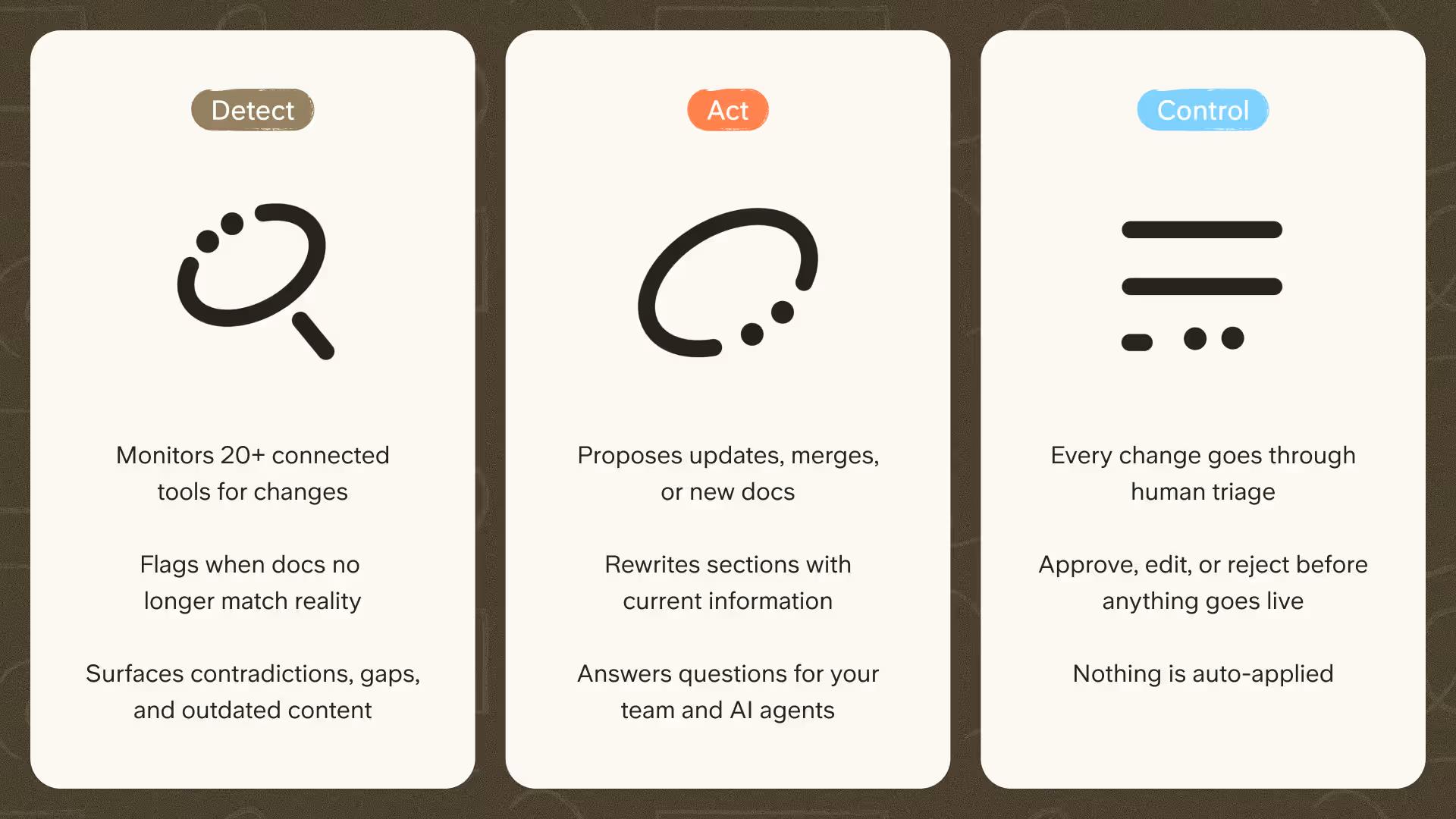
Crucially, nothing is applied automatically. Every change routes through a human who approves, edits, or rejects it, which answers the fear running through this entire survey: an AI that acts without caveat. Here, the agent proposes and a person decides.
The rest maps straight onto what our respondents asked for. Verified docs carry a badge and a review cadence, stale ones are excluded from AI answers rather than left to rank, and because the agent is permission-aware, any assistant reaching your knowledge inherits your team's existing access rules.
A practical first move
If a document feeds a human decision or an AI answer, it needs three things: a named owner, a freshness signal, and a way to leave search when it dies. Behind those, it needs a system that flags drift instead of waiting for someone to trip over it.
If you do only one thing this quarter, do this: audit your highest-traffic and highest-ranked docs first.
That is where staleness does the most damage, because those are the pages your team and your AI reach for most.
Counterintuitively, your oldest docs are rarely the problem. Your most-used ones are.
Final thoughts
Stale documentation stopped being an admin problem the moment AI started reading your docs for you. The quality bar went from a spectrum to something closer to binary, because the human judgment that used to round off the rough edges is no longer in the loop by default.
The throughline across 143 stories is not that old documents exist. It's the trust we extend to anything that looks official and ranks first.
The teams pulling ahead fixed the trust signals, verification, ownership, and search hygiene, rather than chasing individual bad pages. They stopped treating their knowledge base as a library to tidy and started treating it as infrastructure that maintains itself.
If that's the shift you're trying to make, book a demo and let us show you what your knowledge base looks like when it flags its own drift before your team does.
Frequently asked questions
Why is stale documentation more dangerous now than before AI?
Because AI systems repeat outdated content with full confidence and act on it instantly, while a human reader tends to hesitate and apply context. That hesitation used to contain the damage. AI removes it, so a single outdated page can influence many automated decisions before anyone notices the source was wrong.
How often should internal documentation be reviewed?
The most effective approach ties reviews to change events rather than a fixed calendar. Whenever an infrastructure change, platform update, process change, or project milestone occurs, the related docs are reviewed immediately. Scheduled quarterly reviews still help for lower-risk content, but they consistently lag behind reality on fast-moving documents.
What is the most common cause of outdated docs staying in use?
Two causes combine: no clear owner, and continued discoverability in search. A document with no accountable owner is never updated, and as long as it surfaces in search results it keeps getting trusted and reused. Removing dead docs from search matters as much as assigning ownership.
Does archiving an old document fix the problem?
Not on its own. Archiving keeps a document in the system, and if it remains discoverable in search or AI retrieval, people and tools will still treat it as current. The reliable fix is removing outdated content from search and retrieval indexes, not just moving it to an archive folder.
How do you stop an AI assistant from citing outdated documents?
Make freshness a retrieval signal. Verify and date current documents, exclude unverified or expired ones from AI answers, and keep a human review step before any AI-proposed change becomes official. Treating documentation accuracy like a tested, owned, monitored system is more effective than relying on anyone to spot errors.
What does stale documentation actually cost a business?
Reported costs range widely, from a few thousand dollars in rework to tens of thousands in lost deals and chargebacks, plus blown deadlines and eroded trust. Industry research from Gartner estimates poor data quality costs organizations an average of $12.9 million a year, and stale documentation is a significant and often overlooked contributor.