Someone asks where the current refund policy lives. You send them the link. A few weeks later someone else asks the same question, and you send the same link again.
Both times the answer was already written down. The question came to you instead of the knowledge base because you are easier to search, and each interruption costs the person asking about 25.5 minutes before they are back in the work they left.
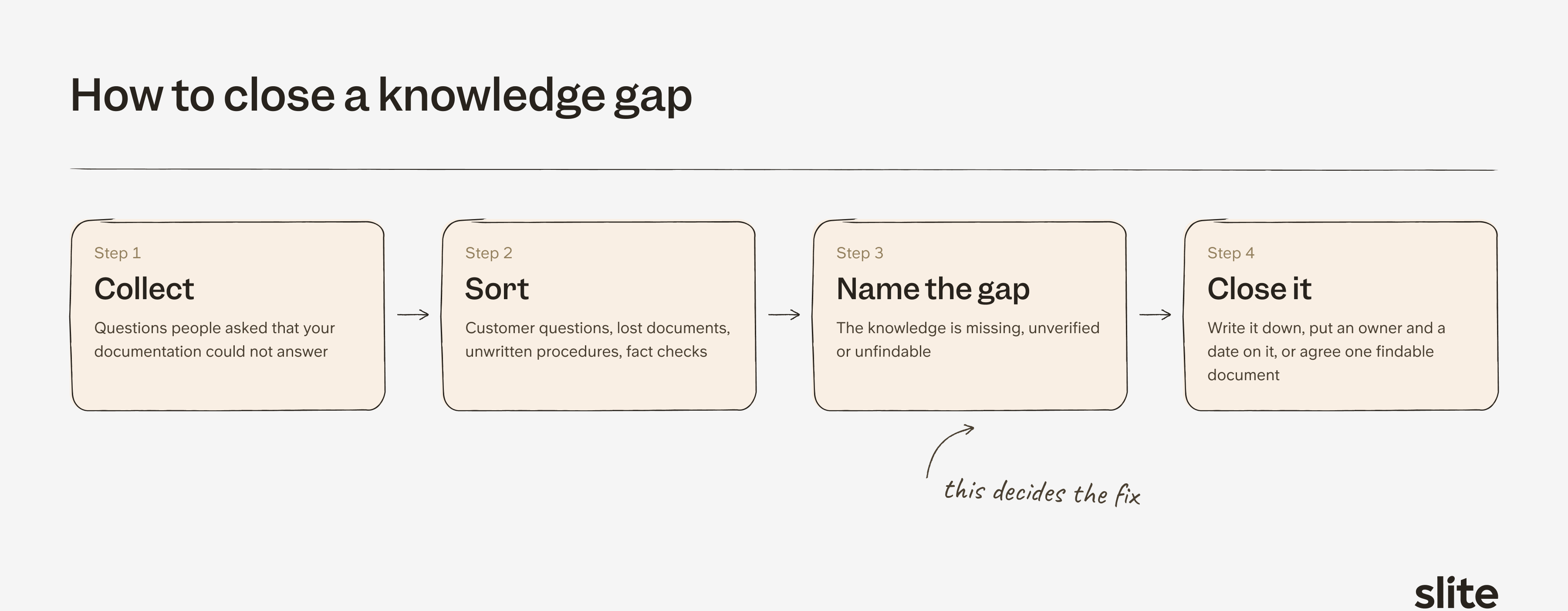
Questions like these are the most useful record of your knowledge gaps your team will ever produce. They tell you which parts of your documentation people need and can't use. They also separate out three different problems, and each one takes a different fix.
Key takeaways
- A knowledge gap is a question someone needed answered and couldn't answer from your documentation without asking a colleague.
- Gaps take three forms: the knowledge was never written down, nobody can tell whether it's still true, or it exists and can't be found.
- Writing a new document only helps when the knowledge was never written down.
- The questions your team already asks are the cheapest way to find your gaps, and in 2026 most of that log can be collected for you.
- Some gaps are better left open.
What a knowledge gap is
A knowledge gap is a question someone on your team needed answered and couldn't answer from a source they trusted. It's a gap in what your company has written down, measured by what people actually needed.
This matters because a question is a concrete event. You can count how often it came up, who it stopped and for how long, which is what makes a knowledge gap analysis possible at all.
Company knowledge goes wrong in two ways, and they need different fixes.
- Fragmentation. The information exists somewhere in your tools, often in more than one version, and nobody can say which copy to use. People don't get to the answer at all, so they ask a colleague instead.
- Accuracy. The information is written down and no longer true. People find it, act on it, and the mistake only turns up later, which makes this the more expensive of the two.
Finding and closing gaps is one job inside knowledge management, and usually the one teams start with, since the questions arrive whether or not anyone is counting them.
Three kinds of knowledge gap: missing, unverified, unfindable
Fragmentation and accuracy show up in your documentation as three recognizable situations.
- Missing. Nobody has written it down. The only copy could be in someone's head, and the answer exists only while they're available to give it.
- Unverified. A document exists, and nothing on it says whether it's still true. People read it, can't tell how old it is, and go ask a person anyway.
- Unfindable. The right document exists and is correct, but search doesn't return it, or it returns four versions and none of them says which one to use.
Writing a new document is the right move when the knowledge is missing. When a document already exists and nobody has checked it, writing another one adds a second unchecked page. When the document exists and can't be found, writing another one adds another copy to search through.
Reaching for a new document every time someone asks something is its own problem. Teams that do it end up with sets of near-identical playbooks, each one written by someone who couldn't find the initial one, and those duplicates are a record of earlier attempts to close the same gap.
Knowledge gap examples
Knowledge gap examples are really just the questions your team asks when your documentation lets them down, and they fall into four recognizable types.
| Question type | What it sounds like | Kind of gap | What's behind it |
|---|---|---|---|
| Customer questions | "What do we tell them about data residency?" | Missing or unverified | The answer lives with the people who handle those conversations and was never written down |
| Lost documents | "Where's the current onboarding checklist?" | Unfindable | No agreed source of truth, or search can't reach it |
| Unwritten procedures | "Is there a process for offboarding contractors?" | Missing | Nobody wrote the procedure down the first time it was worked out |
| Fact checks | "Is this still how we handle refunds?" | Unverified | No review routine, so nothing on the page shows when it was last checked |
The wording is what makes these hard to spot. People rarely ask where the data residency policy lives. They ask what to tell a customer who wants to know, so the question that lands in your chat looks nothing like the title of the document that would answer it.
How to find knowledge gaps in the questions your team already asked
Most teams don't keep a record of the questions they couldn't answer. The questions get answered in a chat thread and then they're gone, and the only trace is a growing sense that the same things keep coming up.
That record is worth building, because it's the only evidence of a knowledge gap that comes with a date, a person and a count attached. Everything else is a guess about what people don't know.
Two things make this easier than it used to be. Asking people in a survey returns general complaints about documentation, because nobody remembers what they failed to find last March. And since 2026, most knowledge bases with AI search keep this log themselves: every question their AI couldn't answer is already being written down, so the collection step is often just a matter of switching it on and reading it.
How to build a log of unanswered questions
- Pull the questions from the places people ask them: team chat, the shared inboxes your team answers from, your help desk, and whatever record your knowledge base keeps of searches and questions that came back empty.
- Use a window of six to twelve months. That's long enough for the recurring questions to repeat, and recent enough that the answers still apply.
- Strip anything that shouldn't go near a model before you export: personal data, customer identifiers, and anything covered by a confidentiality obligation.
- Sort the remainder into the four types with AI, using the prompt below.
- Count each type and sort by volume, highest first. The shape of that count tells you which of the three gaps you mostly have.
Here's a prompt that does step four:
You are sorting internal questions to find knowledge gaps.
For each question below, return:
1. The question, cleaned up.
2. One category: CUSTOMER_QUESTION, LOST_DOCUMENT (looking for
   something that likely exists), UNWRITTEN_PROCEDURE (asking for a
   process that may not exist), FACT_CHECK (checking whether
   something is still true).
3. A confidence score from 1 to 5.
4. The topic in three words or fewer.
Group near-duplicate questions and give each group a count.
Output as a table sorted by group size, largest first.
Don't invent questions that aren't in the input.
One thing to check before you start is whether the log already exists and nobody reads it. In our experience it's common for an internal chat assistant to notify a team every time it can't answer something, with the queue building up unread.
If you'd rather start from the documents you already have than from the questions you were asked, that's a knowledge audit, which tells you how much of what you've written can still be trusted.
How to close each kind of gap
Match the fix to the kind of gap. Missing knowledge needs writing down, unverified knowledge needs an owner and a visible date, and unfindable knowledge needs one agreed document that search can reach.
When the knowledge is missing
Get it out of the person who holds it and into your knowledge base, in one sitting, while they're talking. An interview is faster than asking them to write it up themselves, and it produces something usable even if they never come back to edit it. The knowledge transfer template gives you the questions to ask.
This is the gap that grows without anyone noticing, because the person holding the knowledge is usually the one answering the questions, and answering takes them less time than documenting.
Over months their head becomes the place the company keeps that knowledge, which is tribal knowledge.
When the knowledge is unverified
Put a named owner on the document and show the reader when it was last checked. When we asked 149 teams what would make them trust their documentation, a named human owner who had verified it came top at 78%, ahead of a link to a live source of truth at 63% and recent edits at 56%.
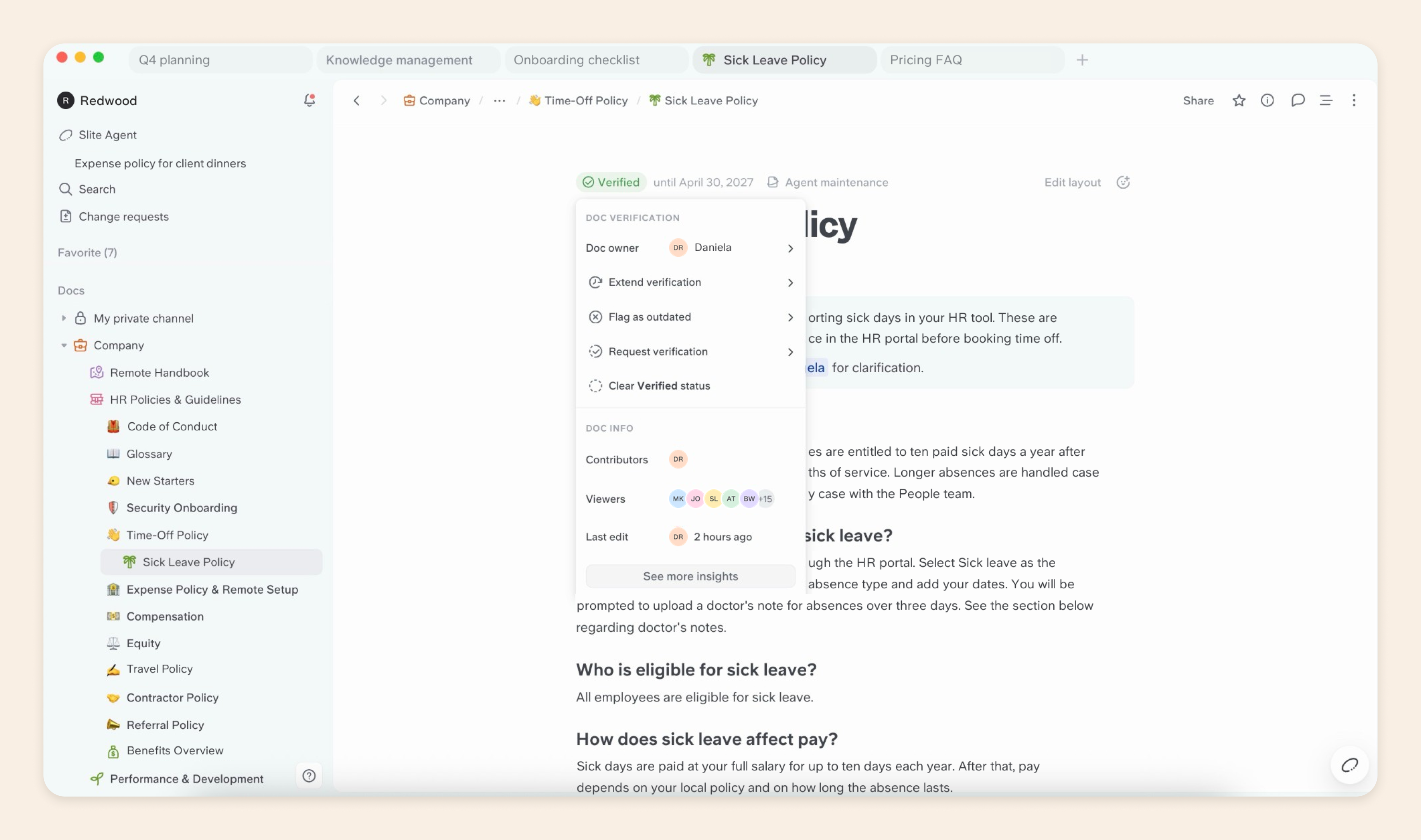
The reason to bother is what happens after one bad answer. Once a team has watched an AI tool answer from an out-of-date document, they stop trusting answers from that source, including the correct ones, and go back to asking people.
For review dates and clearing a backlog of unchecked pages, see knowledge base maintenance.
When the knowledge is unfindable
Find the one document that lays out the right information, mark it verified and give it a named owner.
That combination is what gets it retrieved in AI search, and it tells a reader which copy to use when several come back. Then merge the other copies into it, or replace them with a link to it.
When people stop trusting what search gives back, they go and ask a colleague instead, and that person becomes the company's source of truth without ever agreeing to it. Left alone, the scattered copies that caused it turn into an information silo.
Which gaps to close first, and which to leave open
Rank the gaps by how often the question comes back and what it costs the person who's stuck, then work down from the top. How often it comes back is in your count. What it costs is your judgment.
A question asked twenty times that costs two minutes each time matters less than one asked three times by an account executive in front of a customer, so weigh the cost of being stuck alongside the count.
Counterintuitively, some gaps are better left open. Put these in a separate pile:
- Questions that came up once and are unlikely to come up again.
- Questions where talking to a person is genuinely the better answer, like anything that needs judgment about a specific customer.
- Questions that keep returning because a process changed and nobody announced it. No document will hold until the process settles, and the fix belongs with whoever owns it.
- Questions that belong to another team, where the answer exists in their documentation and the real gap is that your people don't know to look there.
Write down why you dismissed each one, so the same question doesn't get triaged from scratch in six months.
You also don't need to move your documentation into a new tool to fix a gap. Teams often want search to work on the content where it already lives, and that's frequently the right call, because making what exists reachable costs less than moving all of it.
If you're putting this on a longer footing, with owners and measures around it, start with knowledge management strategy. The knowledge management strategy template has a place to record what your count found.
How to find and close knowledge gaps in Slite
Everything above works with any knowledge base and a spreadsheet. What changes when the knowledge base answers questions itself is that the log stops being something you have to assemble.
Slite keeps a record of the questions its AI couldn't answer, and of the answers people reported as wrong. You work straight from that list:
- Take a question off the list and assign it to the person who knows the answer.
- Write the answer into the document where it belongs, or create the document if the knowledge is missing.
- Mark the document verified, so the next reader can see it's been checked.
- The next person who asks gets the answer instead of you.
The Ask Insights documentation covers how to read the list. The missing answers tab shows up once a workspace owner turns on logging for unanswered questions, and for people who have permission to read every question.
Two things matter for unverified knowledge:
- Slite's search and agent say they found no answer rather than assembling a plausible one, so a gap shows up as a gap instead of as a confident wrong answer.
- A document marked outdated is left out of what the agent will answer from, so verification controls what AI is allowed to say as well as what a reader sees.
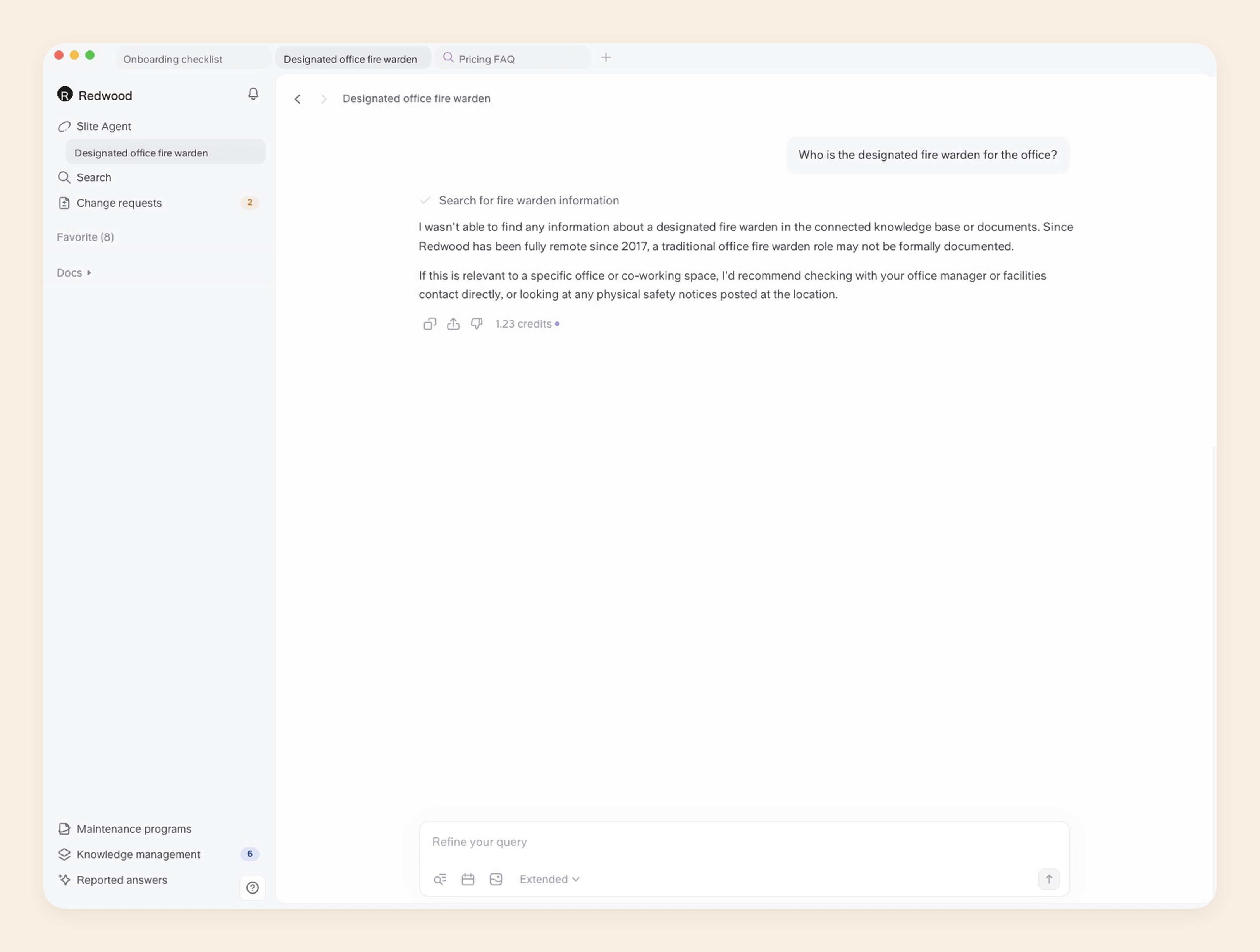
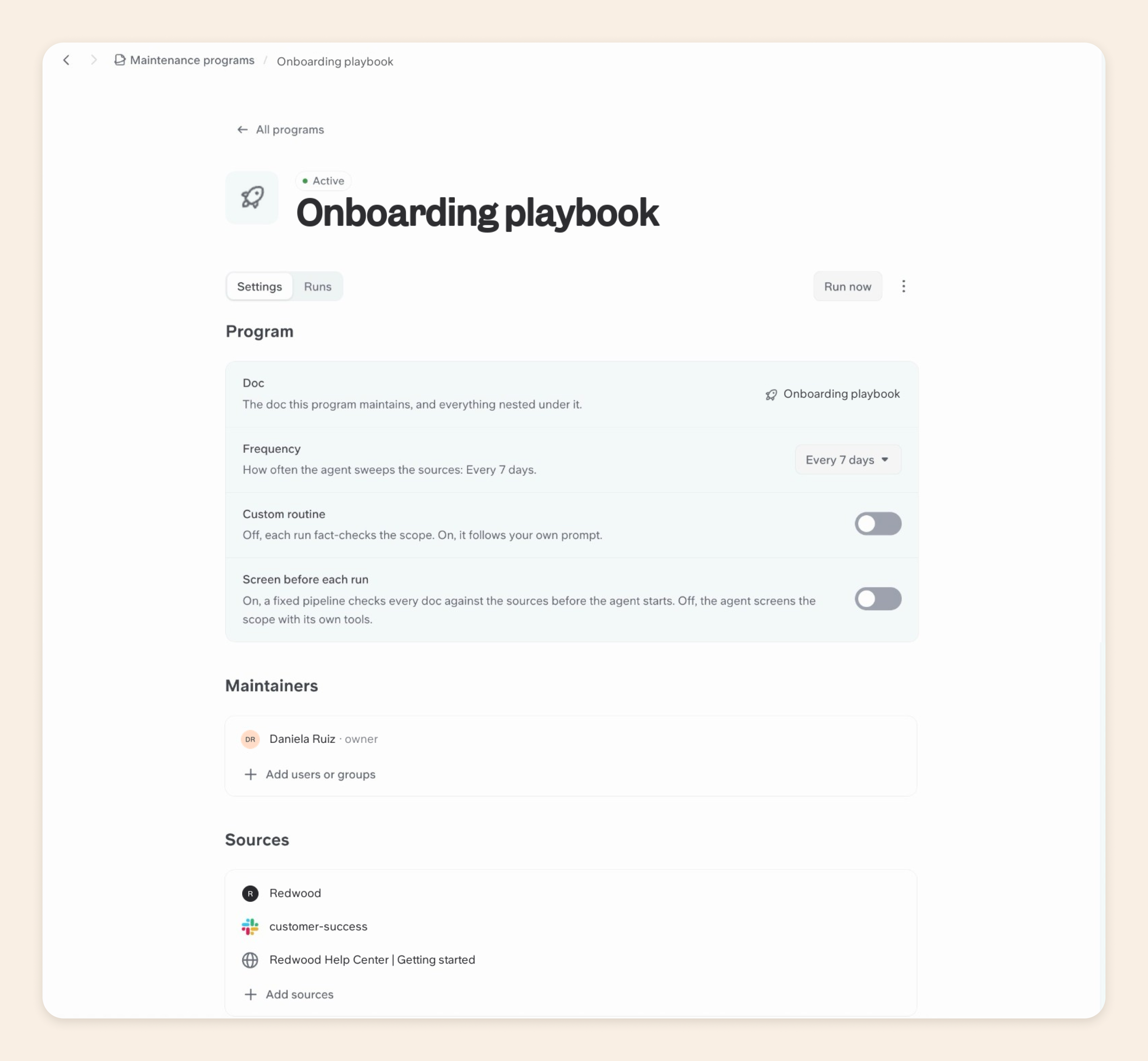
Maintenance is what keeps the list short.
Set up a maintenance routine on the documents that answer the most questions. You pick the sources it should check against, which can be other documents or connected tools like Linear and Intercom, name the people who maintain them, and choose how often it runs.
On that schedule the agent rereads each document against those sources and proposes an update wherever something has gone out of date. The suggestions wait in triage for someone to approve or dismiss, so a document only changes once a person has looked at the change. The questions you closed last quarter are a good guide to which documents deserve a routine.
Final thoughts
The list of what your team can't find already exists. It was written by the people who gave up on the knowledge base and asked someone instead, and it's sitting in your chat history and your help desk queue.
Read it and it tells you what to do: write the thing nobody wrote down, put an owner on the page nobody has checked, or fix the search that can't find the page you already have.
If you want to see what that record looks like in a knowledge base that keeps it for you, book a demo and we'll walk through the unanswered questions in your own content.
FAQ
What is a knowledge gap analysis?
A knowledge gap analysis is the exercise of finding where your company needs knowledge it hasn't written down, can't verify or can't locate, then sizing those gaps and deciding which to close first. It produces a ranked list of specific gaps rather than a general assessment of how good the documentation is.
How often should you look for knowledge gaps?
Pull a six to twelve month window once a year, and read the log of unanswered questions continuously once it exists. The annual pull shows you the pattern and the shape of the work. The running log catches the new gap that appeared because something changed last week.
Can AI close knowledge gaps on its own?
AI can find a gap and draft an answer for it. Deciding whether that answer is true, and who owns it from here, is still a person's job, and it's the part that keeps the knowledge base trustworthy. A confident answer drawn from an unverified document is a gap that has become harder to see.