You know how it goes when you start deploying agents seriously. You end up with a folder of Markdown files, a set of cursor rules, and a sync script you wrote at 6pm so the whole thing doesn't go stale by Friday.
One founder building agent-first tooling put it to us plainly: "I'm not building it for me, I'm building it for my agents. I'm always repeating the same info."
An engineering lead we spoke with described the same setup at his company: agents read the knowledge base and produce Markdown files per project, and they have a CLI tool that syncs it.
Both of them built something called context layer to the best of their capabilities. This guide goes over the history and how to optimize its shape, as well as defining it: what a context layer is, how it differs from a semantic layer, what a complete one contains, and how to decide whether to build or buy yours.
Key takeaways
- A context layer is the tier between your raw knowledge sources and your AI models. Its job is deciding what actually reaches the model's context window at inference time.
- It is a superset of the semantic layer with a different consumer: semantic layers serve human analysts through BI tools; context layers serve AI agents, and add documents, permissions, and live data to the metric definitions.
- A complete one has six stages: sources, ingestion, permission resolution, conflict and freshness resolution, an interface (usually MCP), and evaluation. Permissions, conflicts, and evaluation are the stages most teams skip, and where most production failures live.
- Many agents should share one layer. Per-agent context plumbing (Markdown folders, sync scripts) works only for a single agent, in maintenance and in accuracy.
- You can build one, and many teams try: expect a costly first year and a permanent maintenance and evaluation loop. Buying trades that for betting on a market that analysts consider still unsettled.
What is a context layer?
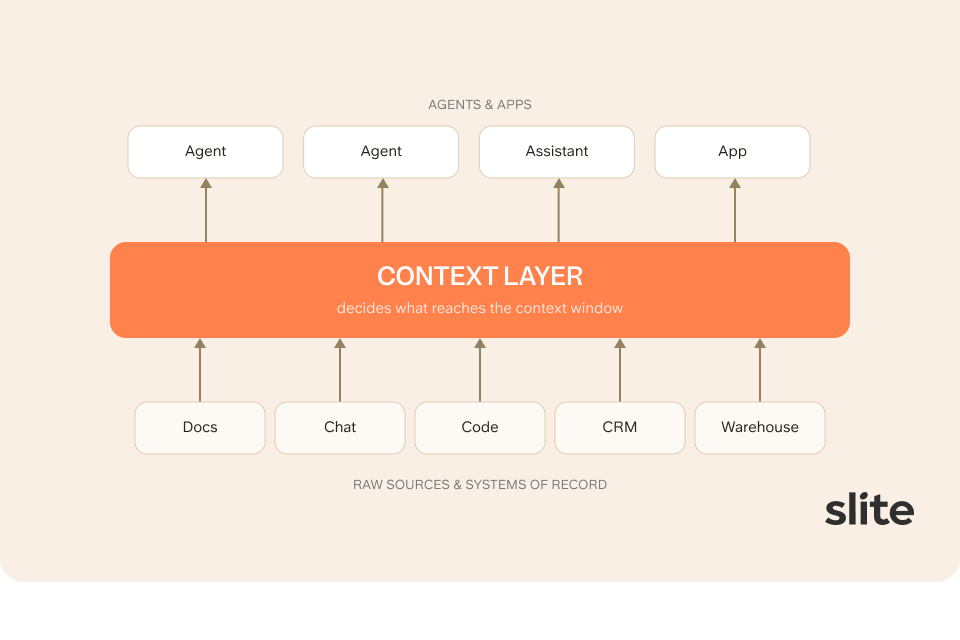
A context layer is the layer of infrastructure that sits between an organization's raw knowledge sources and its AI models, deciding what information actually reaches the model's context window. It gathers, filters, and permissions content from many systems so that agents answer from current, authorized, relevant context.
This means that the context layer is a position in your stack: the tier between raw sources (docs, Slack, code, CRM records, warehouse tables) and the model. Its job is deciding what crosses into the context window at inference time.
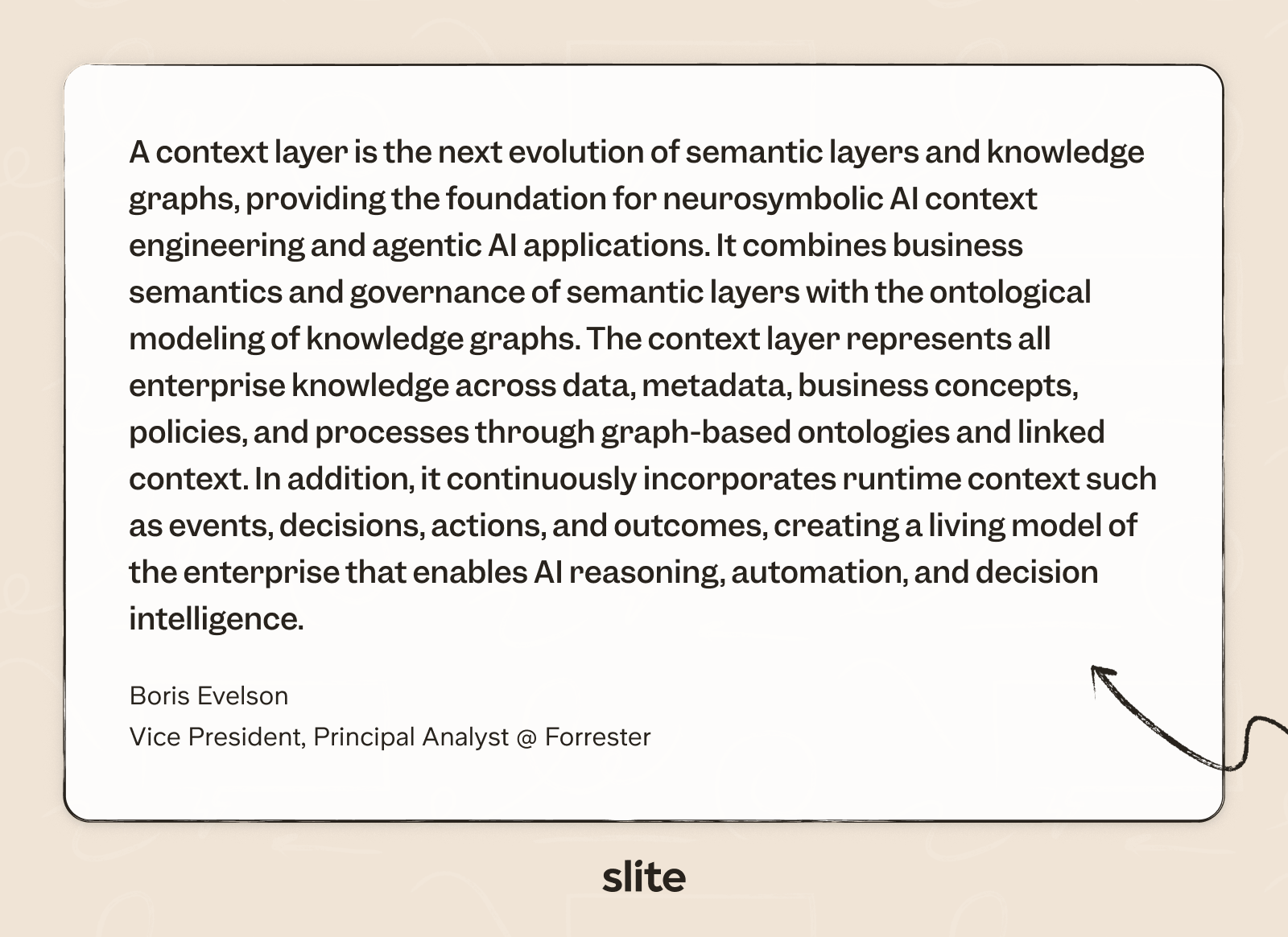
Forrester's first formal definition came in August 2026 and it frames it as the foundation for agentic AI applications, combining the semantics of semantic layers with the modeling of knowledge graphs.
The context layer sits one level below a company brain. The layer is the substrate; a company brain is the product a company gets when the layer is in place and working.
Where did the term come from?
Benn Stancil's essay "The context layer" (August 2025) put the phrase into industry vocabulary, and he frames it explicitly as a retry of his own 2020 metrics-layer idea.
His opening line: "Let's try this one again, I guess."
Of the six companies building a metrics layer by end of 2021, he notes, two pivoted, one got acquired, and one stalled.
The chain since then moved fast from September 2025 when Anthropic published its context engineering guidance.
In January the following year OpenAI published the internals of its in-house data agent, the first numbered reference architecture from a frontier lab, built around six explicit layers of context.
And finally it's concretized as Forrester published the first formal analyst definition in August 2026.
As a16z notes, many names have emerged for the same idea: context OS, context engine, contextual data layer, ontology. The underlying concept stays the same.
Context layer vs semantic layer
A semantic layer defines your business metrics over structured data, so every dashboard can agree on what revenue means. A context layer serves a different consumer: it assembles everything an AI agent needs to answer, which adds documents, decisions, permissions, and live data on top of those definitions.
The two are genuinely related, which is exactly why they get confused.
The semantic layer is the older idea by three decades, first mentioned in a US Patent submisison in 1991.
Today the practical relationship is simple: a context layer is a superset of the semantic layer, built for agents rather than analysts.
If your company already runs a semantic layer, the context layer sits above it and draws on it; nothing gets thrown away.
Forrester calls the context layer "the next evolution of semantic layers and knowledge graphs," which explains it as continuity rather than a clean break. What changed is the consumer and the scope, and that changes almost every design decision:
| Dimension | Semantic layer | Context layer |
|---|---|---|
| Primary consumer | Human analyst via a BI tool | AI agent at inference time |
| Scope | Metric definitions, dimensions, filters | Semantics plus documents, decisions, policies, permissions, runtime data |
| Binding | Historically locked to one BI tool | Delivered over a protocol interface (MCP) |
| State | Static definitions | Continuously updated from live sources |
| Failure mode | Dashboards disagree | An agent answers confidently and wrongly |
In the agentic era, the failure mode is where a business will see the biggest negative effect on the ROI.
A stale metric definition used to produce a mildly confusing dashboard that could be fixed or reinterpreted by a human analyst that can use their undocumented knowledge to figure out what went wrong.
However, in agentic workflows, the same staleness produces an agent that states a wrong answer with total confidence.
In a July 2026 survey of 101 enterprises by VentureBeat, 57% reported that in the past six months their agents produced confident but wrong answers traced to missing or inconsistent business context (a modest, directional sample, as VentureBeat itself notes).
Context layer vs data layer vs memory
The semantic layer is one of several neighbors. In practice you juggle two more terms that often get bundled in with context layer: the data layer and agent memory.
Here's how they separate:
| Context layer | Semantic layer | Data layer | Agent memory | |
|---|---|---|---|---|
| What it is | The tier deciding what knowledge reaches the model | Shared business definitions over structured data | The storage and pipelines holding raw data | What one agent retains across its own sessions |
| Serves | All agents and humans | BI tools and analysts | Everything above it | One agent |
| Scope | Docs, messages, records, tables, decisions | Metrics, dimensions | Rows, files, events | Conversations, corrections |
| You have one if... | Agents pull governed, permissioned context from one shared source | Revenue means the same thing in every dashboard | You have a warehouse or lake | Your agent remembers last week's correction |
In short:
- Memory is private to an agent and accumulates from its own interactions.
- A context layer is shared across every agent and human, and is maintained deliberately.
The deeper treatment of authoritative data vs documentation lives in our system of record guide.
What is the purpose of the context layer in AI agents?
The purpose of a context layer is to supply AI agents with accurate, current, permission-appropriate company knowledge at the moment they answer. Without it, agents guess, answer from stale documents, or answer confidently and wrongly.
Agents forced this layer into existence because models arrive knowing nothing about your company.
OpenAI's engineers put it directly in their data-agent write-up:
"Without context, even strong models can produce wrong results, such as vastly misestimating user counts or misinterpreting internal terminology."
The discipline of assembling the right context at the right moment is context engineering; the context layer is the piece of infrastructure that discipline operates on.
The retrieval mechanics underneath both are covered in our article about MCP vs RAG.
How to build a context layer: a reference architecture
A complete context layer has six stages: sources, ingestion, permission resolution, conflict and freshness resolution, an interface, and evaluation.
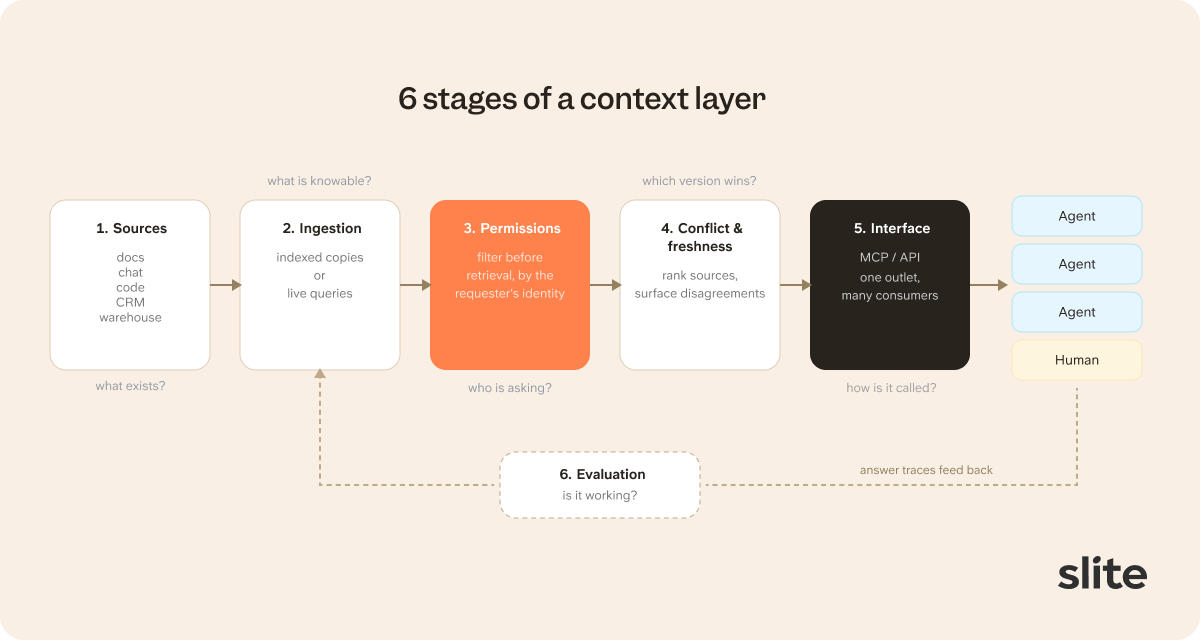
1. Sources. Company knowledge lives in five or more systems at any organization, each with their own set of information. The layer's first job is reaching all of them.
2. Ingestion. Ingestion strategy decides what is even knowable. Some content should be copied and indexed; some should never be copied at all and instead queried live at question time (customer records, warehouse tables).
3. Permission resolution. One of the security concerns with agents is if content that was accessible to only a few people becomes reachable by anyone with a simple search. The architectural answer is to run the permission check before retrieval, filtering the candidate set by the requester's identity, so restricted content never enters the generation step at all.
4. Conflict and freshness resolution. When two documents disagree, which version wins? The working principle is confidence by source type: you trust different kinds of evidence differently. In practice, code beats a Slack message about the code.
5. Interface. Agents need a way to call the layer, and MCP has standardized it. MCP is the wire; the context layer is what travels over it.
6. Evaluation. Evaluation loop is cruicial in agentic work to measure accuracy on a regular basis.
When it comes to format, much of the industry assumes the layer must be a pre-built knowledge graph.
Our CEO Christophe Pasquier, who has spent a decade building knowledge tools, argues the other side:
"A graph goes stale the second you rebuild it and it's expensive to maintain. Runtime retrieval answers today's question with today's context."
Both approaches are legitimate; the tradeoff is freshness and maintenance cost against traversal power.
Why should many agents share one context layer?
Many agents should share one context layer because that is the only setup where maintenance, accuracy and permissions scale with the number of agents. Each agent added to a shared layer gets the same governed context; each agent added to per-agent plumbing adds one more copy to keep in sync.
The first reason is maintenance. A shared layer means one ingestion pipeline, one permission model, and one sync loop, no matter how many agents consume it. Per-agent copies each need their own sync job, and every copy is one more place for context to go stale.
The second reason is accuracy. Agents answering from separate copies drift apart as the copies do, and the effect is measurable.
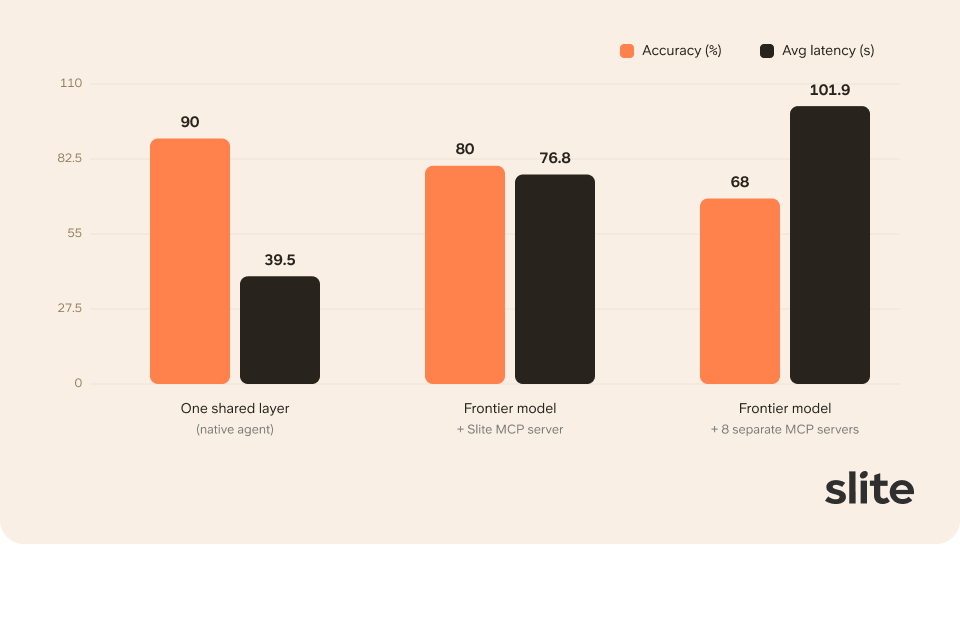
In an internal benchmark we ran across 41 real company questions, an agent retrieving from one assembled layer answered at 90% accuracy in 39.5 seconds on average. The same frontier model wired to eight separate MCP servers, one per tool, dropped to 68% accuracy at 101.9 seconds. The bolted-on pattern cost 22 points of accuracy and 2.6x the latency.
The third reason is permissions. When the permission decision lives in the shared layer, an agent can only reach what its user could already open, and adding an agent adds no new access surface. When every agent carries its own credentials, each one is a separate audit problem, and the inversion fear from stage 3 comes back with every new deployment.
The last reason is evaluation. One shared layer gives you one retrieval path to measure, so stage 6 runs once for the whole fleet, and a fix to the layer improves every agent at once. With per-agent plumbing, every copy needs its own eval loop, and in practice most of them never get one.
Should you build or buy a context layer?
In short, build a context layer if you have a dedicated platform team and context too unusual for generic ingestion, and buy one if your layer today is Markdown files, a sync script, and one owner.
The deciding factors are actually the permanent maintenance and evaluation loop that follows.
Plenty of teams build their own context layer. Our CEO's observation from enterprise pilots: roughly 90% of them had already tried building in-house before reaching out to an internal AI knowledge base like Slite. The question is what building actually costs over time.
The most instructive build we've studied belongs to a European e-commerce support platform, whose internal AI platform team (about 8 people) built a context layer from scratch:
- a knowledge graph of roughly 12,000 nodes stored as Markdown in GitHub,
- two-layer retrieval (a skills layer of pre-built recipes, then graph traversal),
- and a nightly job that clusters failed answer traces and opens pull requests to fix the gaps.
Their self-reported cost of ownership is self-reported: €0.10 to €0.30 per typical query (up to €10 for complex ones), and about 1.5 FTE at half time to maintain today.
The first 18 months were, in their engineer's words, "waaaay more expensive."
Their forward view is: "Creating agents will be very, very easy in a year. But the context for agents will remain the hard thing."
Our own survey of 149 teams found 27% had tried to DIY a shared knowledge layer and abandoned it, almost always over maintenance.
More teams have given up on building one than have got one working (17%).
Go for building if:
- You have a dedicated internal AI platform team and a code-first culture
- Your context is unusual enough that generic ingestion won't model it
- You can staff the maintenance loop indefinitely, and the eval loop too
Go for buying if:
- Your "layer" today is Markdown files plus a sync script and one owner
- You need permissions inherited from source systems rather than rebuilt by hand
- The 1.5-FTE steady state (after a far more expensive first year) isn't a team you want to fund
How do you evaluate a context layer?
From running our own LLM-judge eval suite in CI, here's what's worth measuring:
- answer accuracy against a fixed question set,
- latency,
- cost per query,
- which sources got cited and how many,
- tool errors,
- and the rate of questions the layer declines to answer due to insufficient sources.
Where does a context layer sit, and who owns it?
Positionally, it sits above your systems of record and below your agents: the underlying content such as your internal documentation mostly stays exactly where it already is. You're adding governance and access over it, and you don't have to migrate everything to get started.
General ownership is genuinely unsettled, but parts of it is:
- data teams own it where the layer is warehouse-shaped;
- platform or DevEx teams own it where it grew out of agent tooling;
- IT or ops own it where it grew out of the knowledge base.
Another factor to consider in the ownership conversation is who owns the freshness?
In our self-maintaining knowledge base guide we talk about that freshness being crucial for reliable company context, even though it is not perfectly solved anywhere.
When one doc says A and another says B, the current best practice is surfacing both versions with dates for a human call, rather than letting the layer pick silently.
The layer will outlast the agents
The agent frameworks you're evaluating this quarter will look different next quarter. The context underneath them is the durable asset, which is exactly the builder's line worth repeating: creating agents is getting easy; the context for agents remains the hard thing.
If you're currently the person maintaining the Markdown folder and the sync script, you've already built version one of a context layer.
The practical next step is an audit you can run this week:
- list every place an agent gets company context today,
- mark which of the six stages each one covers,
- and write down who owns it.
These answers will lead you to the biggest gap in your current context layer set up, and you can start addressing it one by one.
How Slite serves as a context layer for agents and humans
Slite is a knowledge base that works as a shared context layer: it connects 20+ tools where your company knowledge lives, assembles their content into one governed, permission-aware source, and serves it to both your team and any MCP-compatible agent. The same layer answers a teammate's search and an agent's retrieval call, so humans and agents ground on the same picture.
For humans, that takes the form of enterprise search across the connected stack: your docs, CRM records, tickets, and code answer from one place, and every answer respects what the person asking is allowed to see. For agents, the Slite Agent retrieves from the same assembled layer, and the MCP server extends it to agents you run elsewhere, from coding assistants to internal workflows. Permissions are inherited from the signed-in user, so adding another agent adds no new access surface.
The stages most teams skip are the ones handled for you. Ingestion runs continuously across the connected tools, permission checks run before retrieval, and stale or contradictory content gets flagged for a human to resolve rather than silently served. You keep your systems of record exactly where they are; the layer sits above them.
FAQ
How do you build a context layer for AI?
Building a context layer means connecting knowledge sources, choosing an ingestion strategy per source (indexed copies or live queries), resolving permissions before retrieval, handling conflicting or stale content, exposing everything through a standard interface such as MCP, and measuring answer quality continuously. Most teams underestimate the ongoing maintenance and evaluation work.
What are the 5 AI layers?
Common descriptions of an AI stack include an infrastructure layer (compute), a data layer (storage and pipelines), a model layer (the LLMs themselves), a context or knowledge layer (what the model knows about the organization), and an application or agent layer (what users interact with). Boundaries vary by framework; the context layer is the newest addition to the stack.
What is the purpose of the context layer in AI agents?
The context layer supplies AI agents with accurate, current, permission-appropriate organizational knowledge at inference time. Models arrive with no knowledge of a specific company, so without this layer agents guess, answer from stale documents, or answer confidently and wrongly. The layer decides what information reaches each agent's context window and enforces who may see what.
What is an enterprise context layer, actually?
An enterprise context layer is shared infrastructure that connects an organization's knowledge systems (documents, chat, code, CRM, data warehouse) and serves governed context to every AI agent and employee from one place. It differs from per-team or per-agent setups by enforcing permissions centrally, resolving conflicting information, and serving many consumers over a standard interface.