Someone on the account team asks:
What changed with this customer over the past quarter, and what should we know before the renewal?
The answer is there, of course. The current contract sits in Salesforce. Product complaints live in Intercom. An important promise was made in a Slack thread. The latest account plan is in your knowledge base, next to an older version nobody archived.
But do you have the time to jump through five apps, half of which you barely open, and stitch the answer together? We know you don't.
If you're building a company memory layer i.e. an AI context layer that can retrieve and reason over knowledge across your tools, these are the kinds of questions it should actually answer. During your research and vibe-coding sessions, you have probably come across two terms repeatedly: MCP and RAG.
That leaves you with a practical architecture question. Should you implement both? Is one enough? Or do you need neither?
The short answer: use RAG to retrieve company knowledge, and use MCP to make that retrieval available to AI agents.
The longer answer requires understanding what MCP and RAG actually are, what function each performs within the architecture, and where each is most useful. Let's get into it.
Key takeaways
- MCP and RAG are not competing approaches for an AI-powered company memory layer. RAG retrieves and consolidates knowledge, while MCP makes that capability available to AI agents.
- Using MCP as a retrieval method only works well for precise lookups and actions when the source and record are already known. It's much better to use native, deep integrations for retrieval and only use the MCP for serving your memory layer to AI Agents in real workflows.
- Using RAG for retrieving across sources is the norm, but be cautious about your RAG architecture. Broad questions across multiple company systems need agentic RAG to plan searches, choose retrieval methods, rank evidence, and resolve gaps.
- The strongest architecture combines source-specific integrations and agentic RAG for retrieval with MCP as the interface through which other AI agents access the finished answer.
- Beyond MCP and RAG, a reliable company memory layer also needs permissions, freshness, authority, conflict handling, evaluation, and ongoing maintenance.
MCP vs. RAG: the simple difference
For company knowledge, MCP and RAG perform complementary jobs. RAG finds and prepares the evidence an AI needs; MCP makes that retrieval capability available to the AI applications where people work. Together, they form the retrieval and access foundation of a company memory layer.
What is RAG?
Retrieval-augmented generation, or RAG, is an architecture that retrieves relevant information from an external knowledge source and gives it to a language model before the model generates an answer.
Imagine the language model as a capable consultant arriving at a company on their first day. They know how to analyze information and write a clear answer, but they have not read your contracts, support tickets, meeting notes, or account plans.
RAG gives that consultant a research assistant.
When someone asks a question, the research assistant searches the company's knowledge, selects the most relevant passages, and places them in a briefing pack. The consultant then answers the question using that evidence instead of relying only on what they already know.
A basic RAG system does this in four steps:
- Prepare the knowledge. Documents are usually divided into smaller passages and added to a searchable index.
- Search for relevant passages. When a question arrives, a retriever looks for passages that are likely to contain the answer.
- Prepare the briefing pack. The strongest passages are placed alongside the original question in the model's context.
- Generate the answer. The model reads the question and retrieved evidence, then produces a response.
Many RAG systems use embeddings to perform the search. An embedding gives each passage a position on a map of meaning. Passages about similar subjects sit near one another on that map, even when they use different words. This lets the system find a note about "contract expansion," for example, when someone asks what changed before a renewal.
The original RAG paper described this as combining a model's internal knowledge with information retrieved from an external index.
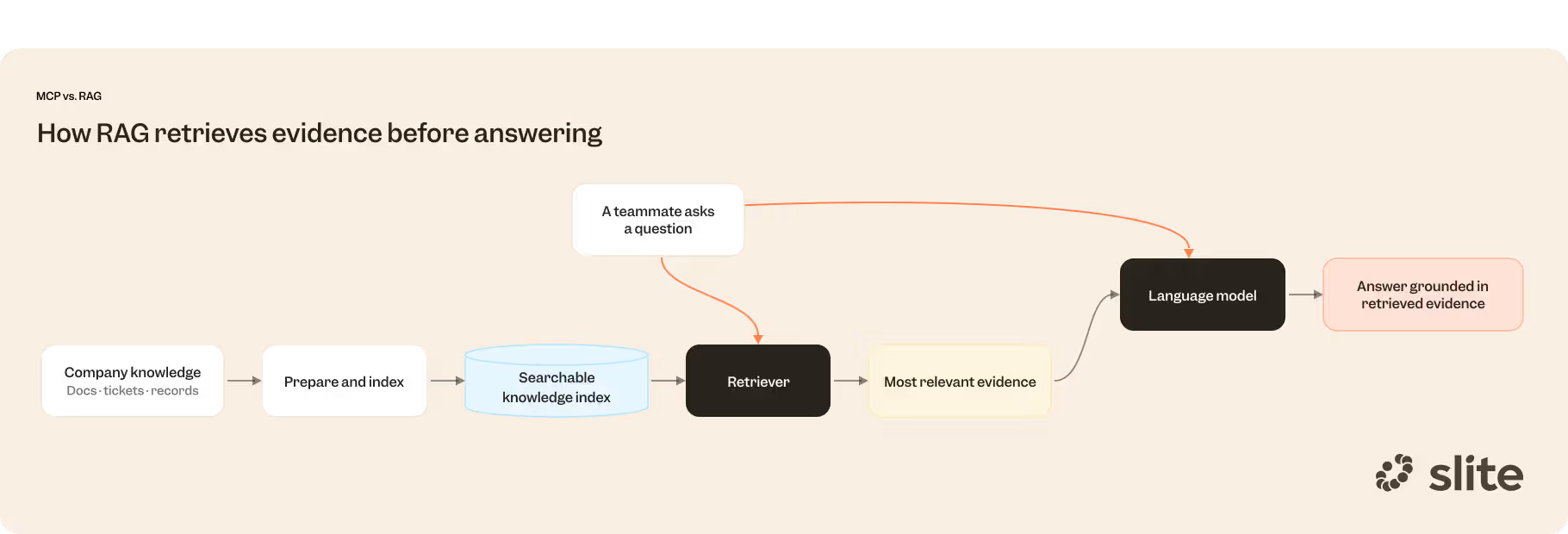
A basic RAG system behaves like a research assistant performing one library search. A more advanced system can break a question into smaller investigations, search several sources, combine semantic and keyword retrieval, query structured databases, call live APIs, compare conflicting evidence, and search again when something is missing.
We will call this more advanced approach agentic RAG throughout the article.
What is MCP?
Model Context Protocol, or MCP, is an open standard for connecting AI applications to external systems.
To understand why it exists, start with APIs.
Most business applications have an API. An API lets one piece of software communicate with another through code. The API processes the request and returns the account data. APIs can also accept commands that change something, such as creating a ticket, updating a record, or sending a message.
This is how developers have connected applications for years. But every API works differently. Each has its own documentation, authentication method, request format, available actions, and response structure.
A coding agent can read API documentation and write code to call an API. But every API has different instructions, authentication, request formats, and errors, so developers still need to build a custom integration.
That is manageable for one agent and one API, but quickly becomes messy across dozens of company systems.
MCP introduces a common protocol between the AI application and those systems.
MCP does not replace their APIs. Instead, an MCP server can sit in front of an API, and expose its capabilities in a format that MCP-compatible AI applications understand.
The official MCP documentation compares it to a USB-C port: different external systems can connect to AI applications through the same standard interface.
An MCP connection has four main parts:
- The host: The AI application where the user works, such as Claude, ChatGPT, or an IDE.
- The client: The component inside the host that maintains a connection to an MCP server.
- The MCP server: A program that presents the capabilities of an external system through MCP.
- The external system: The application, API, database, or collection of files behind the server.
The MCP server describes what it makes available through three building blocks:
- Tools are operations the AI can call, such as searching Salesforce, creating a Linear issue, or sending a Slack message.
- Resources are pieces of information the application can read, such as a file, database record, or API response.
- Prompts are reusable instruction templates for common workflows.
An MCP server may include a README for the developer installing it. But the AI agent does not have to rely on that README to understand the server. MCP provides machine-readable definitions for its capabilities.
For example, a tool definition can tell the AI:
Name: get_account
Description: Retrieve a Salesforce account by its ID
Required input: account_id
The definition acts like a small instruction card. It tells the AI what the tool does, what information it must provide, and what kind of operation it can request.
When the user asks a question, the flow looks like this:
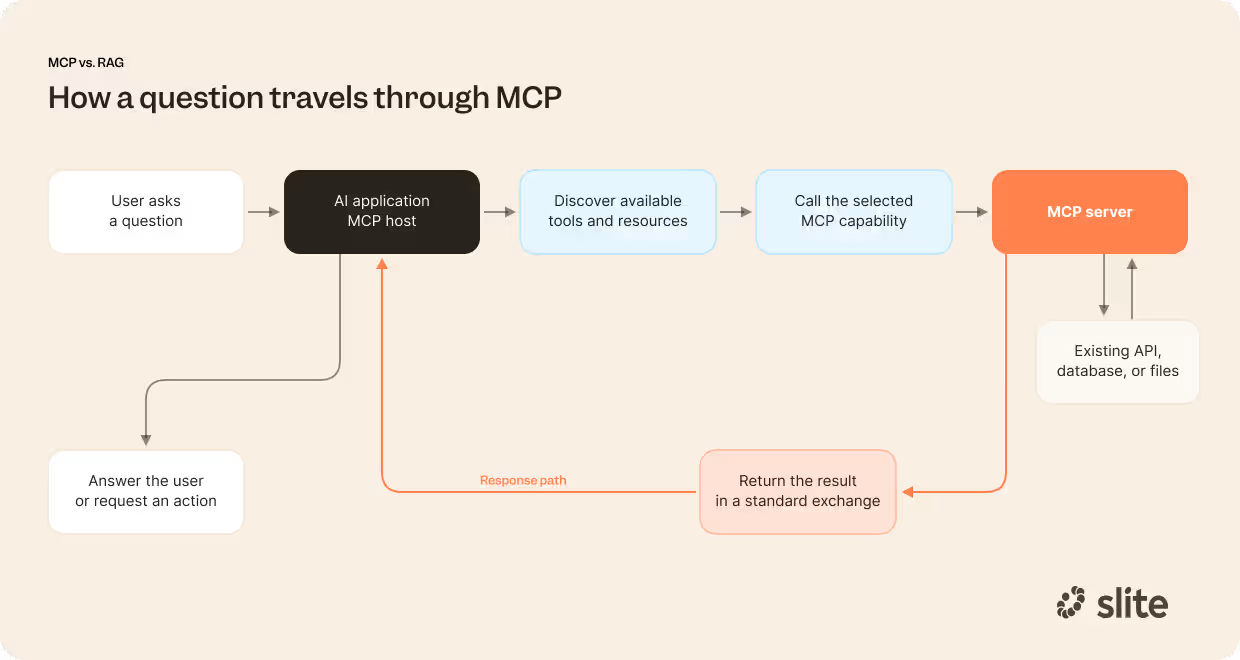
Suppose Claude needs the renewal date for a known Salesforce account. It discovers that the Salesforce MCP server exposes a tool for retrieving the account, calls it with the account ID, and receives the record through a standard MCP response.
MCP vs. RAG comparison
MCP and RAG are not two ways of doing the same job.
MCP answers: How can this AI application connect to an external system and use what it offers?
RAG answers: What information does the AI need for this question, and how should that information be found and prepared?
| Question | RAG | MCP |
|---|---|---|
| What problem does it solve? | Finding the best evidence for a question | Connecting AI applications to external systems |
| What does it connect? | A question to relevant knowledge | An AI application to tools, data, and workflows |
| What does it return? | Selected context for the model to use | Data, content, or the result of an action |
| Does it decide what is relevant? | Yes, through retrieval and ranking | No. It returns what the connected capability provides |
| Can it combine several sources? | Yes, especially in an agentic RAG system | Not by itself. The AI application must call and combine results from several servers |
| Can it change something in an app? | Not as a retrieval method | Yes, when a server exposes an action as a tool |
| When is it most useful? | Broad questions where the answer may be spread across several sources | Precise lookups and actions where the destination is already known |
| How can they work together? | A RAG system can retrieve information through MCP servers | An MCP server can expose an entire RAG system as one capability |
An MCP connection to Salesforce can retrieve the renewal date. Another MCP connection can search Intercom or Slack. But MCP does not inherently decide which systems to search, which results matter, or how conflicting information should be resolved.
That is the job of the retrieval system. An agentic RAG system can plan the investigation, call the relevant sources, rank what comes back, and prepare the evidence the model needs. The completed RAG capability can then be exposed through MCP so that Claude, ChatGPT, or another AI agent can use it.
Where direct MCP retrieval works, and where it starts to break
You might be thinking: if all your company tools have MCP servers, why build a separate company memory layer? Connect the AI to Salesforce, Slack, Intercom, and Slite, then let it find the answer itself.
That is a reasonable approach. Direct MCP works well when the destination and request are clear, such as fetching a renewal date from Salesforce or updating a known Linear issue. Some of our customers tried extending this approach to broader company questions before moving to a dedicated memory layer. They ran into two problems.
1. The agent does not always choose the right tool
Tool selection is not deterministic. MCP servers often expose several capabilities so an agent can do everything a user might need. As you connect more servers, some of those capabilities begin to overlap.
For example, Slite can expose one tool that finds documents matching a query and another that sends a question to Slite Agent, which retrieves and consolidates an answer. Models have sometimes selected document search even when explicitly asked to use Slite Agent.
A wrong choice might still return relevant-looking information, making the failure difficult to notice. The risk grows as the agent receives more tools with similar names and purposes.
2. Raw retrieval fills the context without resolving the question
The agent must read tool definitions before deciding what to call. It must then hold the results of those calls in its context.
A CRM call might return three deal records. A Slack search might return several long threads. A document search might add overlapping excerpts. Multiply that by several company systems, and much of the model's context is spent carrying and sorting raw material before it can reason about the actual question.
More information does not necessarily mean better context. The client agent still has to infer what the user meant, decide which evidence matters, reconcile conflicts, and produce one coherent answer.
Direct MCP solves access. It does not, by itself, solve retrieval. For broad questions such as "What changed with this customer, and what matters before the renewal?", that retrieval work is what a company memory layer should handle.
MCP is still useful in this setup
These limitations do not mean MCP should disappear from your architecture. They mean it should provide access to your company memory layer rather than act as the memory layer itself.
If you are building company memory for your team, you should generally host it as a shared cloud service. That gives you one place to connect sources, enforce permissions, refresh knowledge, improve retrieval, and determine how evidence is ranked and consolidated. Every AI agent then works with the same retrieval system instead of rebuilding that logic inside each client.
You can expose the completed memory layer through one high-level MCP tool:
ask_company_memory(question)When Claude, ChatGPT, or a coding agent calls that tool, the cloud service handles the investigation. It selects the sources, retrieves and ranks the evidence, resolves what it can, and returns a compact answer with citations.
Why basic RAG is not enough
After seeing the limits of direct MCP retrieval, you might reach for the opposite solution: put all your company knowledge into a vector database and use RAG to search it.
RAG comes in several forms, and the simplest version does not match every retrieval problem. The simplest version of RAG, Naive RAG, works for a clean collection of similar documents. A company memory layer has a harder job.
1. Not every source should be searched the same way
Semantic search works well for finding passages in documents. But company knowledge also lives in CRM fields, support tickets, Slack conversations, code repositories, and warehouse tables.
Each source requires a different retrieval method. A vector search can find a paragraph about product usage, but it cannot reliably calculate whether usage declined over the last quarter. That requires a structured query against the underlying data.
2. Similar information is not always the right evidence
Basic RAG retrieves passages that look similar to the question. It does not automatically know which source is current, authoritative, or complete.
For the renewal question, it might retrieve an old account plan because its wording closely matches the query. It might find the original support complaint but miss the later message explaining how it was resolved. The result can sound coherent while excluding the evidence that actually changes the answer.
Why you need agentic RAG
Agentic RAG treats retrieval as an investigation rather than a single search.
For the renewal question, it can separate the work into commercial changes, unresolved support issues, usage trends, and team commitments. It can then choose the right retrieval method for each part: semantic search for documents, keyword search for conversations, an API call for CRM records, and SQL for usage data.
It can compare what comes back, preserve conflicts, search again when evidence is missing, and return one answer with citations.
This is still RAG. The difference is that naive RAG retrieves the nearest passages once, while agentic RAG plans and adapts its retrieval to the question.
How to build a company memory layer with MCP and RAG
Agentic RAG and MCP form the retrieval and access foundation of a company memory layer. They work best when the retrieval system sits behind the MCP interface rather than being rebuilt inside every AI client. For a hands-on example of standing one up fast, see how Cerebras built its knowledge base.
Combine agentic RAG and MCP
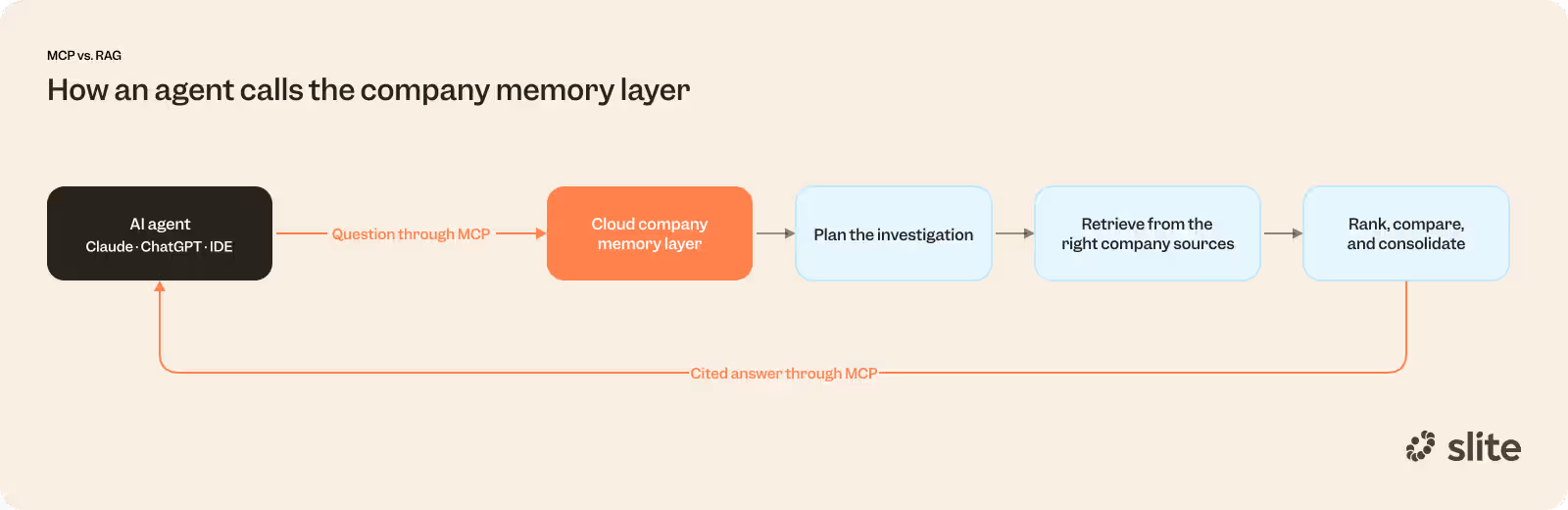
The flow has four steps:
- The AI agent asks one high-level question. Instead of choosing among dozens of source tools, it calls a company-memory capability through MCP:
ask_company_memory(question, date_range?, required_citations = true). - The RAG system plans the investigation. It breaks the question into smaller information needs, selects the right sources, and chooses the appropriate retrieval method for each one.
- The system retrieves and consolidates the evidence. It can search independent sources in parallel, apply permissions, remove duplicates, compare freshness and authority, preserve conflicts, and search again when information is missing.
- MCP returns the completed result. The AI agent receives a compact answer with citations, conflicts, and unresolved questions. It can use that context to write, analyze, code, or decide what to do next.
Keep narrower MCP tools available for precise follow-up actions, such as opening a complete source, confirming a live CRM value, creating a task, or updating a record after approval. The same applies to specialist sources: where no native integration exists, a marketing data MCP can bring ad and analytics data into the retrieval plan.
When to use MCP, RAG, or both?
Summarizing the insights above, this is where MCP, RAG, both, or neither come into play while building your memory layer:
| Use case | What to use | Why |
|---|---|---|
| Search one approved document collection | Basic RAG | Bounded corpus and straightforward retrieval |
| Answer a broad question across company systems | Agentic multi-source RAG | Needs planning, source selection, ranking, and consolidation |
| Fetch one known CRM value | Direct MCP | The source and record are already known |
| Update a ticket or record | MCP action | This is a tool operation, not retrieval |
| Let Claude access company-wide knowledge | RAG exposed through MCP | Central retrieval can be reused by any client |
| Add a specialist data source to the retrieval plan | Native integration or selectively loaded MCP | Depends on the quality and requirements of the source |
| Reconcile conflicting company claims | Retrieval + trust layer | MCP access alone does not determine truth |
Beyond MCP and RAG: what a company memory layer still needs
MCP solves connection, and agentic RAG solves retrieval. But return to the renewal question: "What changed with this customer over the past quarter, and what should we know before the renewal?" The system can find a Salesforce renewal date, a Slack message requesting an extension, and an outdated account plan without finding whether the extension was approved, so relevant evidence alone does not guarantee a safe answer.
Your company memory layer also needs mechanisms for:
- Evidence quality: Check relevance, source authority, freshness, and whether the information has been verified.
- Governance: Track ownership, enforce permissions, and preserve citations and timestamps so people can inspect the answer.
- Completeness and conflict handling: Detect missing evidence, compare disagreements, search again when useful, and say when an answer cannot be confirmed.
- Operating efficiency: Route each task to the right model, limit unnecessary searches and model calls, and run independent retrieval in parallel to control cost and latency.
- Evaluation and maintenance: Measure answer quality, source coverage, tool-selection failures, cost, and response time as models, integrations, and company knowledge change.
Connection and retrieval are only the foundation. A useful company memory layer must also make its answers trustworthy, inspectable, affordable, fast, and maintainable.
How we built Slite Agent as a company memory layer
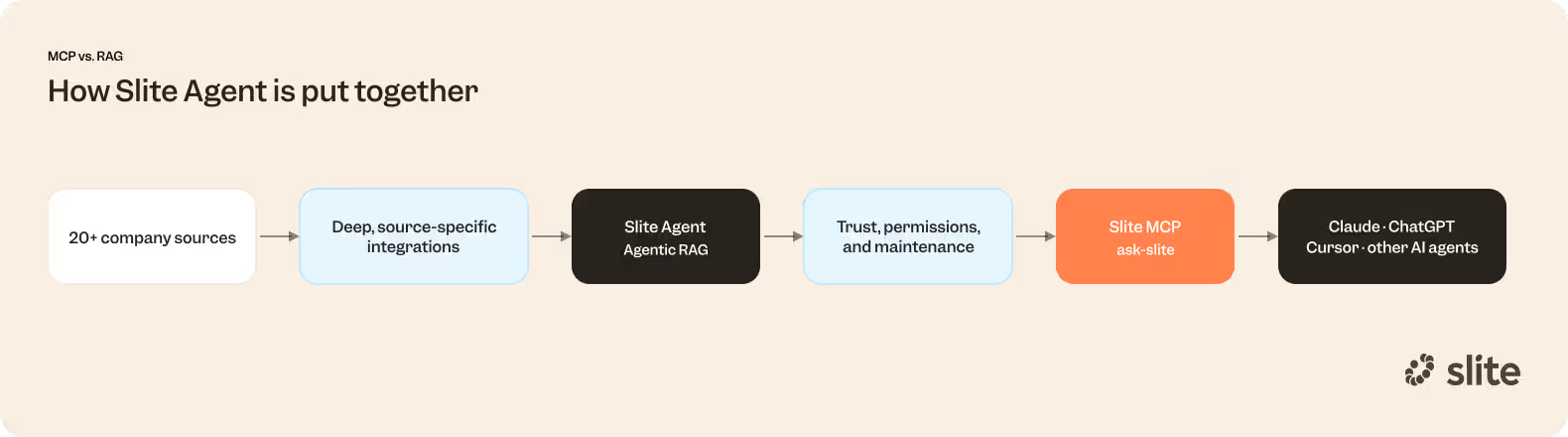
Slite Agent is Slite's self-maintaining company brain. It answers questions across Slite and more than 20 connected company tools, including Slack, Salesforce, Google Drive, Intercom, Jira, GitHub, and BigQuery.
Disclosure: we make Slite Agent. We are using it here as one implementation of the architecture, not the only possible design.
We didn't use MCP for retrieval across tools, we built native integrations
We did not connect those sources by giving a general-purpose agent 20 MCP servers. We built deep, source-specific integrations.
Slack contains conversations whose meaning depends on time and participants. Salesforce contains structured account records. BigQuery requires SQL. GitHub contains repositories and code. Each integration preserves the useful structure of its source and, where supported, its permissions.
This lets the retrieval system use semantic and keyword search for documents, structured queries for databases, and live API calls for current operational values instead of flattening every source into generic text chunks.
We use Agentic RAG for retrieval on top of the source integrations
Above those integrations, our RAG architecture evolved from a single search into an agentic retrieval system.
Slite Agent can break a broad question into smaller investigations, select the right sources and retrieval methods, search independent paths in parallel, compare what comes back, and retrieve again when evidence is missing. It then returns one answer with the supporting sources rather than handing the user a pile of raw results.
Once those solved, we had to handle permissions, accuracy, and security
Retrieval quality is only part of the system. Slite Agent also has to keep restricted evidence away from unauthorized users, preserve citations, and use signals such as freshness, ownership, and verification when deciding what information is safe to rely on.
The architecture also has to stay efficient. Simple lookups should not trigger a full investigation, specialist capabilities should load only when they are needed, and independent retrieval paths should run in parallel where possible. The system must be evaluated continuously as source behavior, models, and company knowledge change.
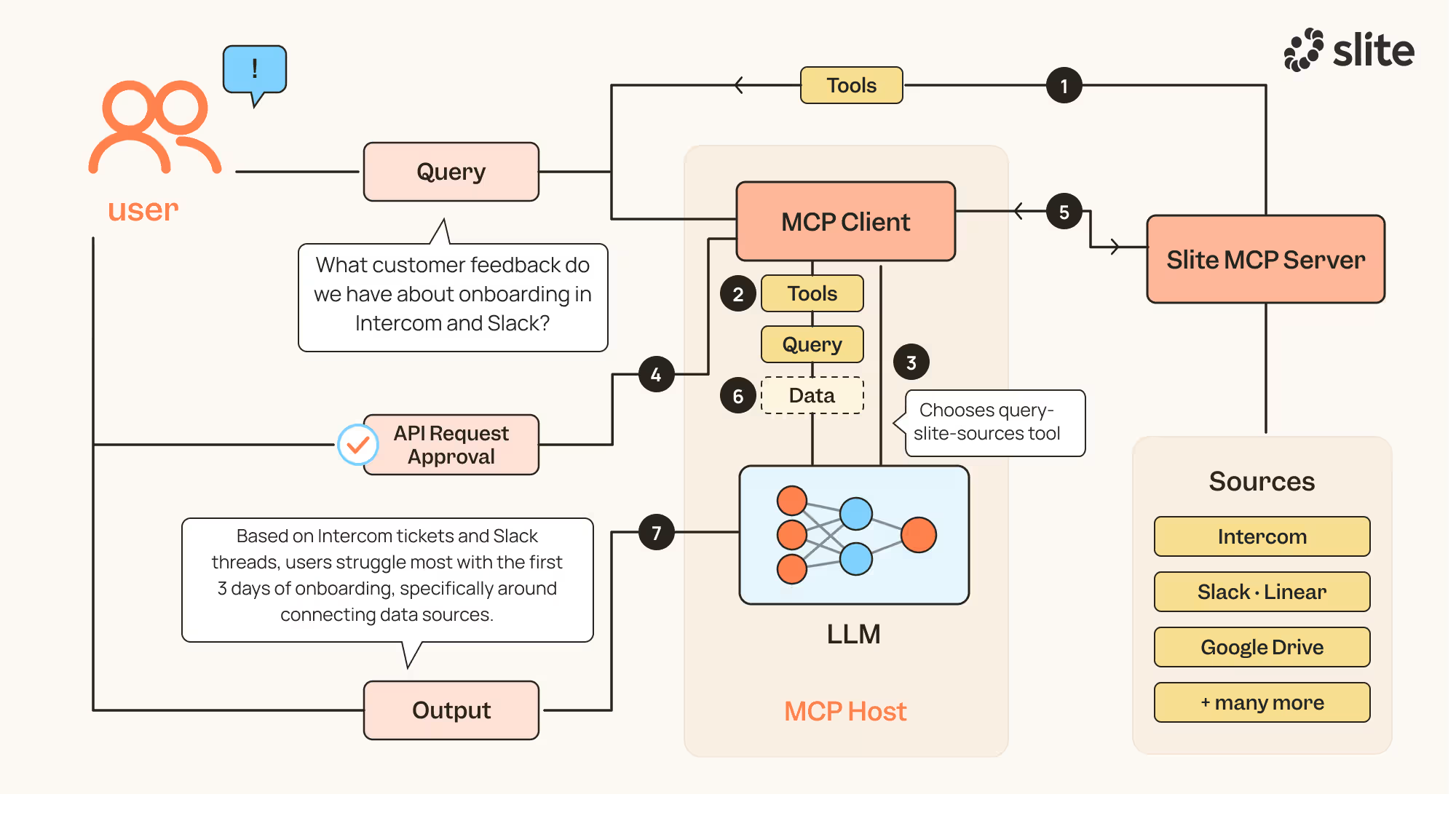
Ultimately, this is how Slite's retrieval architecture ends up looking:
We built an MCP to expose Slite to AI Agents
We built the Slite MCP so knowledge workers could use the completed retrieval capability from Claude, ChatGPT, Cursor, and other MCP-compatible AI tools.
Instead of making the external agent search every company system itself, it can call one high-level tool:
ask-slite(question)Slite Agent handles the investigation across the connected sources and returns the answer with its supporting evidence.
Today, customers submit more than 15,000 questions a week to Slite Agent.
So, should you use MCP or RAG?
If you are building a company memory layer, you will need both.
Use agentic RAG to investigate company knowledge by planning searches, selecting sources, ranking evidence, and consolidating what it finds. Use MCP to make that completed capability available to the AI agents where your team already works. Go directly to a narrower MCP tool when the source and record are known or the agent needs to perform an approved action.
We hope this article has made the role of each clear enough for you to design the retrieval layer correctly. But retrieval is only the beginning. You still need to solve permissions, freshness, authority, conflicting evidence, model routing, evaluation, latency, cost, rollout, and constant maintenance as your company knowledge changes.
If you plan to build all of that yourself, we wish you luck. See how one version of this architecture performed in our 41-question company-search benchmark.
If you would rather start with a company memory layer that is already built, deployed, and maintained, explore Slite Agent or book a demo.