Every team already runs on a stack of authoritative systems, whether anyone calls them that or not.
The CRM owns your customers. The HR system owns your employees. The issue tracker owns project status.
These are your systems of record, and they've been the backbone of company knowledge since long before anyone put "AI" in a product name.
But the trouble starts when that AI is pointed at company knowledge.
An agent can't tell an authoritative record from a doc that went stale six months ago. It retrieves both, blends them, and answers with total confidence.
One prospect building internal agents at a 3,000-person mobility company put it plainly: unlike humans who question their managers, agents act on bad data without verification.
The fix is understanding two layers that do two different jobs.
Systems of record guarantee data integrity, one domain at a time. A source of truth keeps everyone, human and AI, aligned across all of them.
This article defines the first layer, shows how it differs from the second, and explains why keeping the two in sync just became the whole game.
Key takeaways:
- A system of record (SOR) is the authoritative source for a specific type of data, like the CRM for customer data.
- A source of truth aggregates knowledge from many systems of record into one aligned view.
- You need both: SORs for data integrity, a source of truth for organizational alignment.
- A knowledge base is a source of truth, and it works best when it stays connected to your systems of record rather than duplicating them.
- In the AI era, SORs matter just as much as before: agents act on whatever they retrieve, so records and docs can't be allowed to drift apart.
What is a system of record?
A system of record is the single authoritative system where one type of business data officially lives. It's the source other systems sync from, and the one that wins when two systems disagree. Common examples include the CRM for customer data, the HRIS for employee data, and version control for code.
Plenty of tools hold a copy of your customer data. Only one of them is allowed to be right about it.
A real system of record owns exactly one data domain. Writes into it are governed and validated, so a deal stage or a salary field can't be edited casually by anyone passing through.
Other systems pull from it, never the reverse. And when a dispute comes up in a meeting, it's the screen everyone opens to settle the question.
What are examples of systems of record?
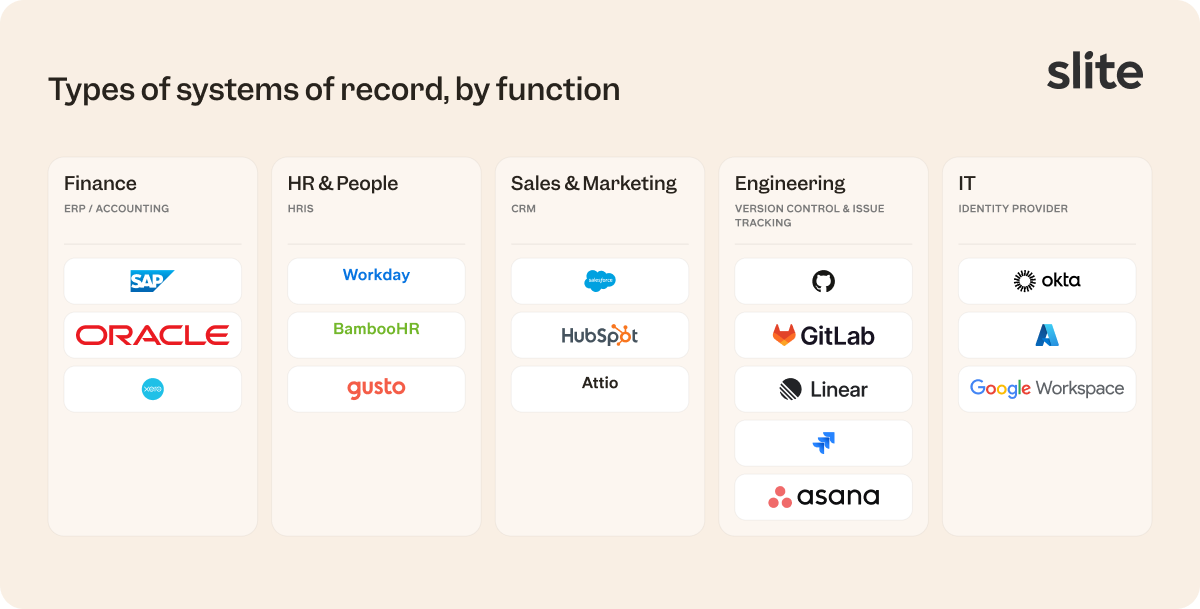
Most companies run one system of record per function:
- an ERP or accounting tool for finance,
- an HRIS for people data,
- a CRM for sales,
- version control and an issue tracker for engineering,
- and an identity provider for IT.
Each is the authoritative source for its own domain.
Mapped by function, a typical stack looks like this:
- Finance: the ERP or accounting system. Revenue recognized here is the revenue.
- HR and People: the HRIS (Workday, BambooHR, Gusto). Titles, salaries, start dates.
- Sales and Marketing: the CRM (Salesforce, HubSpot, Attio). Accounts, contacts, pipeline.
- Engineering: version control for code, the issue tracker for work status.
- IT: the identity provider for who has access to what, monitoring for what's actually running.
Companies used to run one giant ERP that tried to own everything. Over the past two decades that unbundled into specialized tools, each authoritative for a narrower slice.
The number of systems of record in a typical company keeps growing, which makes the coordination issue more important.
System of record vs source of truth
The system of record and source of truth are mistakenly used interchangeably in many companies, even though they are very different.
- A system of record is the authoritative source for one type of data.
- A source of truth is the layer that aggregates and aligns information from many systems of record into one consistent view.
They solve different problems, and a healthy company needs both for keeping an honest overview of their company knowledge.
Here they are presented side by side, including the system of engagement that represents the third category, important to distinguish:
| Layer | Job | Example |
|---|---|---|
| System of record | Owns one data domain; guarantees *data integrity* | The CRM for customers, the HRIS for employees |
| Source of truth | Aligns knowledge across domains; guarantees *organizational alignment* | The company knowledge base |
| System of engagement | Where conversation and collaboration happen | Chat, meetings, email |
The confusion between the first two rows is expensive.
When Geoffrey Moore introduced the systems-of-record framing in his 2011 AIIM white paper, he explicitly classed wikis with the collaborative layer that sits on top of systems of record.
His performance standard for a system of record was "Accuracy & Completeness" with permanent retention.
A wiki optimizes for something else entirely: accessibility.
That said, a knowledge base is a source of truth, and your systems of record are what it draws on and what it needs to be plugged into.
Each SOR establishes the facts for its domain; the knowledge base is where those facts get assembled into internal documentation a whole team can align around.
We go deep on that second layer in our guide to the single source of truth, so here we'll keep the focus on the record side.
One team lead described the split perfectly during an evaluation: their wiki "is still where we draft things. It's just no longer where we decide things."
Drafting and deciding are both essential. They're just different jobs.
Why do systems of record matter more in the AI era?
AI agents answer from whatever they retrieve. When a stale doc contradicts the system of record, an agent can serve the wrong version as a confident answer. That makes the gap between your records and your documentation an operational risk, and it makes clean, designated systems of record a prerequisite for trustworthy AI.
To be clear, you always needed this. A company that can't say which system owns which fact doesn't actually know where it stands.
But before AI, the cost was human friction:
- repeated questions,
- a wrong number in a deck,
- an afternoon lost to reconciling spreadsheets.
Agents changed the cost structure.
A human who finds two conflicting docs gets suspicious and asks a colleague. An agent has no such reflex. It grounds on whatever it retrieves and executes, and the output looks authoritative precisely because language models are good at writing.
There's a second-order effect we hear about constantly in sales calls: trust erosion.
Once people stop trusting the data in the docs, they stop reading them, and then they stop writing them.
The knowledge that lived in people's heads stays there to build onto the existing tribal knowledge that goes undocumented.
The resolution follows directly from the two-layer model.
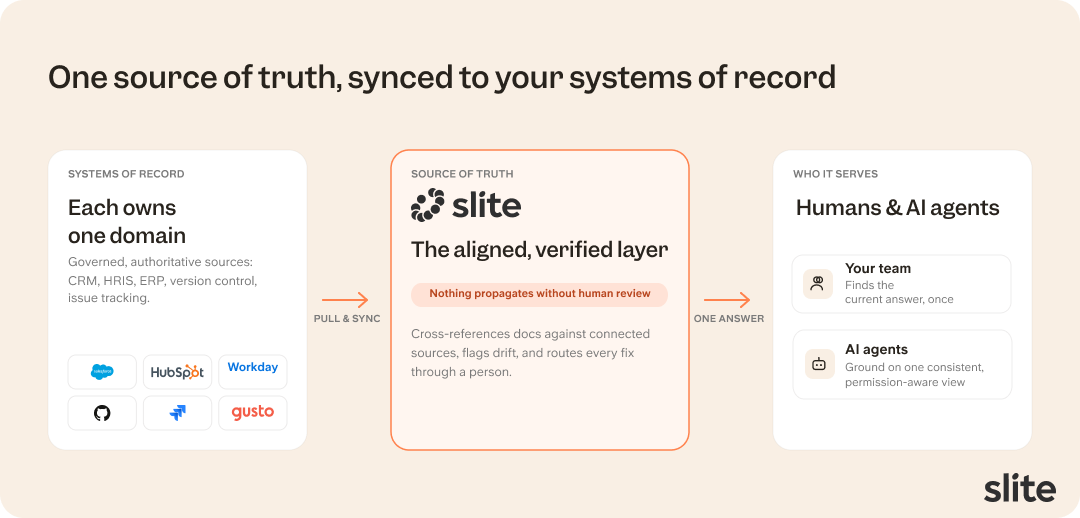
Your source of truth has to pull from your systems of record and update as they change, so humans and agents see one consistent picture.
The industry data backs the urgency: Salesforce's 2025 Trust in Business Data survey of 500+ US leaders found confidence in data accuracy down 27% since 2023, while 76% said AI increases their need to be data-driven.
Reliance is rising exactly as trust falls. Syncing the layers is how you close that gap.
How does a source of truth stay in sync with your systems of record?
A source of truth stays in sync by connecting directly to the systems of record, pulling updates as the underlying data changes, flagging documentation that has drifted, and keeping answers permission-aware. Manual copy-paste can't sustain this; the connection has to be live and automatized.
If you're evaluating how to build this layer, the checklist is genre-level and tool-agnostic:
- Live connections to your SORs. The knowledge layer reads from the CRM, the issue tracker, the code host. Facts get referenced at the source instead of manually cloned.
- Records that refresh as sources change. When the SOR moves, the doc that summarizes it should move too, or at least get flagged.
- Drift detection. Something has to notice when a doc contradicts the system it describes, before a reader (or an agent) trips over it.
- Permission-aware answers. An aggregated view must still respect who's allowed to see what.
- Human verification. A change proposed by automation should pass through a person before it becomes truth.
The obvious objection: can't a disciplined team just keep the wiki updated by hand?
In our experience, no, and the reason is structural rather than moral.
Maintenance always loses to urgent work, and the gap between docs and reality widens silently until trust breaks.
That maintenance debt is the central story of why knowledge bases fail, and it's why the sync has to be built into the system rather than into someone's calendar.
How Slite connects your systems of record to one source of truth
Slite is a knowledge base with an AI agent that connects to your systems of record, keeps documentation current as they change, and routes every proposed change through human review. It's built to be the source-of-truth layer, and it doesn't replace your CRM, HRIS, or issue tracker.
It sits above SORs as the aligned, verified layer.
Concretely, Slite connects to the tools where your facts actually live:
- CRMs like HubSpot, Attio, and Salesforce;
- issue trackers like Linear, Jira, and Asana;
- GitHub and GitLab for engineering;
- BigQuery for data; Intercom and Zendesk for support.
Anything without a native connection can plug in through MCP, including your HRIS.
The Slite Agent then does the sync work: it cross-references your docs against those connected sources, surfaces what's stale or contradictory, and drafts the fix.
Nothing applies automatically. Every change lands in a triage queue for a person to approve, which is why we describe the goal internally as becoming the version control layer for company knowledge, where nothing propagates without human review.
Verification states and word-level doc history mean you can always tell what's current, who changed what, and when.
And because sources are mirrored permission-aware, the aligned view never leaks a fact to someone who couldn't see it in the source system.
If you want to see what your own stack looks like with the two layers connected, book a demo and we'll walk through it with your actual tools.
Final thoughts
The goal was never to cram everything into one system. Companies tried that, and the tools unbundled anyway, because specialized systems of record are genuinely better at governing their own domains.
The goal is a source of truth honest enough that your systems of record, your team, and your AI all agree. Two layers, two jobs: records for integrity, a source of truth for alignment, and a live connection between them so neither quietly diverges from reality.
Run the three-step map on your own stack this week. Most teams find at least one place where a doc, a spreadsheet, or a wiki page is quietly pretending to be a system of record. Naming it is most of the fix.
FAQ
Is a knowledge base a system of record?
No. A knowledge base is a source of truth: it aggregates and aligns knowledge drawn from your systems of record, but it isn't the authoritative source for any single data type. Customer data still belongs to the CRM, employee data to the HRIS. The knowledge base is where those facts get synthesized into docs a team can align around.
What are examples of systems of record?
Typical examples include the CRM for customer and pipeline data, the ERP or accounting system for financials, the HRIS for employee data, version control for code, the issue tracker for engineering work, and the identity provider for access. Each is authoritative for exactly one domain.
Is Slack a system of record?
No. Chat tools are systems of engagement, the layer where work gets discussed. Decisions made in chat should be recorded in the appropriate system of record or documented in the source of truth, because conversation threads offer no authority, structure, or guarantee of currency.
Why do systems of record matter for AI agents?
Because agents act on whatever they retrieve, without judgment about which source is authoritative. A designated system of record, connected to a synced source of truth, gives an agent one consistent picture to ground on. Without it, every conflict between a doc and a record becomes a potential confident wrong answer.
Can a source of truth pull data from multiple systems of record automatically?
Yes. A connected knowledge base can maintain live links to the CRM, issue tracker, code host, and other systems of record, refresh or flag documentation as those sources change, and keep answers permission-aware. This is how Slite works: the agent detects drift against 20+ connected tools and proposes fixes that a human approves before anything changes.