A teammate at one of our customers spent two full days following an internal guide before realizing the team that owned it had changed the process months earlier. The doc looked authoritative and was wrong.
That used to be the worst case. The same outdated guide is now being read by AI agents inside that customer's stack, and an agent doesn't know to ask in Slack when something looks off.
One stale doc no longer misleads one person. It mis-trains every downstream bot that reads it. For engineering teams, the sharpest version of this problem is keeping the knowledge base in sync with the codebase.
A new category is forming to address this: the self-maintaining knowledge base. An agent does the work on the KB itself, writing, updating, restructuring and archiving, while humans approve every change.
We've built our next product phase, Slite Agent, around it. This guide covers what a self-maintaining knowledge base is, why every team needs one, how to build the loop, and how to evaluate any vendor claiming the category.
Want to see Slite Agent in action? Book a call with us and we'll show you around.
Key takeaways
- A self-maintaining knowledge base uses an AI agent to write, update, restructure and archive docs, closing the gap between what's documented and what's true.
- Three capabilities define the category: auto-ingestion (connecting to where work happens), self-maintenance (detecting drift and drafting fixes) and control (human review before anything ships).
- The cost of stale documentation has changed. A human can tell when a doc looks off and ask in Slack. An agent can't, and will answer confidently on top of an outdated SOP.
- The loop: the agent ingests from connected sources, detects drift and drafts a fix. A human approves. The KB stays accurate over time.
- A self-maintaining KB is better infrastructure for humans and the source of truth every downstream agent in your stack depends on for context and SOPs.
What is a self-maintaining knowledge base?
A self-maintaining knowledge base is a wiki where an AI agent does the maintenance work (writing, updating, restructuring, archiving) while humans approve every change. The wiki gets more accurate over time without any single person being responsible for keeping it that way.
The term is used loosely right now, often interchangeably with adjacent ideas like self-healing, self-learning or agentic knowledge management. The differences tell you whether a system closes the loop or only patches one part of it.
Self-maintaining vs. self-healing vs. self-learning
Self-healing patches drift automatically after detection. Self-learning adapts to usage patterns. Self-maintaining does the operational upkeep work, with human approval at the write step.
Self-healing is a capability an agent has. The right default in a shared KB is that every change is human-reviewed, because errors in shared knowledge cascade across every reader and every downstream agent. The control section below covers this in detail.
Self-maintaining vs. AI search on a static wiki
AI search reads a frozen corpus. A self-maintaining KB writes back to it. Without the write loop, the corpus rots underneath the search.
A one-line test for any tool calling itself agentic: if it can answer a question about a doc but can't propose an edit to it, it's AI search.
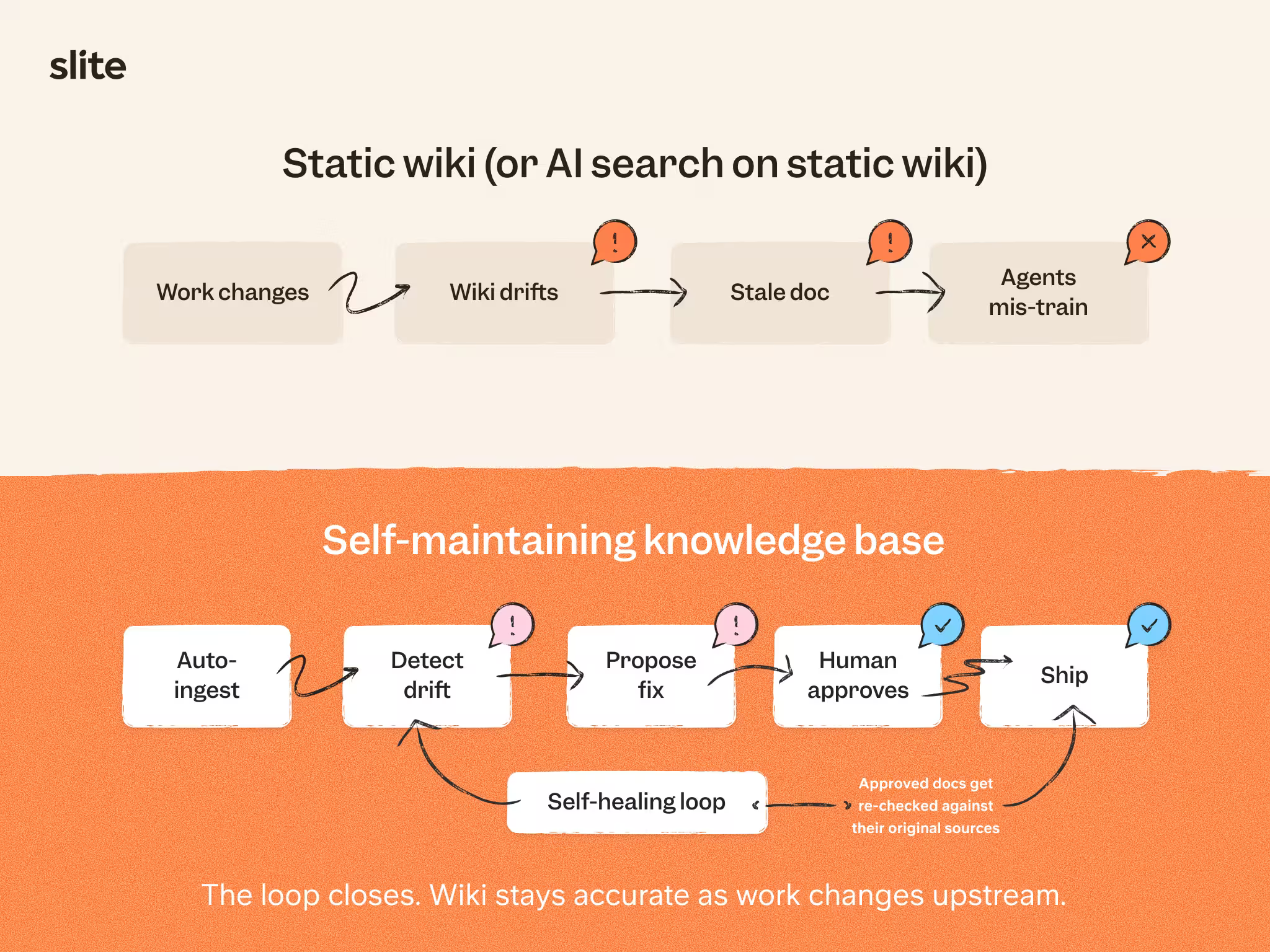
Self-maintaining vs. agentic knowledge management
Agentic KM is the broader practice. The self-maintaining KB is the tooling layer that makes the practice possible.
Agentic KM describes a way of operating, where agents participate in how knowledge is created, found and kept current. The self-maintaining KB is the surface where that practice runs.
What we're building at Slite
The self-maintaining knowledge base is the category we're building toward at Slite.
Slite Agent puts a maintenance layer on top of the wiki. It draws on what we learned running Slite and Super, our retired AI search assistant, for thousands of teams, and on hundreds of conversations with customers about where their knowledge breaks.
The three capabilities, the loop and the evaluation questions below reflect how we think this work should be done, based on that research and on the design choices we made while building it.
The three capabilities that define a self-maintaining knowledge base
A self-maintaining knowledge base needs auto-ingestion, self-maintenance and control. Miss any one and you have a chatbot with a wiki attached.
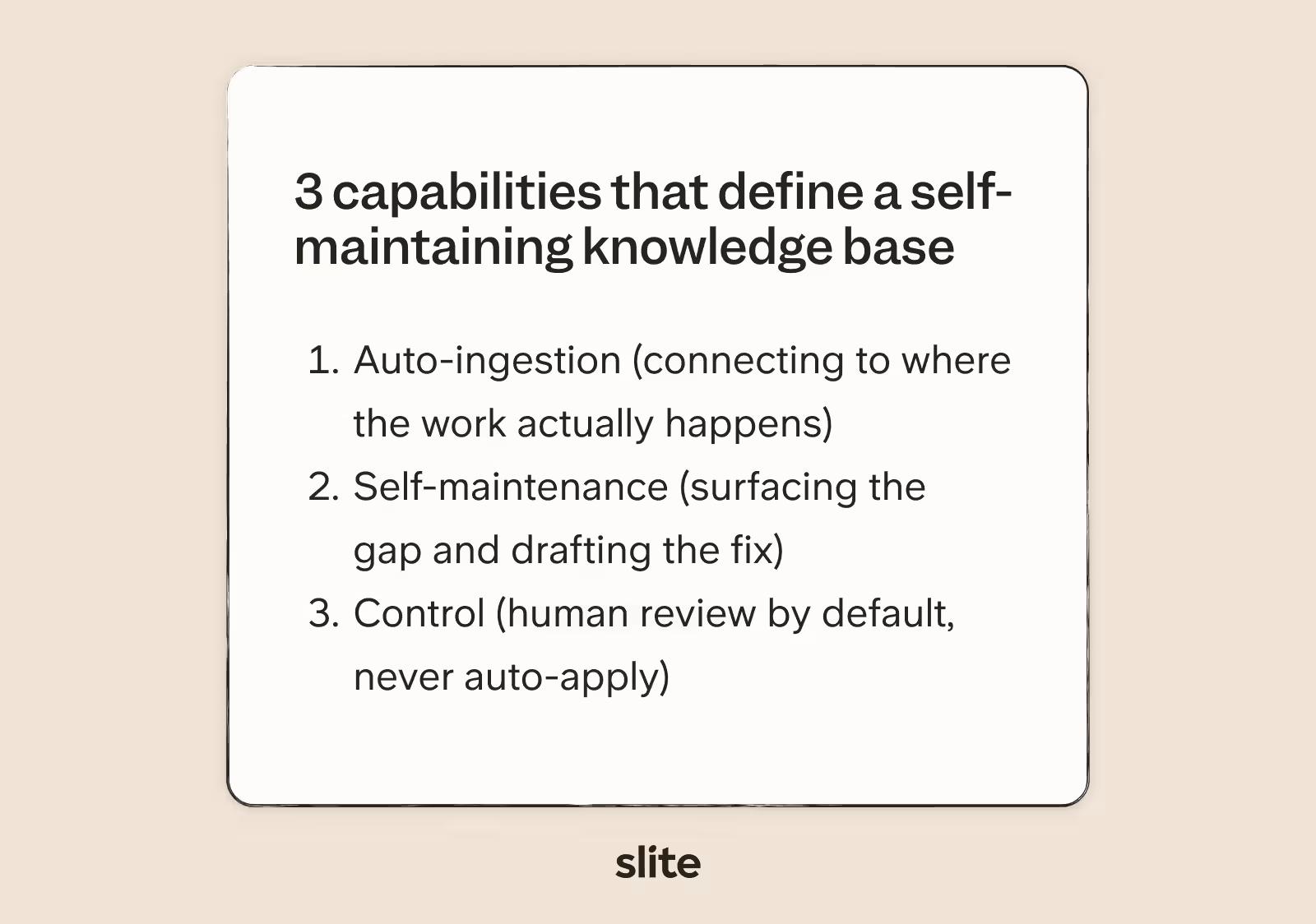
Each capability is a distinct technical problem and a distinct governance problem.
Auto-ingestion: connecting to where the work happens
Knowledge drift starts where the work happens, in a Slack channel, in task comments, in a pull request, so the system has to be plugged into those upstream tools, not only the wiki.
Things change by the hour:
- Engineering changes a deploy step in a pull request.
- Support updates a refund policy in a macro.
- A product manager rewrites the onboarding flow in a ticket.
The wiki finds out, if at all, weeks later, when someone notices and does the update by hand.
An agent that only watches the wiki compares a stale corpus against itself. It can tell you a doc is old, never that it's wrong, and those are different problems that need different machinery.
Self-maintenance: surfacing the gap and drafting the fix
Self-maintenance means the agent both detects the stale section and drafts the replacement, in one motion.
Surfacing a gap is the easy half. Plenty of tools can flag that a doc hasn't been touched in 90 days.
The hard half is drafting the replacement from the recent work updates scattered across different tools. Without it, the system has moved the work from the writer's plate onto the reviewer's plate.
In practice the agent:
- identifies what's gone stale,
- drafts what the new version should say, with enough context for a human to approve, edit or dismiss it quickly.
If this capability is missing, the team gets a longer to-do list. Given that only 1 in 20 documents gets updated in any given month, the wiki keeps rotting at the same rate.
Control: human review by default, never auto-apply
In shared knowledge, a human approves before anything ships. This is where the analogy to coding agents breaks down.
Coding agents can auto-apply because the blast radius of a wrong change is small. You're the reader, you're the reviewer, and your test suite catches what you miss.
In a shared knowledge base, one wrong update becomes input for every reader, every onboarding flow, every customer-facing assistant and every agent reading the wiki to ground its own answers. The blast radius is the entire team, plus every machine downstream.
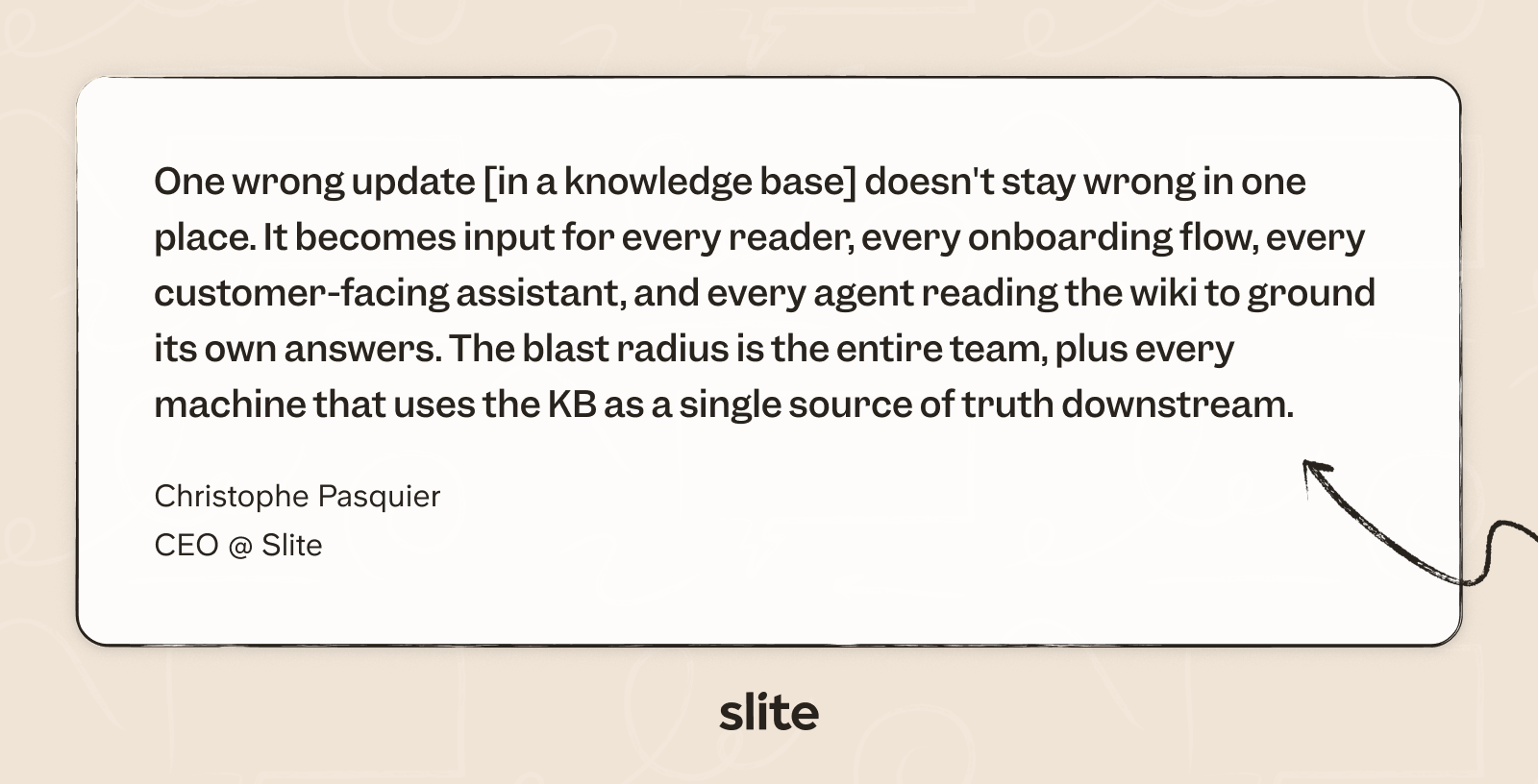
Agents should also respect document permissions the same way human users do. If a teammate can't see a doc, neither can their agent.
We saw this confirmed from the outside. A platform team at one of our enterprise customers was independently building their own approval queue for agent-updated docs before we shipped ours. They had concluded on their own that auto-apply in a shared KB was a non-starter.
If this capability is missing, the first time the agent gets something wrong, the wrong answer is already in production, already being read by humans and machines, and already mis-training the next thing downstream.
Why every team needs one now
Stale docs used to slow down humans. Now they mis-train every AI agent that reads them, and agents don't know they're working off bad context. Three things changed.
The agent era changed the stakes
Agents are scaling and the data foundation they read isn't keeping up. A self-maintaining KB grounds context and SOPs in a source of truth that agents can rely on.
McKinsey's 2025 enterprise survey found that 23% of enterprises are scaling agents in at least one function, with knowledge management among the leading ones, and that 80% of them cite shaky data as the roadblock.
Without a maintenance layer, every agent in the stack grounds on a wiki nobody is keeping current. With one, the wiki becomes the surface every downstream agent depends on, and the same loop that keeps humans on the right page keeps the bots there too.
Trust collapses fast, and agents collapse it faster than humans do
When humans hit an outdated doc, they fall back to Slack. When agents hit one, they answer confidently on top of it, at scale.
The human side is familiar. One or two visibly wrong guides and the team stops trusting the wiki and routes around it. The head of internal knowledge at a large software company described it to us as a document that was old, still available, and making noise. A data infrastructure company told us their enterprise search platform had become an out-of-date pile of cards nobody looks at, because people get better answers from a human on Slack.
In both cases the humans recognize the doc is stale and route around it. They have judgment and they know to escalate.
Agents don't. An agent will answer against an outdated SOP and ship the result downstream with full confidence. Once that answer becomes the input for the next agent in the chain (the support bot citing the sales bot citing the onboarding bot), the cascade is running before anyone notices.
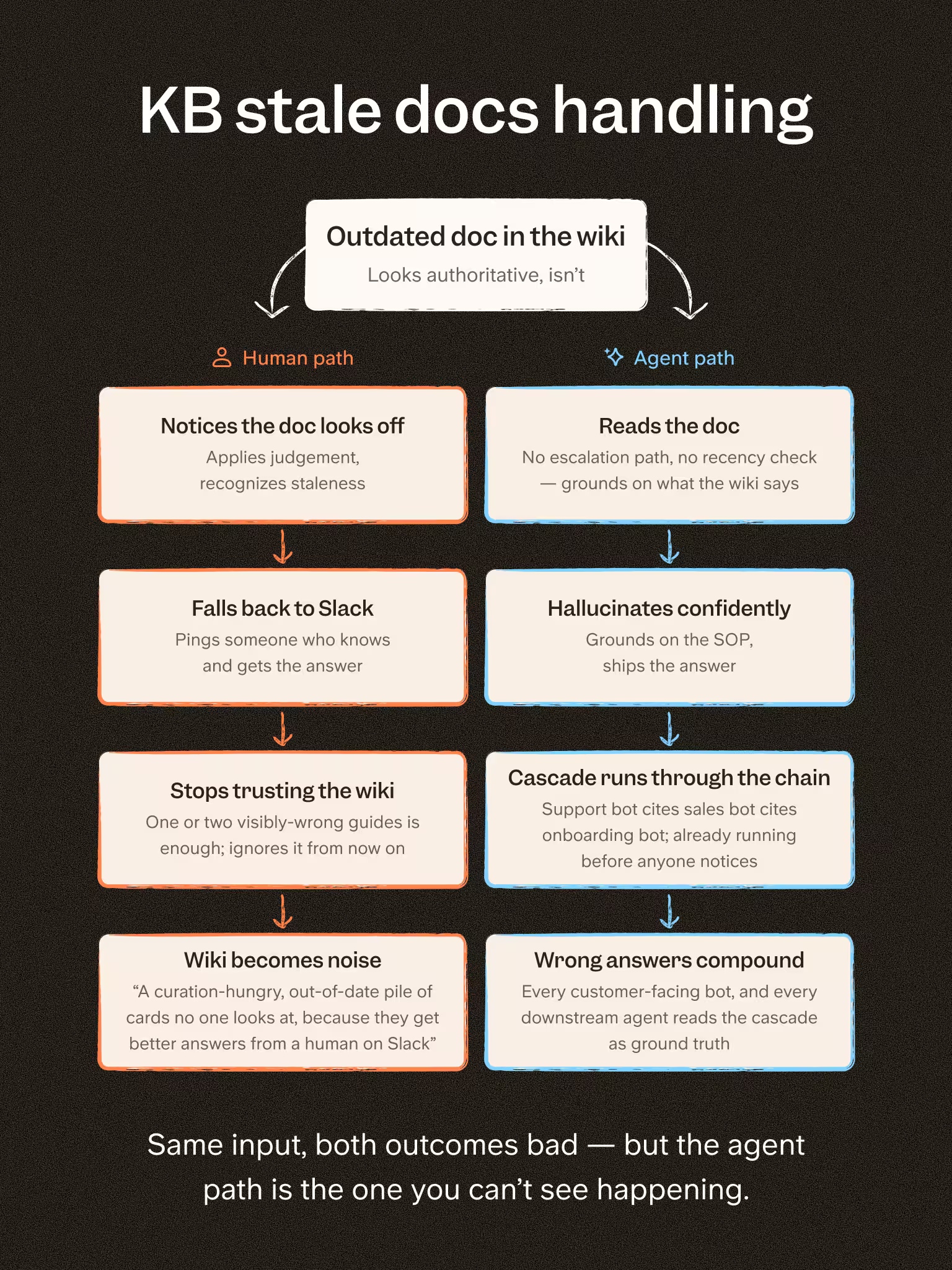
The threshold for good enough docs has shifted. Acceptably stale used to mean humans will work around it. Now it means agents will silently mis-train on it.
Maintenance is invisible, thankless work
The KB owner faces a no-win: commit serious time to upkeep and drop other priorities, or let the wiki decay. A self-maintaining KB removes the human from the ideation and drafting part of the loop, not from the approval step.
Every KB owner has the same shape of problem. They have to:
- notice the gap,
- figure out the right change,
- draft it,
- ship it.
Steps 1 through 3 take most of the time. Step 4 takes ten minutes once the rest is done.
A self-maintaining KB hands steps 1 to 3 to the agent and the human owns step 4. Maintenance becomes a 10-minute review queue instead of a half-day project. If you're still doing it by hand, our guide to knowledge base maintenance walks through the manual version of this same loop.
Fiona, our head of customer experience, summarized the structural problem: "It's a great idea, but it's somehow really hard to get people to do this because they don't care." The fix is to remove the parts of the job that no one wanted to own, rather than to look for people who care more.
How to build your self-maintaining KB
A self-maintaining knowledge base needs three things working together:
- a wiki as your system of record,
- an AI search layer that monitors your connected tools,
- a write-back agent that proposes fixes to the wiki.
At Slite, the three layers map like this: Slite is the system of record, AI search is the retrieval layer that ingests from connected tools and detects drift, and Slite Agent is the maintenance layer that drafts the writes.
| Layer | What it does |
|---|---|
| Slite (system of record) | Verified, structured, permissioned knowledge |
| AI search (retrieval and ingestion layer) | Search across Slite plus 20+ connected tools, always-fresh index |
| Slite Agent (maintenance layer) | Drafts proposed writes, updates, restructures and archives from natural-language intent |
The four steps below describe the loop in operator terms, with our stack or another.
Find the sections that have gone stale
Stop asking "is this doc old?" and start asking "does this doc still match what the team is doing?" The work that changed the answer is in Slack, pull requests, support macros and tickets.
Practically, this means setting up two things:
- A retrieval layer that keeps an always-fresh index of your connected tools, so there's something current to compare against. That's a one-time connect, then it runs in the background.
- An agent that compares your wiki against that index on three triggers:
- on a schedule (sweep the whole KB weekly),
- on demand (when someone asks "is this still right?"),
- and event-based (when a doc flagged as self-maintained is due for a re-check).
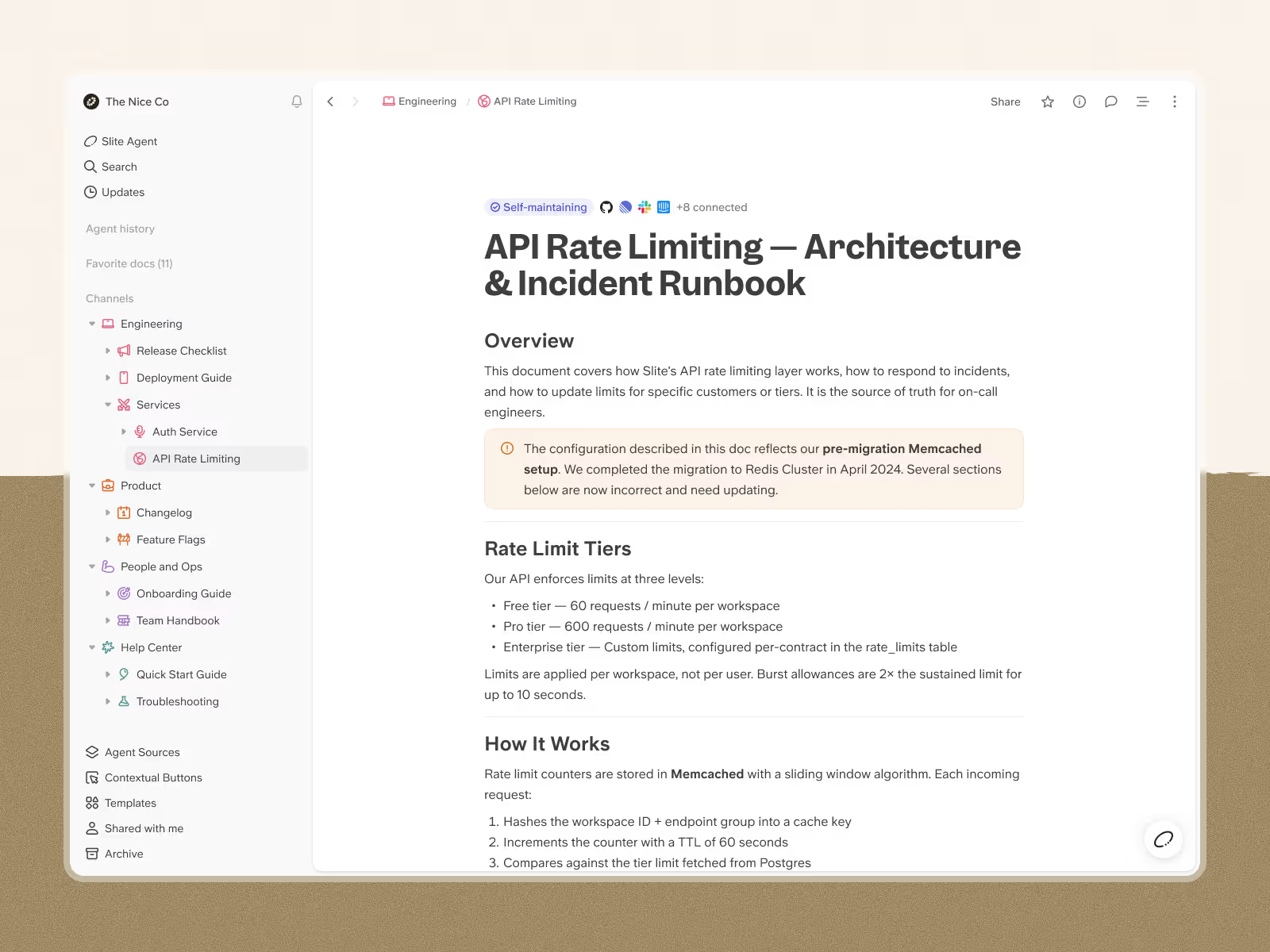
The output is a list of specific sections that no longer match a specific source, with a link to the source so the reviewer can verify. Doc-level alerts are too coarse here. The reviewer needs to know the third paragraph is the problem, not that something in a 2,000-word page might be off.
In Slite, AI search handles the ingestion and keeps the index fresh, and Slite Agent runs the comparisons on all three triggers.
Draft what the new version should say
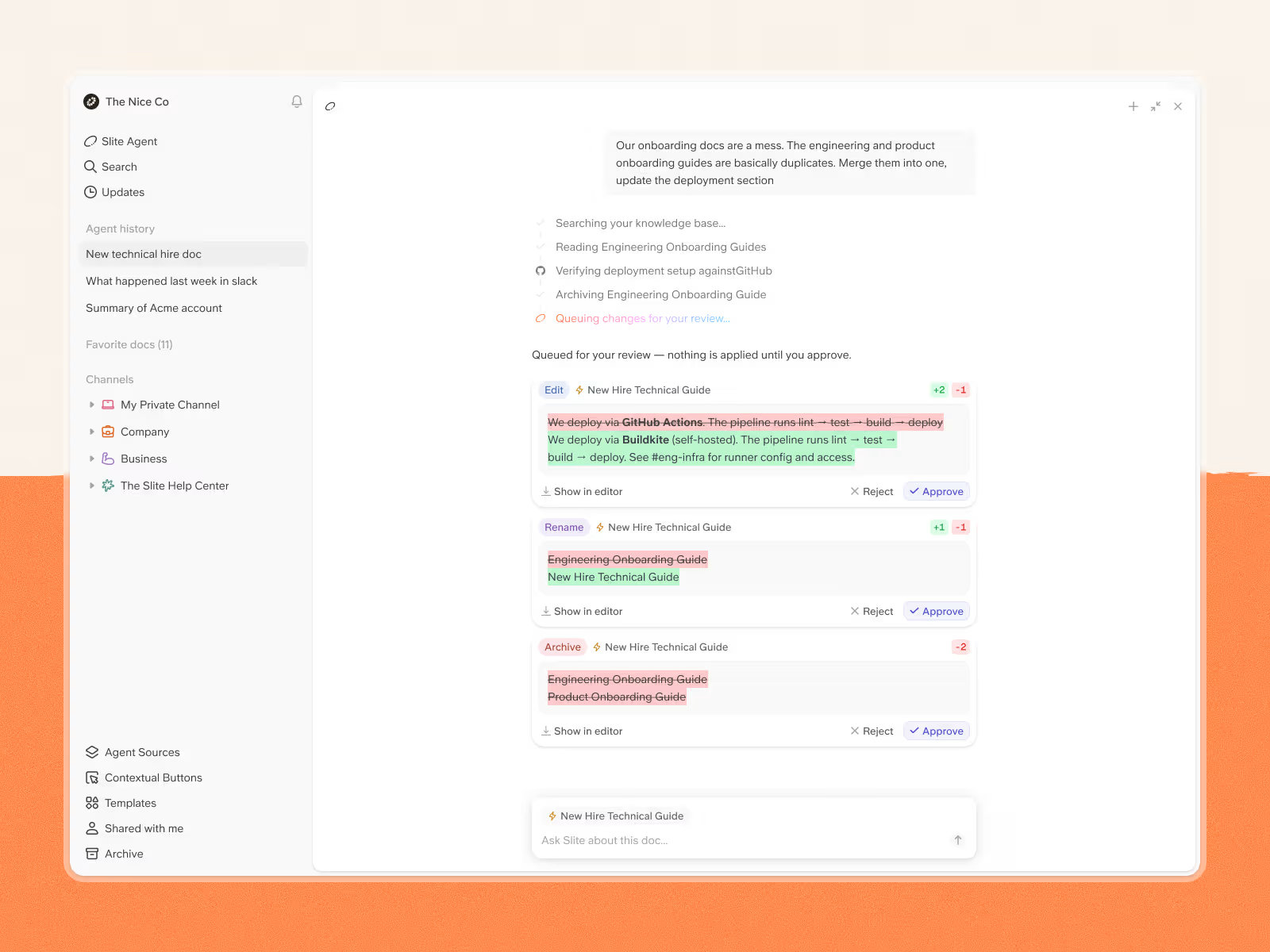
The agent should hand the reviewer a redline, not a to-do. That means three things:
- A unified-diff view, so the reviewer sees what changed in one glance.
- A one-line rationale per edit ("Slack thread on Nov 3 says we now refund within 14 days, not 30"), so they see why.
- An agent callable from wherever the team already works, not only from inside the wiki UI.
If the only way to invoke the agent is to log into the wiki, maintenance is yet another tab to remember. If it's callable from Slack, an IDE, an MCP client or the API, it folds into the work the reviewer is already doing.
Slite Agent drafts changes as unified diffs adapted for the rich editor, with a rationale per edit, and can be called from inside Slite, Slack, Claude, any MCP client or the API.
Give every change a place to land before it ships
Shared docs need a review queue. Auto-apply belongs in personal tools.
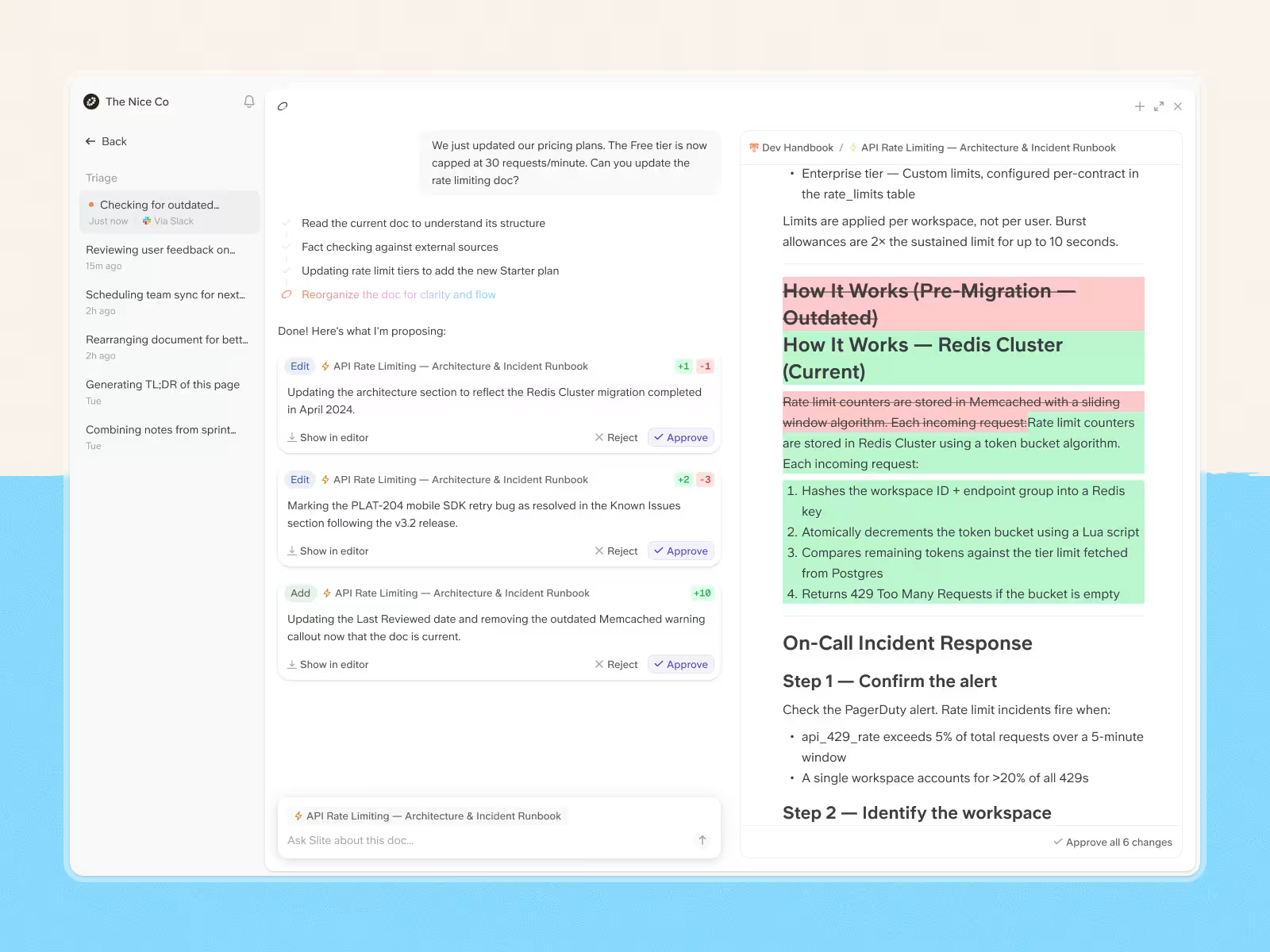
The queue has to handle two shapes of change:
- Single-doc edits, where one paragraph in one page needs updating, get reviewed inline.
- Bulk changes, where one process change ripples across 20 or 30 docs, get reviewed like a single pull request. A reviewer asked to approve the same change 30 times will rubber-stamp it by edit five.
Permissions have to hold throughout. The agent inherits the requesting user's access, no more, no less. An agent that can see docs your interns can't is a governance hole.
The queue should also route by ownership. Engineering's docs don't show up in Sales' queue. The reviewer for a doc is the team that owns it.
Slite Agent ships with a triage view for bulk and per-doc review, an agents-as-users permission model, and queue routing by ownership.
Check the same docs again next month
A doc that's correct today drifts tomorrow, so approved docs have to be re-checked on a cadence, against the same source channels they were originally cross-referenced with.
The shape of the work changes over time. The first round of review takes ten minutes, the second five. By the tenth, the wiki stays current largely on its own and the human's role has shifted from drafting to triage.
The anti-pattern to avoid is a "verified forever" badge with no expiry.
In Slite, approved docs get a self-maintained status that puts them on a recurring re-check against their original source channels, with the agent re-running the same comparison automatically.
How to evaluate a self-maintaining knowledge base
Five questions separate a self-maintaining knowledge base from AI search dressed up in agent language. Each one catches a specific failure mode.
- Does the agent write, or only read? Catches detection without action. If the tool can answer questions but can't propose edits, it's AI search. Drift accumulates anyway, and the team's workload shifts but doesn't shrink.
- Does it auto-ingest from connected sources, or only look inside the wiki? Catches the no-ingestion failure mode. Drift lives in Slack and GitHub before it reaches the wiki. A tool that only checks "this doc was edited 90 days ago" is doing expiry, not detection.
- What's the default: auto-apply or human review? Catches action without control. In a shared KB, auto-apply is a red flag. Ask vendors what happens when the agent gets it wrong.
- Are agents treated as first-class users with permissions? Catches the governance hole, which matters for knowledge base security. The agent should see only the documents the requesting user has access to.
- Can you call the agent from anywhere: Slack, Claude, an MCP client, the API? Catches the locked-in-the-wiki failure mode. A self-maintaining KB has to live where the work happens, or the loop breaks.
Do you need a self-maintaining KB in the first place?
If your team has more than one tool where knowledge lives, more than one person responsible for keeping it accurate, or any AI agent that reads your docs to do its job, then yes. Each trigger shows up at a different stage of company growth.
- More than one tool where knowledge lives. Slack threads, GitHub READMEs, Notion pages, Google Docs, Intercom macros. Once knowledge lives in more than one place, drift between them is automatic. A self-maintaining KB keeps them reconciled, so you stop paying for the drift in every onboarding, every audit and every "wait, where did we land on this?" thread.
- More than one person responsible for keeping it accurate. Single-owner wikis stay current because one person feels the pain. Once ownership is shared or fuzzy, maintenance becomes everyone's job and therefore no one's. The agent picks up the slack that diffused ownership creates.
- Any AI agent that reads your docs to do its job. A support bot, a sales copilot, an onboarding assistant, an internal HR helper. Once an agent is downstream of the KB, stale docs stop slowing humans down and start mis-training agents at scale. The bar for accuracy goes up whether you raise it deliberately or not.
If even one of these describes your team, you're already paying the cost of not having a self-maintaining KB.
Final thoughts
A self-maintaining KB is the source of truth your agents need for context and SOPs. Every support bot, sales copilot, internal HR assistant and onboarding helper in your stack reads from it directly or indirectly. Every agent downstream of an accurate wiki is more accurate than every agent downstream of a stale one, and the effect compounds in your favor or against you.
It's also better infrastructure for humans. The KB owner stops doing the half-day upkeep project nobody volunteers for. Maintenance becomes a 10-minute review queue. Trust in the wiki rebuilds because the wiki stays current, and the team stops routing around it.
If you want to see what that looks like in practice, take a walk through Slite Agent with us.
FAQ
What is the difference between an agent and an assistant?
Agents act, assistants answer. The practical test is whether the tool can take an action that affects shared state. An assistant tells you the refund policy. An agent updates the refund policy doc when it changes in your support workflow.
Can the agent update docs automatically without human review?
In Slite, no, by design. Errors in shared KBs cascade to every reader and every downstream agent, so a human approves every change. Auto-apply is appropriate in personal contexts, such as a coding agent in your own repo, and the wrong default in shared knowledge.
We compare the main documentation automation tools and where each fits in a separate guide.
How do you detect knowledge drift?
By cross-referencing docs against connected sources (Slack, GitHub, Linear, Intercom, Google Drive). When the wiki contradicts the source channels, that's drift. Continuous monitoring beats date-based expiry, because expiry tells you a doc is old, not whether it's wrong.
Does a self-maintaining knowledge base replace my existing wiki?
No. It sits on top of your knowledge base. In our case, Slite is the system of record, AI search handles retrieval and ingestion, and Slite Agent is the maintenance layer. You keep your structured, permissioned KB and add the loop that keeps it accurate.