You have seen the term 'Company Brain' by now.
It showed up in a VC essay, then in a viral repo, then in a Y Combinator request for startups, and now it sits in half the AI threads on your timeline. Somewhere between the fifth post and the tenth, you probably nodded along without being able to say what it actually is.
That's why, for some people, a Company Brain means a context graph, a connected map of everything a company produces. For others it means enterprise search with better manners.
For others it means a self-updating wiki, the company version of what Andrej Karpathy built for his own reading, or what Garry Tan open-sourced as GBrain. Each of these is a real piece. None of them is the whole thing.
In this article we'll try to give you a rundown of what it is, where it came from and why everyone wants one.
Our company brain statistics show 70% of teams know the term while only 20% have one.
Key takeaways
- A Company Brain is a persistent context layer that gathers knowledge from wherever a company creates it and makes that context usable by both people and AI agents.
The practice of assembling that context for a model is context engineering.
- It matters now because agents changed the stakes: people can work around missing context, but agents only know what you hand them and forget between sessions, so context sprawl went from a nuisance to a dependency.
- The term converged from several threads in about a year: the personal "second brain," enterprise search, Foundation Capital's context graphs (December 2025), Karpathy's LLM wiki, Garry Tan's open-source GBrain, and YC's Summer 2026 Request for Startups.
- It is its own category, distinct from enterprise search and from a chatbot bolted onto a wiki. Its real job is capturing the "why" behind decisions rather than only fetching documents.
- Personal and Company Brains split on ownership: a personal brain serves one person, while a Company Brain adds permissions, governance, conflicting sources, and shared trust.
- Choose a personal or open-source tool when the memory is yours or your team is small and close-knit; choose a managed Company Brain like Slite when access levels differ, sources disagree, sensitive data is involved, or agents can take actions.
Company brain - the working definition
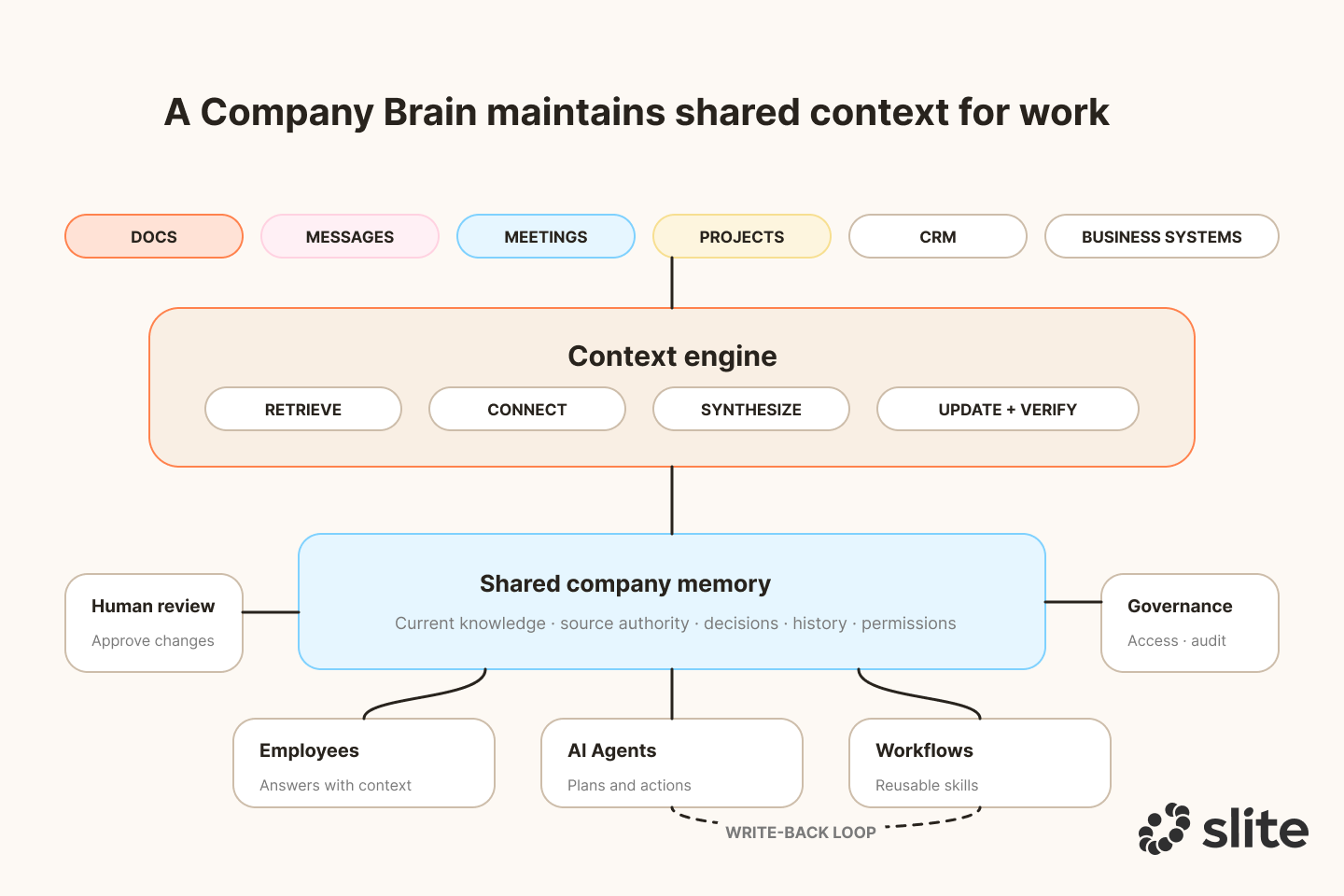
A company brain is a persistent context layer. It gathers knowledge from wherever a company creates it, and it makes that context usable by both people and AI agents.
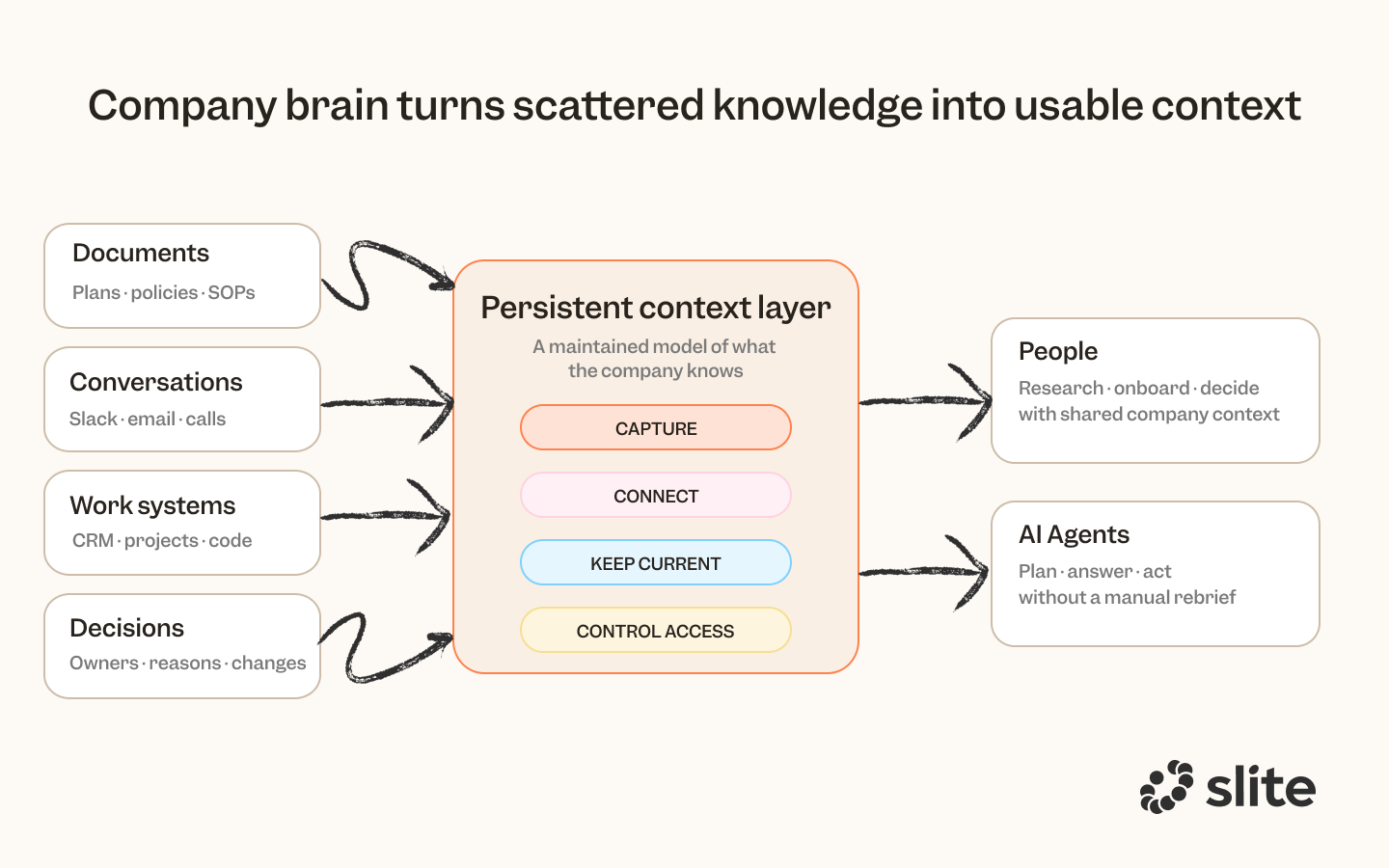
The problems underneath are old and unglamorous:
- Information scatters.
- Institutional memory walks out with people.
- Documents go stale and nobody notices.
This creates context sprawl but humans have always been able to work around it.
But over the last year, what changed is who needs the answer.
People are excellent at working around missing context. You ask the person next to you.
An agent does none of that. It only knows what you hand it, and it forgets between sessions unless something remembers on its behalf.
So a nuisance became a dependency the moment people started briefing agents to do real work.
A company brain supposedly solves context sprawl by giving agents every piece of relevant information about your company.
Where did the company brain come from?
Before anyone used the phrase, two separate desires had been sitting in the market for years, each with its own audience, its own tools, and no real reason to meet.
Emergence of a Second Brain
People wanted to keep what they read, learned, made, and noticed. Tiago Forte most visibly popularized the modern second brain method, and a whole generation of note-takers built systems around it.
But the deeper promise was quieter and more emotional. If you captured enough of your own thinking and connected it well, you might finally see the shape of your own mind from the outside.
Then came Enterprise Search in the late 2010s
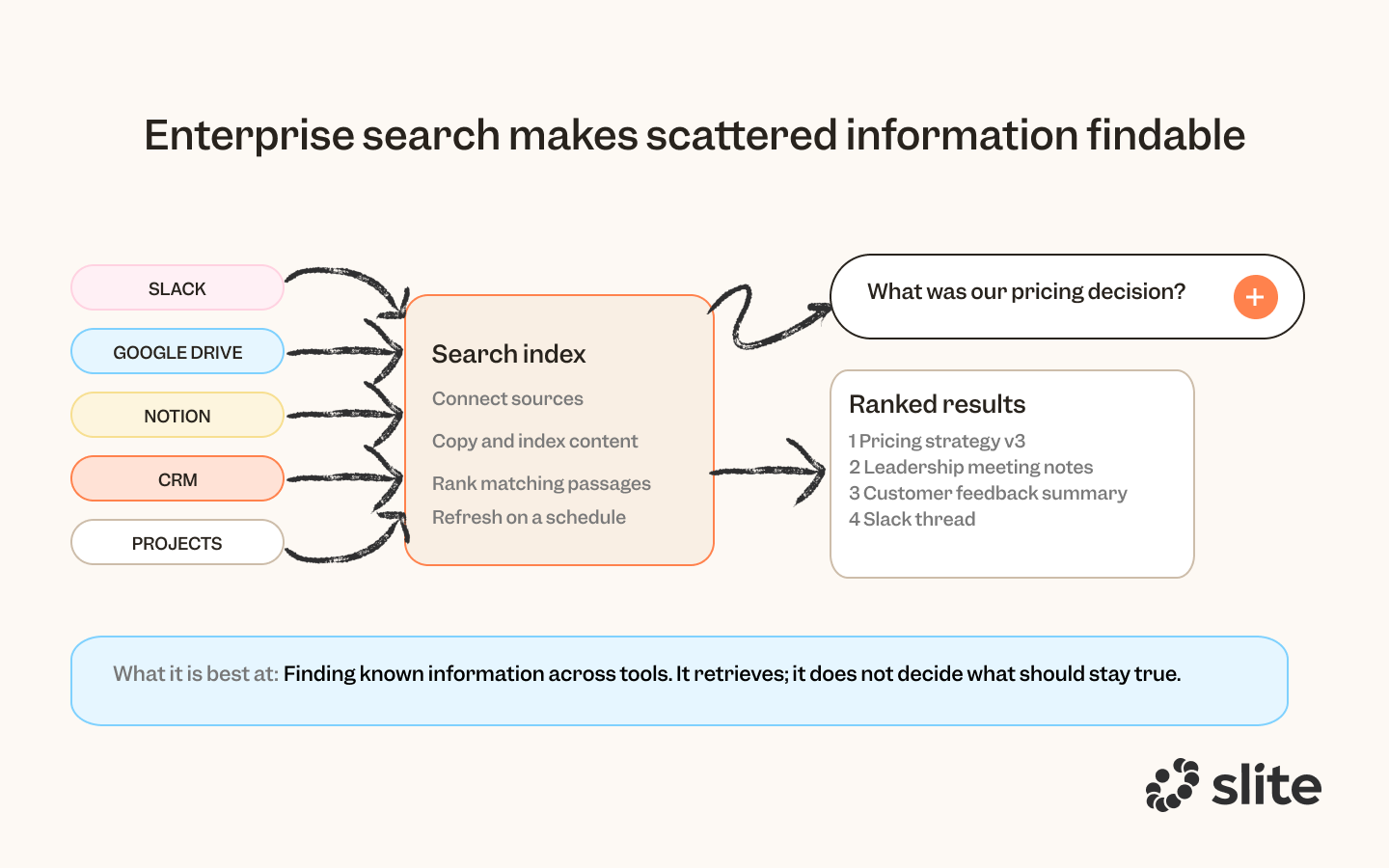
Companies had scattered information long before they had AI. The same five questions got asked in every new-hire onboarding. Enterprise search was the answer and it made things findable across tools that had no interest in talking to each other.
What it never did was maintain anything. It fetched. It did not keep an up-to-date model of how the company works, and it certainly did not hold that model in a form another system could act on.
So one desire was about a person's memory, and the other was about a company's access. They stayed separate because nothing forced them together. Then, over roughly a year, four things happened that did.
In 2025, a VC firm coined Context Graphs
On December 22, 2025, Jaya Gupta and Ashu Garg at Foundation Capital published a piece arguing that context graphs were an enormous opportunity. The framing that mattered went beyond "store more company data": most systems only keep one part of a bigger project, and none of them together form the context of why something happened in the first place.
For example, let's say you start a new marketing project from a water cooler chat with your manager.
- Its proposal doc will be in Slite
- Its progress will be in Notion, ClickUp, Asana
- Its working assets will be in Figma and Google Docs
- Its tracking will be in BigQuery and Google Analytics
An AI could fetch those things, but it can't fetch the watercooler chats or the Slack threads where big decisions actually happened during the execution.
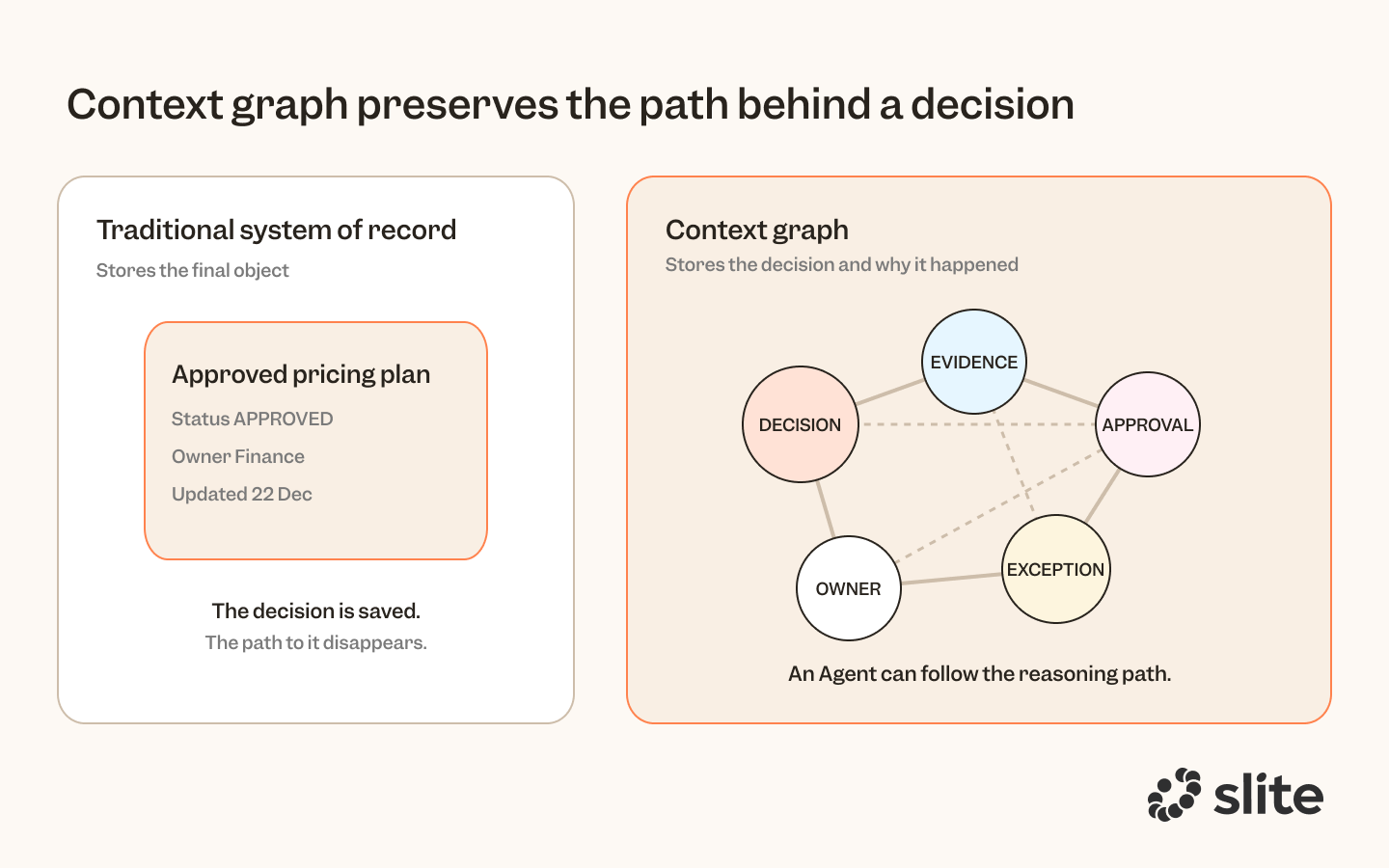
So, Jaya and Ashu argued that companies needed a Context Graph that stitches your information to infer the context of why you did something and why you chose to do it that way. If Agents don't have those as empirical evidence, they'd never be able to make the same considerations while planning/ideating that your team does.
Andrej Karpathy proposed an LLM wiki
In April, Karpathy proposed a persistent layer sitting between raw sources and retrieval, where a model continuously reads what comes in and synthesizes it into an interlinked, navigable set of pages. He framed it across personal reading, research, and business use, which quietly signalled that the same machinery worked at any scale.
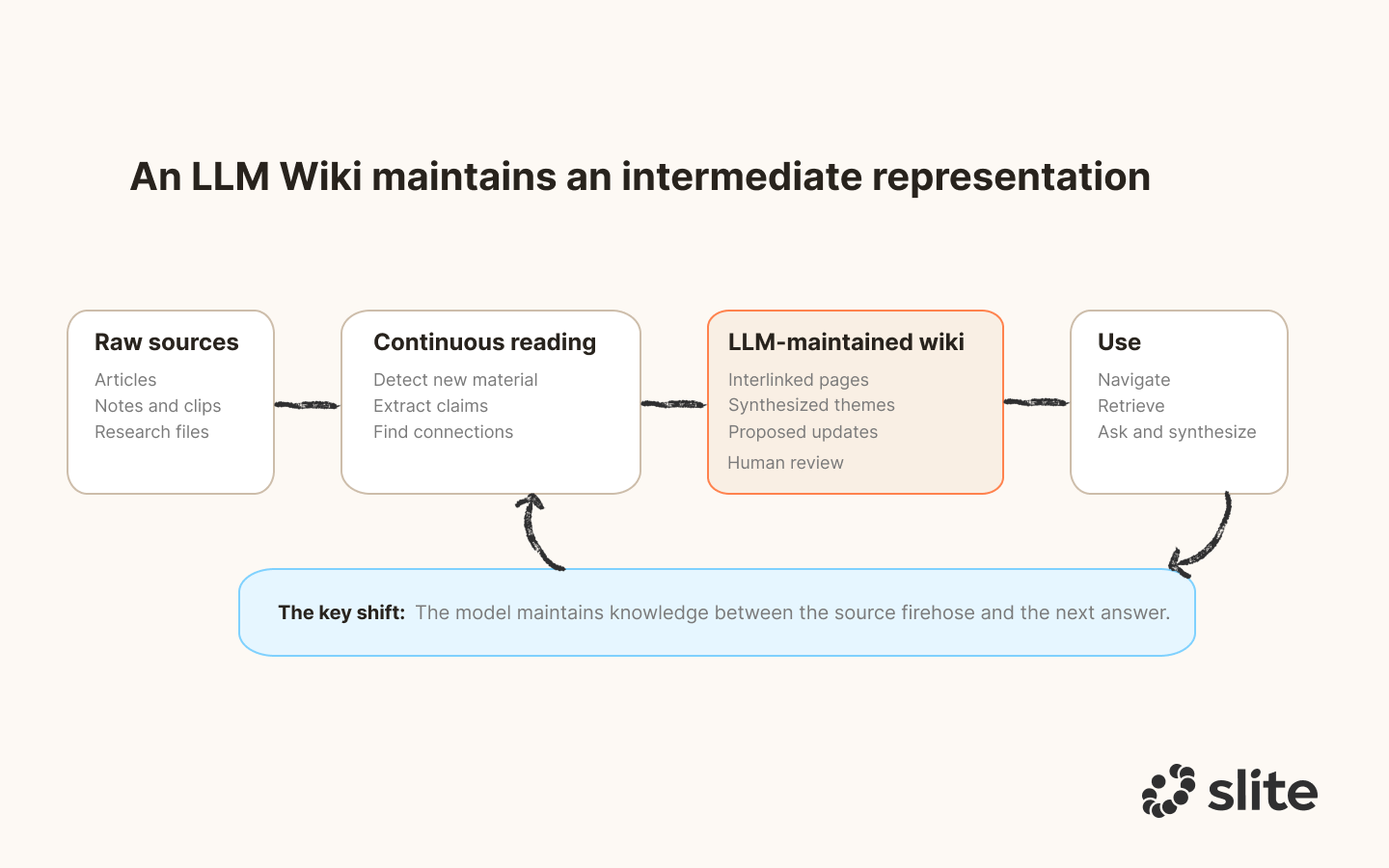
It made an abstract idea concrete enough to build against, and it prompted experiments.
→ Read more: LLM Knowledge Base: How to Build One That Actually Works (2026)
Then came GBrain
Garry Tan built GBrain to serve his own agents, feeding it meetings, emails, and whatever else crossed his day, so that the agents working on his behalf had something to work from. It ingested, enriched, consolidated, and kept going while he wasn't watching.
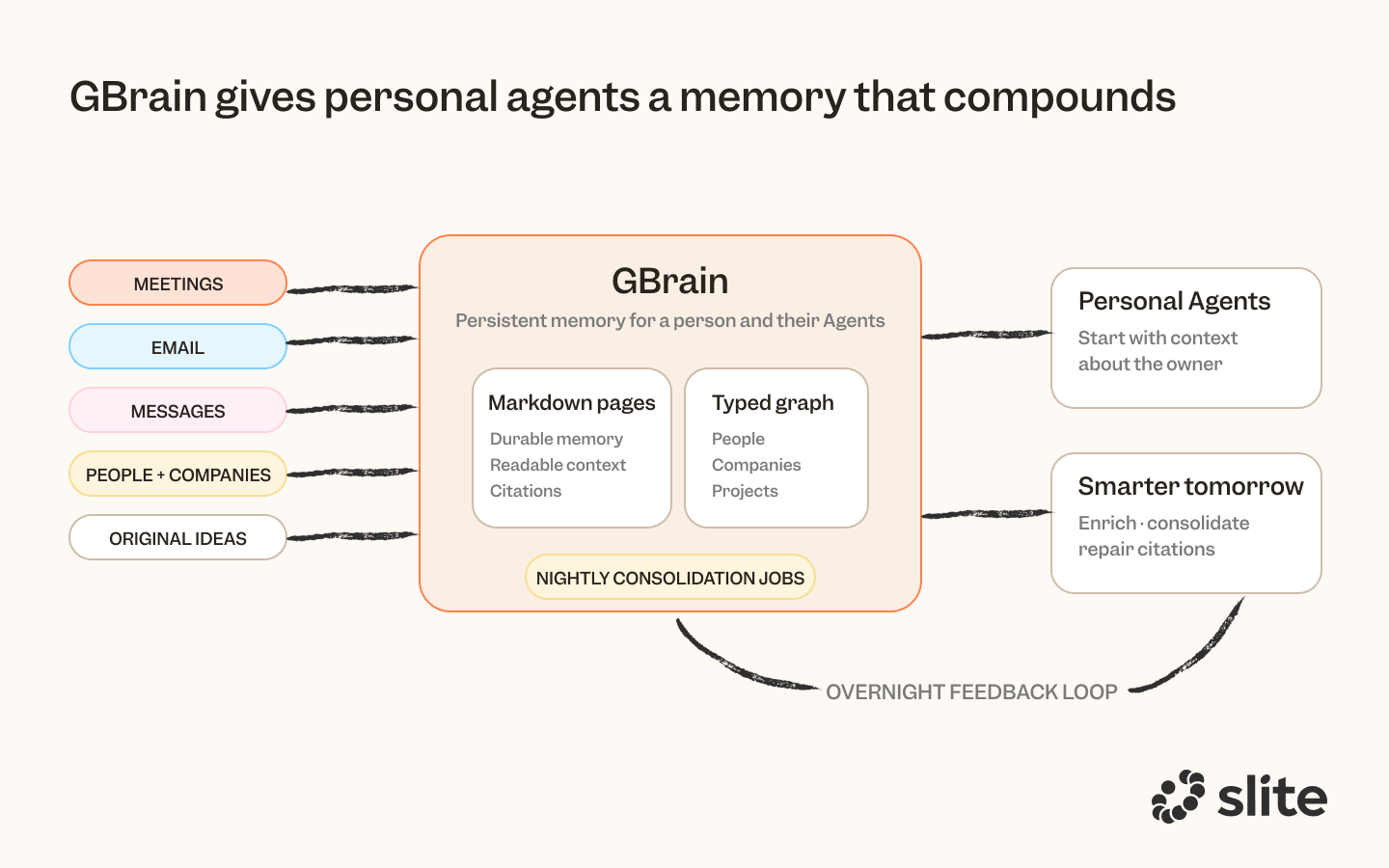
As an open-source implementation, it made persistent memory for an individual and their agents into something you could read, run, and argue with. The project later expanded to support company-brain use cases.
YC's RFS consolidated the above into a Company Brain
Y Combinator's Summer 2026 Request for Startups included an entry by Tom Blomfield titled Company Brain, which cited GBrain directly and asked for "Garry's G-Brain, but for every business in the world."
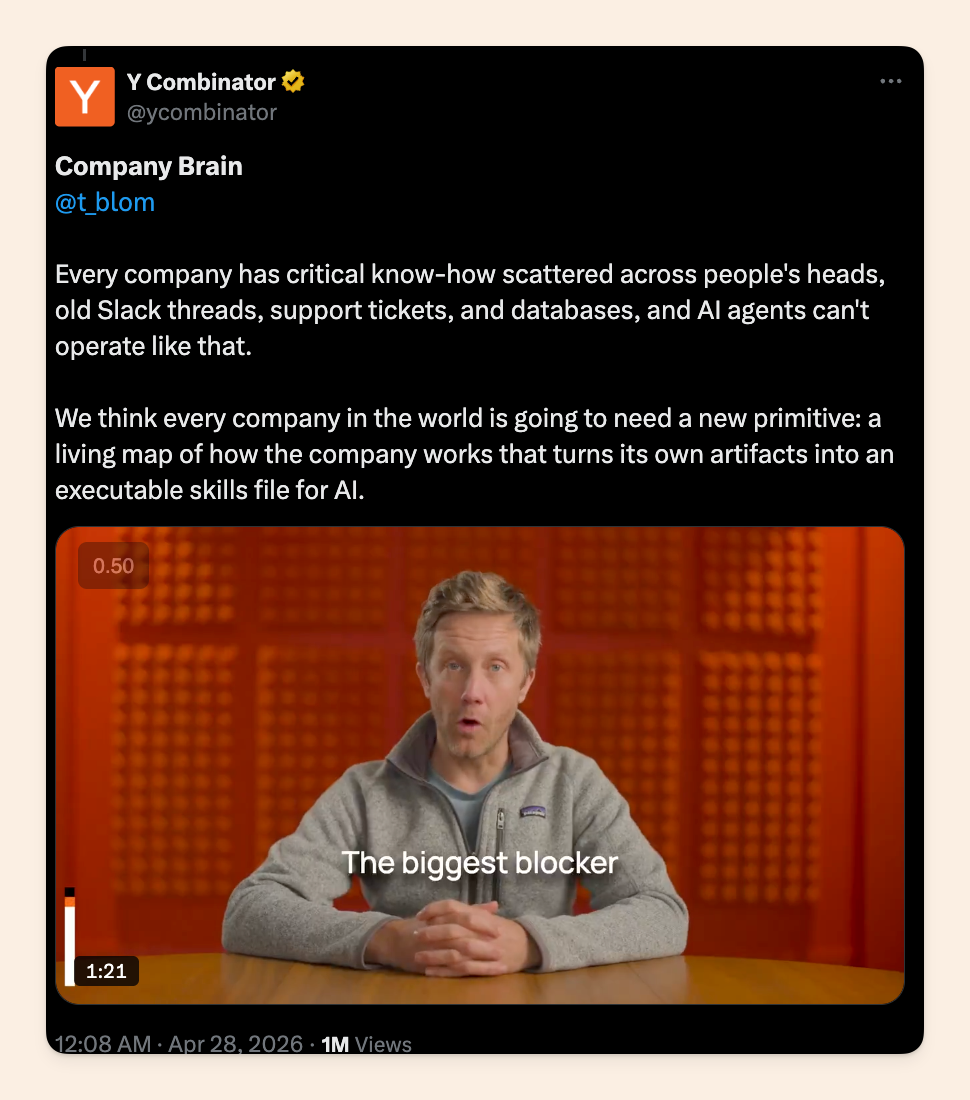
The entry also said plainly what the category is not: company search, or a chatbot bolted onto a wiki. The entry explicitly observed, and correctly inferred, that a Company Brain is a new category with its own challenges and needs dedicated efforts to build.
Personal memory supplied the ambition of a system that reads and synthesizes on your behalf.
Enterprise knowledge supplied the scale and the unglamorous problems.
Decision context supplied the thing worth storing.
Agents supplied the consumer, the reason any of it now has to be machine-readable and current rather than merely searchable.
Why does everyone want a brain?
The pull comes from two directions at once, so it helps to separate what companies actually want from why the personal version feels so exciting.
What companies want
Companies want context to persist between sessions, transfer to new employees and Agents, reveal connections across teams, and stay useful without someone constantly cleaning a Knowledge Base.
All these needs point to the same outcome. Company context should persist, travel, and improve.
Why personal brains feel exciting
A personal brain promises that everything you have read, written, watched, highlighted, or briefly obsessed over can be gathered and connected. You would finally have your own Tower of Babel, with every floor built from something you once consumed or created.
It helps you remember, but the deeper appeal is being able to see yourself from the outside.
Until recently, building this structure meant choosing folders, adding tags, creating links, and maintaining the system yourself. LLMs changed that bargain. They could read what you consumed, connect it, summarize it, and maintain the structure on your behalf.
The second brain stopped looking like a filing habit and started looking like software that could think alongside you.
Where personal and Company Brains split
A Company Brain inherits the promise of persistent memory, then makes it operational. It must map what an organization knows, brief employees and Agents, respect permissions, resolve conflicting sources, and account for decisions that change over time.
Before you jump into deployment or top 10 lists, it's worth mulling over the details and understanding whether you really want a company brain for your team or just care about a personal brain.
| Personal brain | Company Brain | |
|---|---|---|
| Who it belongs to | One person | A team or company |
| What it contains | Notes, reading, ideas, emails, and personal files | Documents, conversations, meetings, projects, customer data, and company tools |
| What it helps with | Recall, synthesis, and self-understanding | Shared work, onboarding, decisions, and automation |
| Who decides what is true | You | Multiple owners and sources |
| Who can access it | Usually only you | Employees and Agents with different permissions |
| What maintains it | Your preferences and habits | Company rules, owners, and automated systems |
| What happens when it is wrong | You receive a bad answer | Incorrect context can affect an entire workflow |
| What matters most | Personal usefulness | Accuracy, access, governance, and trust |
If the knowledge belongs to you and a mistake only inconveniences you, you probably want a personal brain.
Once that context must be shared, permissioned, maintained, and trusted by other people or Agents, you are building a Company Brain.
Which one do you need?
Start with where the context needs to travel.
We compared ten real company brain solutions, from open-source repos to managed products, if you want to see the options side by side.
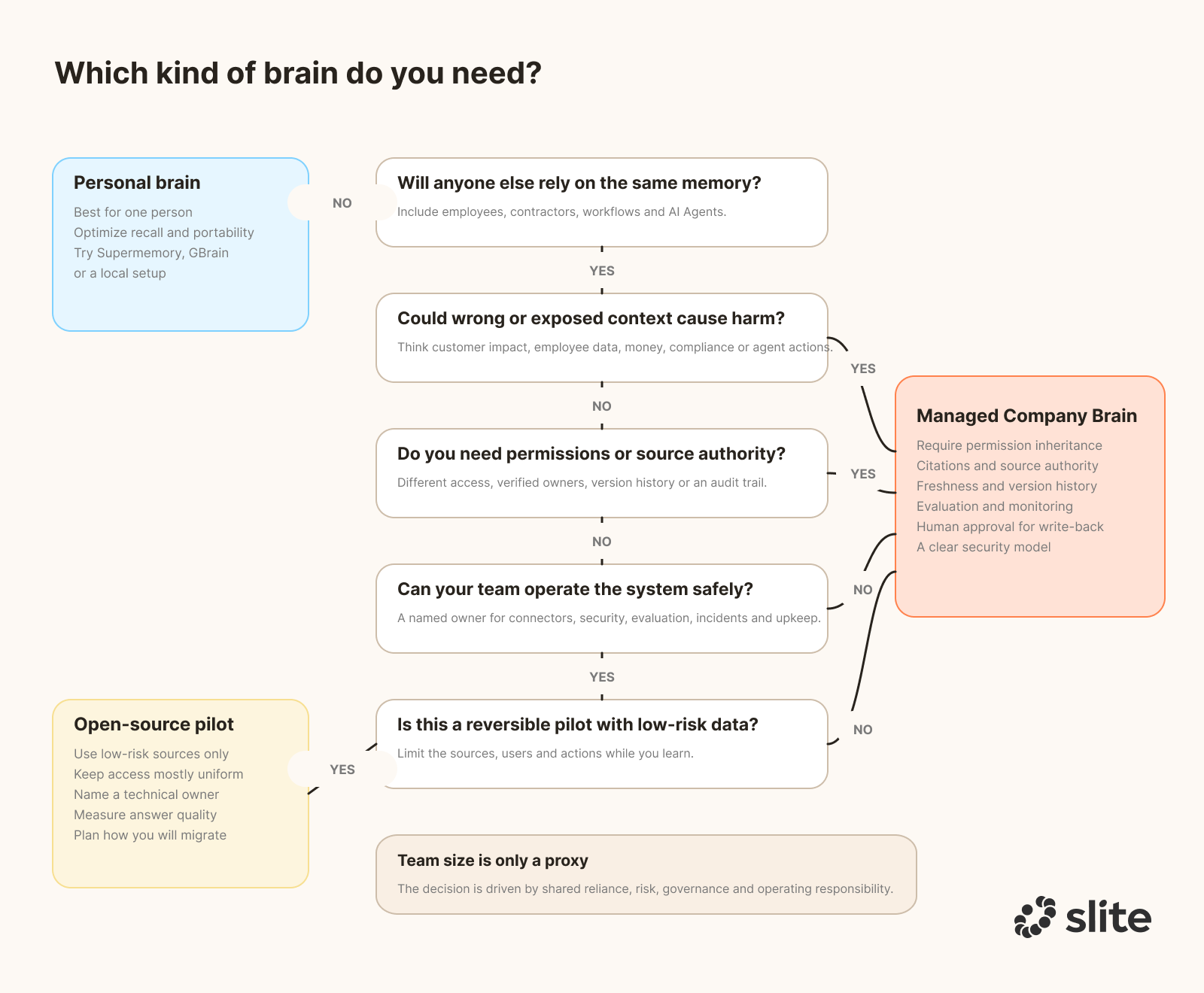
Choose a personal brain when the memory belongs to you
If you want to connect your notes, reading, meetings, and ideas, start with a personal tool.
Supermemory, GBrain, and similar open-source projects can help you build persistent memory without introducing company-wide permissions or governance.
The main question is whether the system fits how you consume and create information.
Consider open source for a small, close-knit team
An open-source Company Brain can work when your team is small, most people can access the same information, and someone technical can maintain the system.
This is a reasonable path for a ten-person startup operating as one unit. It becomes less comfortable when customer data, employee information, or different access levels enter the system.
Open source does not remove the security and maintenance work. It transfers that work to your team.
Choose a managed company brain when context becomes infrastructure
A dedicated company brain, like Slite, is useful when different people and Agents need different access, sources disagree, or company knowledge must remain current without a founder maintaining it.
It should also become the default when the system handles sensitive information or supplies context to agents that can take actions.
Slite Agent is built for this path. It gives teams a governed place to maintain company knowledge and make it available to both employees and Agents.
If you're looking to deploy something for your growing team with such fundamentals taken care of from day 1, book a demo to chat with us.