Someone on Reddit asked the quiet part out loud: Is "single source of truth" a clichéd term?
On reading through the thread and replies, I understood the frustration. The phrase has been used to sell data warehouses, wikis, cloud drives, dashboards, and CRMs. Almost every tool that wants to sound more strategic than storage promises to create one. Most teams have seen that promise fail.
But the slogan itself isn't the problem. If it were, I wouldn't be writing this article.
The problem is the common assumption that a platform can create authority when the organization has not decided where authority actually lives.
When Support answers from an outdated help doc, Sales answers from a deck, Product answers from a recent Slack thread, the company still has knowledge. It just has no reliable way to tell which answer wins.
A single source of truth gives teams a way to verify the current answer. It shows where the answer lives, who owns it, when it was last reviewed, who can access it, and whether it is safe for people and AI agents to use.
Key takeaways
- A single source of truth gives each important fact one authoritative, governed place the team can trust.
- SSOT is a principle, and not a tool category. The product helps only after the team has decided where authority lives.
- A real SSOT needs four properties: authority, uniqueness, accessibility, and ownership.
- Teams lose trust when duplicate docs, stale copies, scattered tools, and tribal knowledge all compete for authority.
- A wiki becomes a source of truth only when knowledge is owned, verified, accessible, and kept in sync with the systems where work happens.
- AI makes an SSOT essential because agents can treat stale or conflicting knowledge as truth and repeat the wrong answer at scale.
- Slite helps teams create a practical SSOT through verified docs, permission-aware search, connected tools, ownership, and human-reviewed agent updates.
→ Need a knowledge base to serve as your single source of truth? Check out Slite.
What is a single source of truth?
A single source of truth is the authoritative place a team relies on for the current, trusted version of an important fact.
The idea comes from data architecture. Each data element should have one place where it is mastered, edited, and treated as authoritative. Other systems can reference that data, but they should not create competing versions of it.
That principle matters just as much for company knowledge. Every important policy, process, customer answer, metric, or decision needs one place that decides what is current. Without that authority, people choose the version that is easiest to find, newest-looking, closest to their team, or shared by the most senior person in the room.
Different types of truth usually live in different systems. The CRM may own customer records. GitHub may own code. Linear or Jira may own engineering work. A verified Slite doc may own a refund policy, onboarding guide, support process, or product positioning page.
The litmus test is: when two answers conflict, the source of truth decides which one carries authority.
What a single source of truth is not
The textbook version defines SSOT as one place where every fact lives, every system agrees, and every person follows the same canonical answer without friction.
Real companies are more distributed than that.
Truth often starts where work happens: in CRMs, tickets, pull requests, support macros, HR systems, finance tools, customer calls, and Slack threads. A wiki cannot natively hold every raw, dynamic fact without becoming a stale copy of the systems it was meant to clarify.
At Slite, we treat SSOT as an imperfect term for a real problem. The practical version is a governed layer that makes authority visible across the places knowledge already lives. It keeps durable knowledge owned, verified, and current. We call that "a single source of truth without the asterisk."
Single source of truth vs. system of record vs. single version of truth
These terms are related, but they solve different problems.
| Term | What it means | Example |
|---|---|---|
| Single source of truth | The principle or architecture: each important fact has one authoritative, governed place people trust. | A company knowledge base that points to the right source and keeps durable docs verified. |
| System of record | The authoritative system where a specific type of raw data lives and changes. | CRM for customer data, HRIS for employee data, GitHub for code, Linear/Jira for engineering work. |
| Single version of truth | A reconciled view, often used in analytics or reporting, where teams agree on one version of a metric or dataset. | A dashboard or warehouse view of revenue, pipeline, or product usage. |
| Canonical doc | A curated, human-readable page that explains a process, policy, SOP, or decision. | A verified onboarding guide, refund policy, security process, or product positioning doc. |
An organization can have many systems of record and still lack a usable source of truth. The CRM may be right about customer fields, GitHub may be right about code, and a dashboard may be right about revenue. The team still needs a governed layer that tells people which source has authority in each context.
Why teams need a single source of truth
We started Slite in 2016 to give teams a single source of truth. A decade of building for this problem has made one thing clear: teams know trusted knowledge matters. The hard part for many is keeping it current while everyone is busy doing the work the docs are supposed to support.
We hear that same hard part in prospect calls, just in more practical language: stale copies, version-control issues, scattered context, knowledge trapped in people's heads, and people losing days to the wrong guide.
Yes, the company still has knowledge. It just lacks clear authority.
It stops "which doc is right?" moments
One prospect described a classic example of this problem: an ICP profile had multiple versions in Confluence, and the team could not tell whether they had found the most recent one. The work had already happened. Someone wrote the doc. Someone updated a version. Someone probably discussed the change somewhere else.
The value disappeared at the moment someone needed to make a decision, because the system could not say which answer had authority.
A source of truth is useful because it settles that moment. It tells the reader which answer is current and which versions have been retired.
It reduces repeated questions and Slack fallback
When people do not trust the docs, they ask a person. The person answers quickly, which makes the workaround feel harmless. Then the same question returns next week, again during onboarding, and again when a customer escalates.
The business slowly turns its most experienced people into a help desk. That is how missing authority becomes tribal knowledge: the current answer lives with people, not in a system the rest of the company can rely on.
A real SSOT moves the answer out of people's heads and into a trusted system, so the expert only has to verify the answer once instead of repeating it every week.
It keeps duplicate docs from competing with the current answer
Duplicate docs are inevitable in a growing company. People copy docs to move faster, adapt them for a team, or preserve an old workflow. The source-of-truth problem begins when those copies remain searchable and unmarked.
One enterprise prospect described the problem exactly: "Duplicate documentation with 80% similarity exists without awareness of redundancy."
Two pages can say almost the same thing, but if no one knows they overlap, both continue to compete for attention.
A single source of truth fixes this by giving duplicates a lifecycle.
It protects teams from stale knowledge
Fiona, who works closely with our customer research, once shared a story about someone who followed an outdated guide and only realized halfway through that the process had changed. The cost was roughly two days wasted.
In a survey of 143 leaders, we found that 76% had seen an AI tool surface a stale doc and produce a wrong answer. Among respondents, 58% reported wasted time or rework, 41% said wrong information reached a customer, 40% saw compliance risk, and one in five saw direct financial loss.
A real SSOT closes that gap by tying trust to status: stale pages are reviewed, retired, or removed from retrieval before people and agents keep treating them as current.
What makes something the source of truth?
A doc, database, or tool earns the status of source of truth only when four properties hold: authority, uniqueness, accessibility, and ownership.
Authority
The source of truth must be designated as the place that decides the answer. If a Slack thread, deck, wiki page, and teammate's memory all carry equal weight, the company has references, not a single source of truth.
Uniqueness
The current answer needs protection from competing versions. That means merging duplicates, redirecting old docs, archiving dead pages, and marking stale material clearly enough that no one mistakes it for the answer.
Accessibility
The people and agents that need the answer must be able to reach it, without exposing knowledge they should not see. HR, finance, legal, security, and customer data still need permission-aware access.
Ownership/governance
Every important fact needs a named owner, review path, and lifecycle. A source of truth cannot be "verified forever," because verification only means something if someone is responsible for checking it again when the work changes.
A wise man once said: "Verifying something forever defeats the purpose of verification."
At Slite, we use the phrase "a green light on a ghost" for docs that still look verified after reality has moved on. The badge says current, but the process, policy, or product detail behind it is already dead.
How to establish a single source of truth
Building a single source of truth is a governance process. The tool matters, but the tool cannot decide authority for the team unless the team gives it that structure.
Designate the authoritative layer
Decide where each type of knowledge should live. Raw, dynamic data should stay in its system of record.
Durable, human-readable knowledge works best in a verified knowledge base: the policies, SOPs, onboarding guides, team processes, decision logs, and internal playbooks people need to understand how work gets done.
Assign single ownership
Every essential doc, process, or knowledge area needs one accountable owner. The owner does not have to write every word, but they are responsible for accuracy, review, and deciding when duplicates should be deprecated. Shared access without ownership is how knowledge drifts for months.
Make lifecycle and verification visible
Readers should not have to infer whether a doc is current. They should see whether it is verified, outdated, expired, or waiting for review. They should also know who owns it and when it was last checked.
Deprecate duplicates as an ongoing discipline
Duplicate cleanup is not a one-time project. Growing teams create duplicates by default, so the source-of-truth system needs a regular habit of redirecting, merging, archiving, or marking older versions clearly enough that they cannot compete with the current answer.
Design for access and permissions
A source of truth has to be accessible without becoming a security risk. Permission-aware retrieval matters because the right answer is only useful when the right person can access it, and restricted knowledge stays restricted. This is where knowledge base security comes into play: the answer should be easy to find without exposing information the reader should not see.
Building a single source of truth for AI agents
The steps above apply to agents too, but an agent reads differently from a person. It retrieves instead of browsing, it does not hesitate when two pages disagree, and it repeats whatever it finds at the speed of every request. Building a single source of truth for AI agents means making a few things explicit that human readers usually work out for themselves.
Give agents one canonical place to retrieve from. Scattered copies across drives, wikis, and old exports all look equally valid to a retrieval system, so duplicates have to be merged, redirected, or removed from the index rather than left quietly searchable.
Structure knowledge so retrieval returns the right chunk. Clear headings, one answer per section, and enough context inside each section stop an agent from assembling a confident answer out of half a policy.
Expose freshness and ownership as signals the agent can read, not just a badge a person notices. When an agent can see who owns a doc, when it was last verified, and whether that verification has expired, it can treat a stale page as unreliable instead of citing it.
Keep permissions attached to retrieval. An agent answering on a teammate's behalf should reach only what that teammate could open, so the same restrictions hold whether the question comes from a person or a workflow.
Taken together, these requirements describe the context layer an agent reasons from. Once it exists, correcting a wrong answer is a single edit to the canonical doc, and the fix reaches every person and every agent on the next retrieval instead of being patched tool by tool.
Why having a single source of truth is essential in the AI era
Before AI, bulk documentation still had a human buffer. People created messy docs, but people also read, questioned, and interpreted them before acting. If two pages had different dates, someone usually hesitated long enough to ask who owned the process or whether the policy had changed.
That buffer is disappearing. AI helps teams create more documentation than they can manually review, while agents also reference that documentation without the same hesitation.
A stale, duplicated, or conflicting page can now become one clean answer that sounds authoritative.
More than three in four surveyed leaders had seen AI surface a stale doc and confidently produce a wrong answer. The documents were not new. The difference was that AI removed the human hesitation that used to contain the damage.
This is why a single source of truth has become more essential. Agents need one authoritative source to reason from, and teams need a way to make stale or conflicting knowledge lose authority before it spreads through automated workflows.
How Slite helps teams create a practical single source of truth
Slite helps teams create a governed, searchable, verified entry point for company knowledge. The product is built around the same four requirements: authority, uniqueness, accessibility, and ownership.
Verified docs for durable knowledge
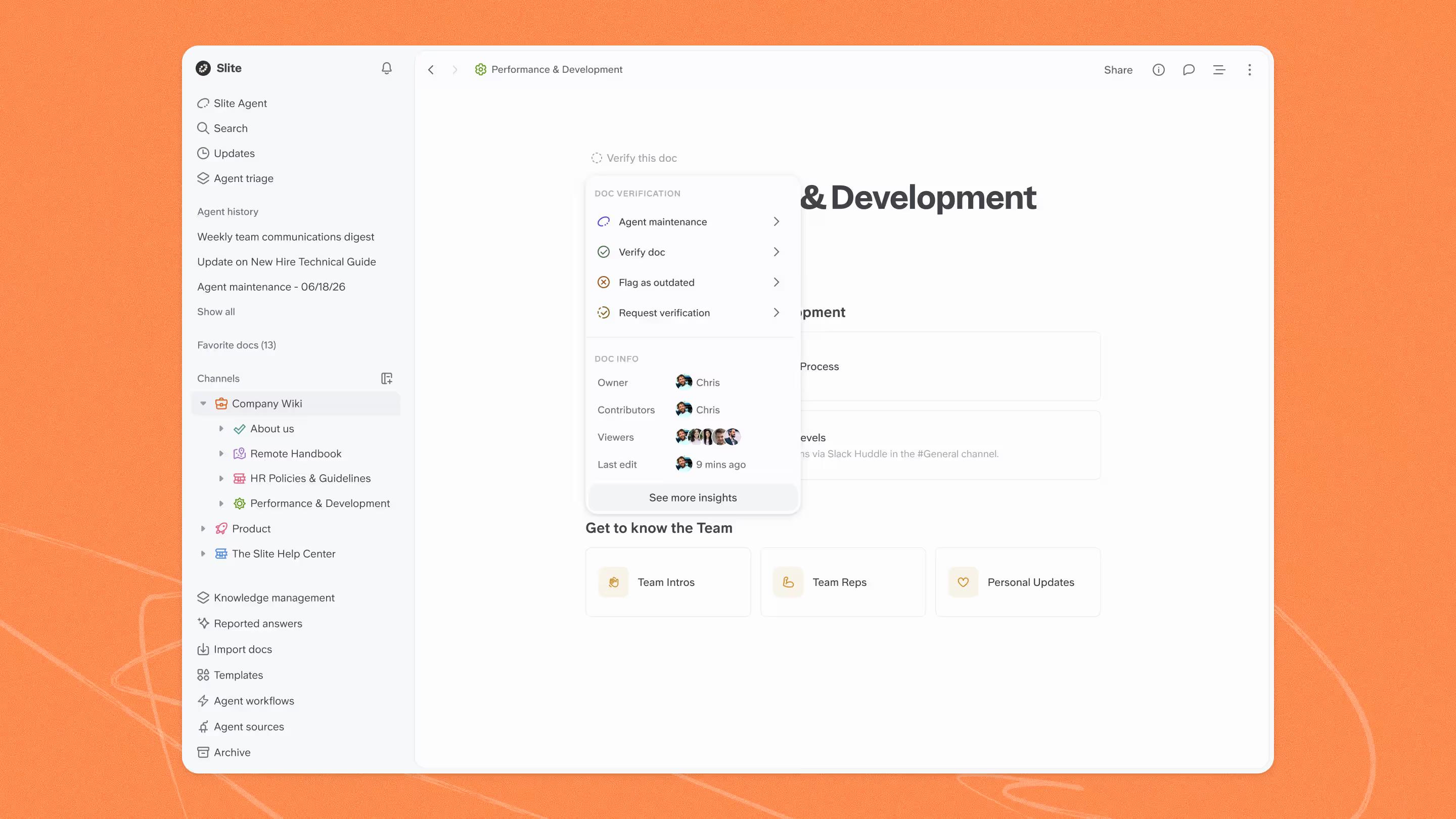
Slite can act as the trusted home for policies, SOPs, onboarding docs, team processes, product guidance, and other durable knowledge. Doc Verification gives readers a visible trust signal: verified, verification expired, outdated, or verification requested.
Connected tools for where work happens
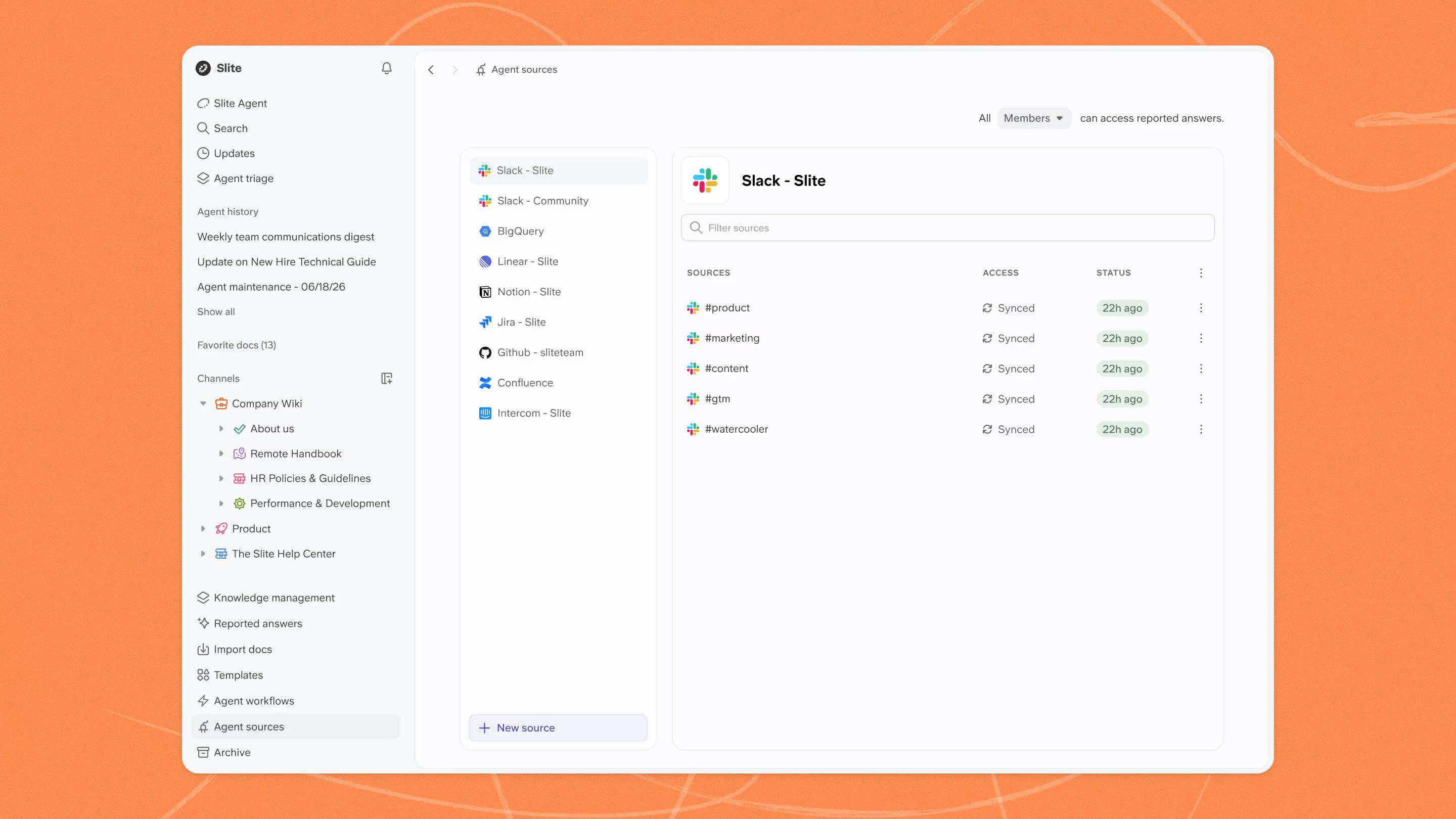
Work happens across Slack, GitHub, Jira, Linear, Google Drive, Intercom, and other systems teams already use. Slite connects to 20 tools so teams can search across knowledge while still respecting where each type of truth belongs.
Permission-aware search for trusted access
A useful SSOT has to protect sensitive knowledge. Slite's permission-aware search helps teams find answers without exposing restricted docs. If a teammate cannot access a source, their search and AI answers do not expose it either.
Ownership and governance for keeping truth current
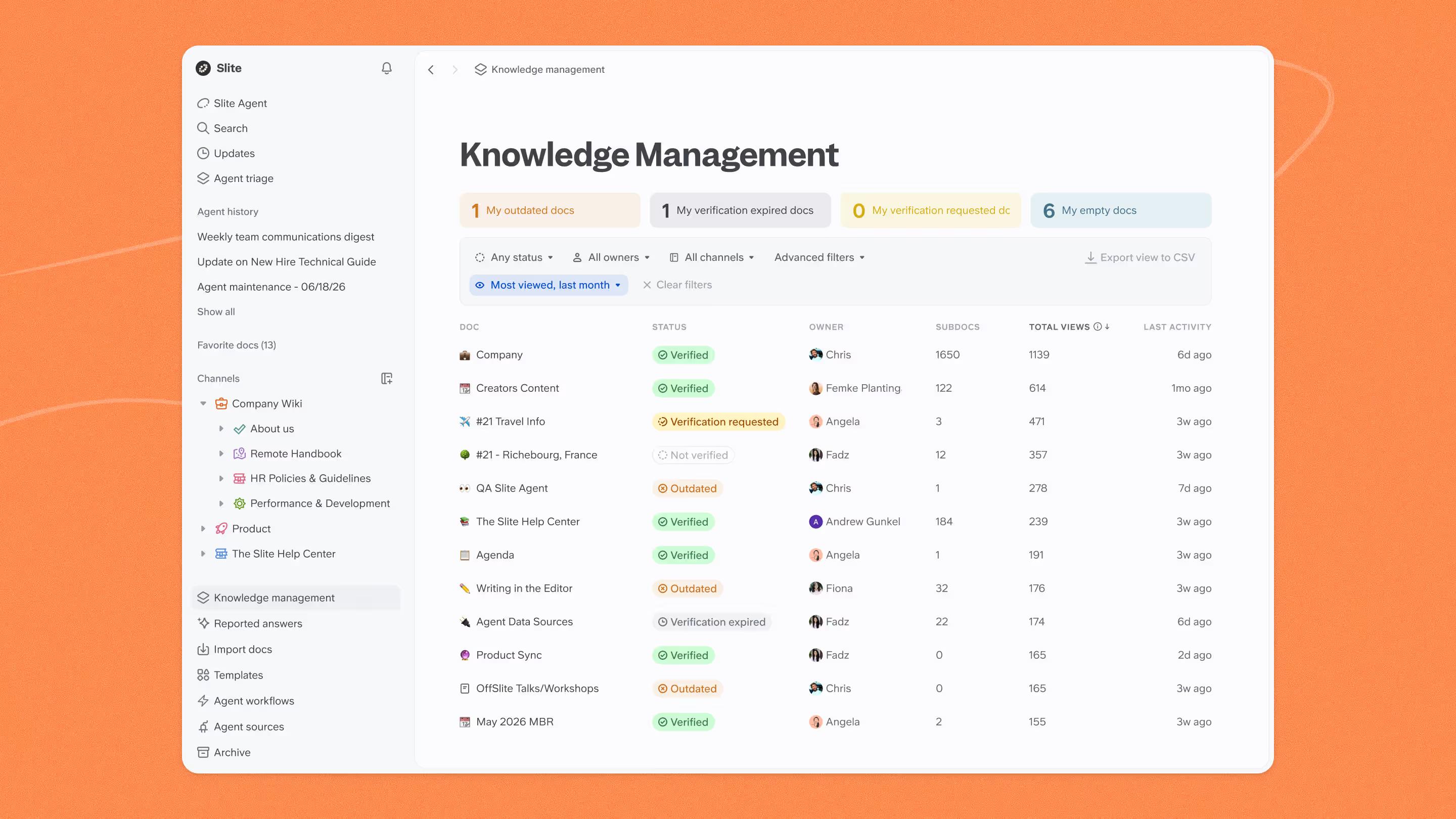
Slite gives every critical doc a clear owner, verification status, and review cycle. Maintenance becomes visible instead of dependent on one doc's admin chasing stale pages across the company.
Owners know what needs attention. Readers know whether a page can be trusted. The knowledge base becomes easier to govern because freshness is built into the way people use it.
Slite Agent for human-reviewed updates
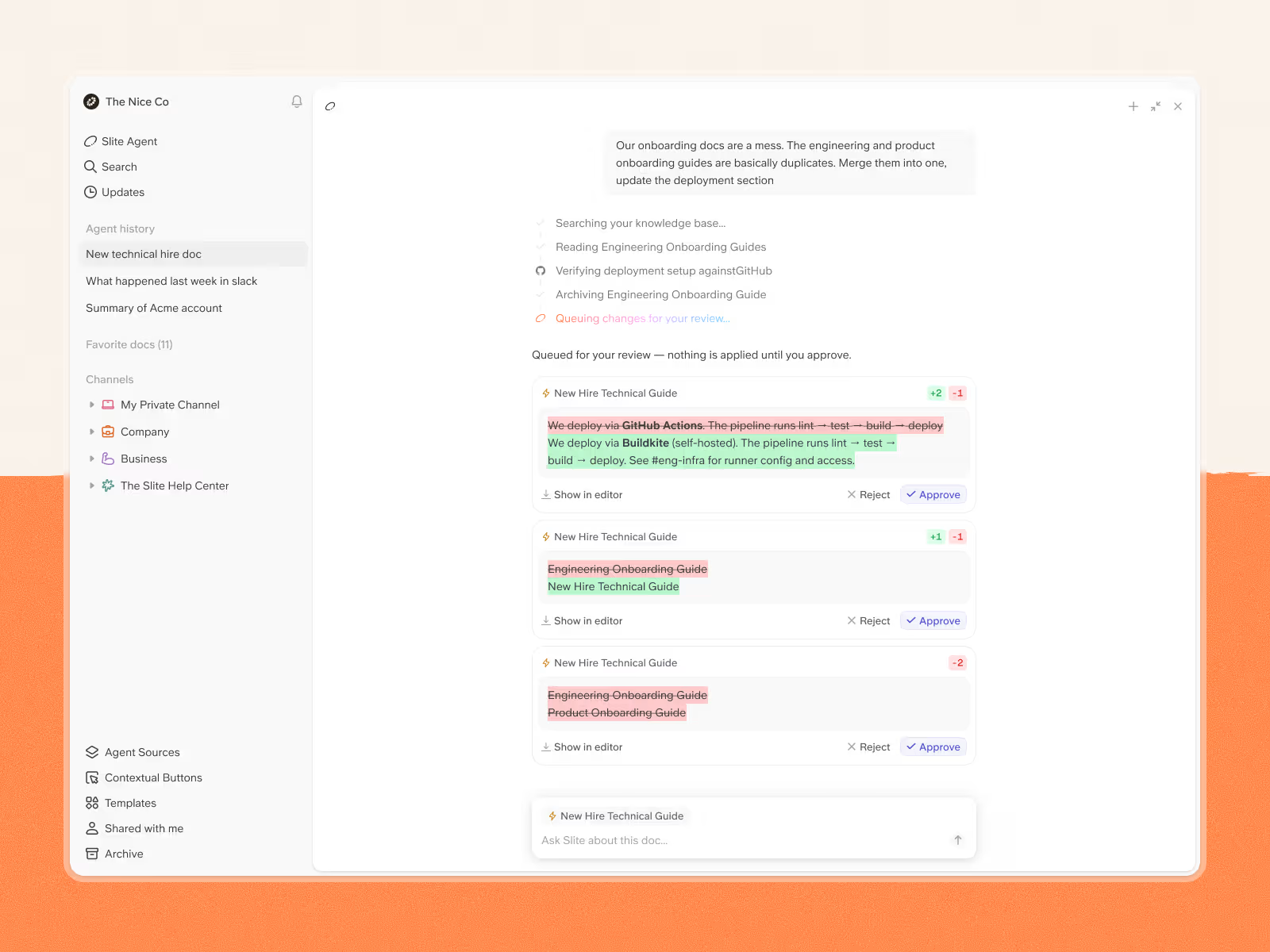
Slite Agent helps maintain the source of truth by finding knowledge drift, drafting updates, and sending proposed changes to the right owner for review. The agent can spot what changed and suggest the fix, while the owner keeps control over what becomes official.
Final thoughts
A useful single source of truth gives every important fact authority.
Someone owns it. Someone verifies it. Old versions are retired. Search respects freshness. People and agents can find the current answer without guessing which doc, thread, dashboard, or teammate to trust.
At Slite, this is the version we care about: a governed layer for company knowledge that stays connected, verified, and usable as the work changes around it.
If your team is trying to build that, book a demo. We'll show you how Slite helps your team build a practical source of truth across existing tools and docs, so trusted knowledge stays owned, verified, and current.
FAQ
What is an example of a single source of truth?
A practical example is a company knowledge layer that points people to the authoritative source for each type of information. The CRM may own customer records, GitHub may own code, and a verified knowledge base may own policies, SOPs, onboarding guides, and process explanations. The SSOT is the governed layer that makes those sources easy to trust and use.
What is the difference between a single source of truth and a system of record?
A system of record is the authoritative system for a specific type of raw data. A single source of truth is the broader principle or governed layer that tells the team which source to trust for each important fact. A company can have many systems of record and still need one source-of-truth layer that makes those answers usable.
Is a data warehouse a single source of truth?
A data warehouse can provide a single version of truth for analytics and reporting, but it is not automatically the source of truth for every operational fact. It may reconcile data for dashboards and metrics, while customer records, employee records, code, policies, and operational processes still live in other systems of record or verified docs.
How do you create a single source of truth?
Start by deciding where each type of knowledge should live. Then assign one owner, make review status visible, deprecate duplicates, and design access around permissions. Make authority clear enough that people and agents know which answer is current, safe, and owned.