A team removes an old approval step to speed up releases. Two months later, a customer contract breaks, and someone finally learns why the step was there. The process document still existed, but the reason behind it was institutional knowledge, and it had left with the person who set the step up.
People leaving is only one way that knowledge disappears. It also goes missing in reorganizations, acquisitions and tool migrations, when contracts end, when decisions stay in a Slack thread, and when documents slowly fall out of date. Most of these give no warning, so there's no exit interview to schedule.
Keeping institutional knowledge takes ongoing upkeep: an owner for each document, a date to review it, and a check whenever the source changes. We built Slite around that upkeep, and the practices below are ones any team can start on this week.
Key takeaways
- Companies lose institutional knowledge through seven routes: people leaving, reorganizations and layoffs, acquisitions, tool migrations, contractor exits, decisions that stay in chat, and documents that go stale.
- The cost is spread across many small delays, such as decisions argued again, slower onboarding and repeated mistakes.
- The written part of institutional knowledge is scattered across tools, and the unwritten part sits with a few people, so mapping both shows where the risk is.
- Keeping it depends on culture and strategy as much as tooling: people write down decisions with their reasons, and every document has an owner and a review date.
- AI initiatives inherit whatever state that knowledge is in. Agents answer only from what's written down, so missing or outdated institutional knowledge becomes confident wrong answers at scale.
What is institutional knowledge?
Institutional knowledge is everything an organization knows about how it works and why, whether it's written down or held in people's heads. It includes processes, customer history, exceptions, vendor and regulatory context, and the reasons behind past decisions. It builds up over years and is spread across teams, documents and tools.
In practice, it covers five kinds of knowledge:
- Decision rationale: why a policy, tool or architecture was chosen, and which options were ruled out.
- Customer and account history: what was promised to a client, what went wrong before and who the real decision-maker is.
- Process exceptions and workarounds: the steps people follow that differ from the official process, and the reason they differ.
- Vendor, contract and regulatory context: renewal terms, compliance commitments and the history of a supplier relationship.
- Who knows what: which person to ask about a system, a client or a past project.
Much of this is tacit, meaning people know it without ever having written it down.
Institutional knowledge is one part of a company's wider knowledge management.
How companies lose institutional knowledge
Companies lose institutional knowledge in seven main ways: people leaving or retiring, reorganizations and layoffs, acquisitions, tool migrations, contractor and vendor exits, decisions that stay in chat, and documents that go stale.
Some losses happen at one moment. Others happen gradually, which is why they often go unnoticed until someone needs the answer.
People leave or retire
Departures are the route most teams plan for, and the planning is still uneven. 92% of organizations don't consistently capture knowledge from employees who are about to retire.
When someone leaves, their documents usually stay, but their relationships and the reasons behind their past calls go with them. An exit interview template gives the handover a structure, and a knowledge transfer plan spreads the work over the weeks before the last day.
Reorganizations and layoffs
A reorganization breaks ownership first. Documents stay where they were, but the person who kept them current moved to another team or left, so nobody updates them anymore.
Layoffs also tend to remove several long-tenured people at once, with little or no time for a handover.
Acquisitions and merged teams
After an acquisition, two companies bring two wikis and two versions of how things work. Nobody is sure which one to trust, so people ask colleagues instead of reading either.
From our experience, merged teams often stop trusting the older wiki entirely, even though it still holds most of their history.
Tool migrations
Moving to a new tool usually carries the pages across and leaves the context behind. Exports tend to drop comments, linked threads and edit history, which is where the reasoning behind a page lived.
The old tool also tends to stay open after the new one goes live. The team then has two sources of truth, and links in one tool point to pages that moved or no longer exist.
Contractors and vendors
When a contract ends, the know-how the contractor built up goes with them. That includes how a system was set up, which workarounds keep it running and why certain choices were made.
If nobody inside the company owns that knowledge before the contract ends, nobody can explain the system afterward.
Decisions that stay in chat
Many decisions get made in a Slack thread or on a call, and the related document never changes. Months later, the outcome is visible but the reasoning can't be found, so the next person either guesses or starts the discussion again.
Documents that go stale
A document that's out of date still exists, but people stop relying on it. Once a team learns that a page might be wrong, they ask a colleague instead, and the page no longer works as institutional knowledge.
Documents fall out of date gradually as products and processes change. The risks of stale documentation grow when teams work in information silos and don't see each other's changes.
What losing institutional knowledge costs a company
Lost institutional knowledge costs time across the whole company, in small delays that rarely show up in one budget line. The costs add up in five places:
- Decisions get argued again, because nobody remembers why the original call was made.
- New hires ramp up slower, since the answers they need sit with a few people.
- The same questions land on the same people, who lose hours each week answering them.
- Mistakes repeat, because the fix existed once and nobody wrote it down.
- AI tools give wrong answers when the knowledge they read is missing or out of date.
Smaller companies often feel this most when their knowledge sits with a handful of founders or directors. When one of them is away, any work that depends on their memory waits until they're back.
Where does institutional knowledge live in a company?
Institutional knowledge lives in two places. The written part is spread across tools such as wikis, shared drives, chat, ticketing systems and CRMs. The unwritten part sits with people and teams, often with one or two experts per topic. Mapping both shows which knowledge is most at risk of being lost.
Most companies keep documents in several tools at once. A process might be described in the wiki, updated in a Slack thread and contradicted in a shared drive, so finding the current version means searching each one. An enterprise search tool searches across all of them at once, which makes the scattered versions easier to find and compare.
The unwritten part tends to sit with fewer people than teams expect. In 65% of popular open-source projects, losing one or two developers would leave most of the code without anyone who knows it.
To map one knowledge area, copy these questions and answer them with the team that owns it:
- Which tools hold documents, decisions or customer history for this area?
- Does the same topic appear in more than one tool, and do the versions agree?
- Who can answer questions about it without asking anyone else?
- Who owns the main document, and when was it last reviewed?
- What would break if that person left or that tool were switched off?
Read the answers this way:
- Several tools with different versions means people can't tell which one is current.
- A single name for the third question means one departure could take that knowledge with it.
- No owner, or a review older than 6 to 12 months, means the document is likely out of date and people may already be working around it.
Start with the areas where a mistake would reach a customer or an audit.
How companies keep institutional knowledge over time
Companies keep institutional knowledge by making documentation part of everyday work. That takes a culture where decisions and their reasons get recorded, a knowledge management strategy that sets who owns what, and shared templates that make handovers and documentation repeatable. Tools help, but they only hold what people choose to write down.
Institutional knowledge is the asset, and institutional memory is the company's ability to keep it over time. Handovers and exit interviews still matter, but they only cover people who leave with notice, so the habits have to run every week.
Culture of documentation comes first. When leaders write down their decisions and the reasons behind them, teams follow.
Documentation also has to be part of the job: in role expectations, in onboarding and in what counts as a finished project. When writing things down is extra work nobody asked for, it gets skipped whenever people are busy.
Those habits hold up better once they're written into a knowledge management strategy: who owns each area, how often it gets reviewed and where each type of knowledge should live.
To give the work a structure from capturing knowledge to retiring what's out of date, many teams follow a knowledge management framework.
Shared templates make recurring documentation repeatable. Handovers and onboarding guides are easier to write, and easier to find later, when every team uses the same format.
Why AI agents depend on institutional knowledge
AI agents can only answer from what they can read. They can't ask the colleague who remembers why a rule exists, so missing or stale institutional knowledge turns straight into wrong answers. The upkeep that keeps knowledge current for people is the same base layer agents need.
A person who finds a stale document can check with someone. An agent treats the document as true, acts on it, and repeats the error every time someone asks.
Through 2026, organizations will abandon 60% of AI projects that aren't supported by AI-ready data. For most teams, that data includes the documents that explain how the company works and why. Much of it still sits in experts' heads, and a short structured interview is the fastest way to turn it into documents an agent can read, using expert interview prompts and templates.
Agents also apply rules literally. A rule without its reason gets applied in cases where the person who wrote it would have made an exception, so decision rationale matters more once agents read your documentation. Teams that connect their agents to one shared, maintained source of company knowledge, a company brain, give every agent the same context.
How to keep institutional knowledge in Slite
Slite helps teams keep institutional knowledge current by giving every document an owner and a review date, and by flagging documents that no longer match the tools they describe.
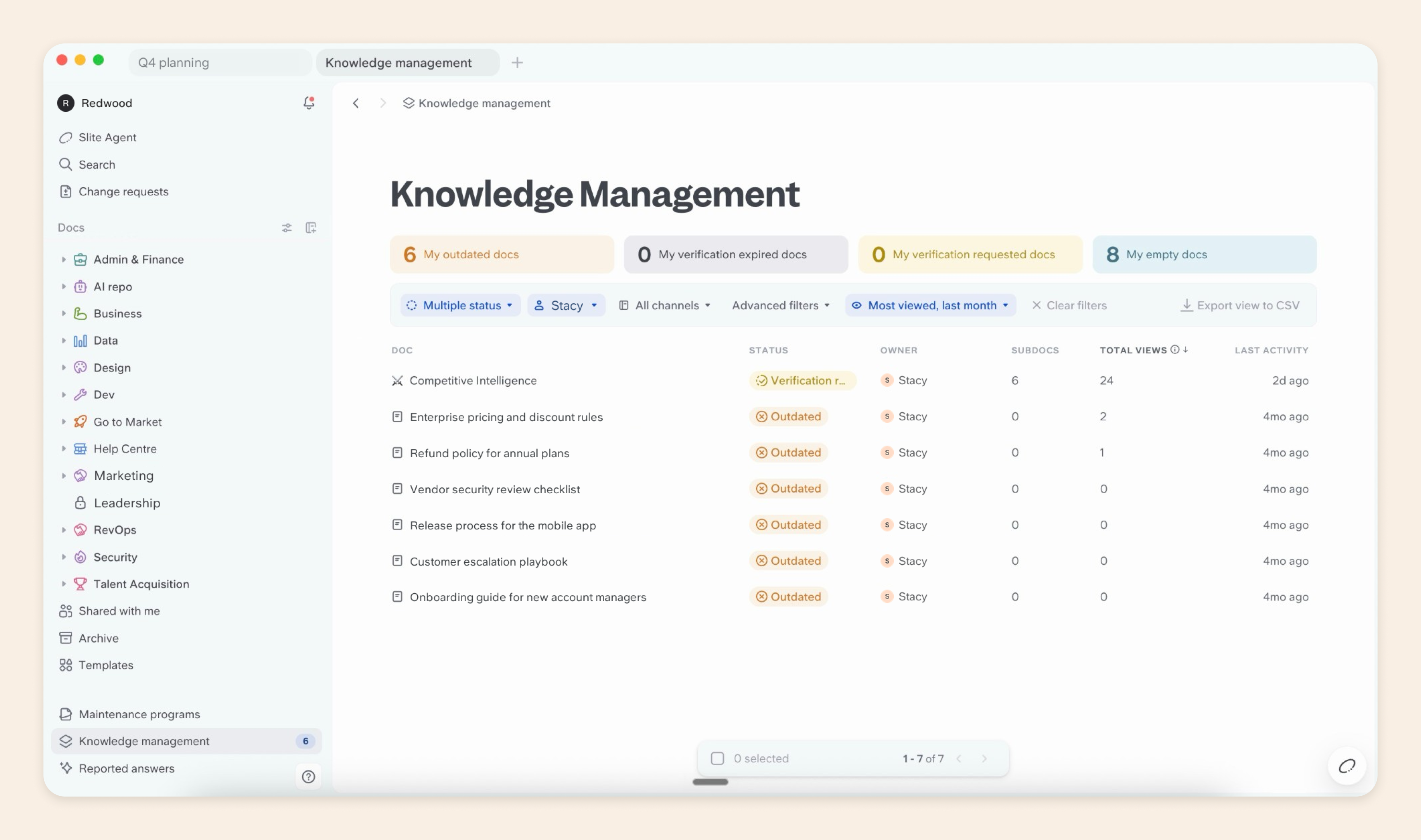
Every document in Slite can have an owner and a verification date. The owner confirms the document is still accurate by that date. When the date passes, the document is marked as needing review, so readers know to double-check it.
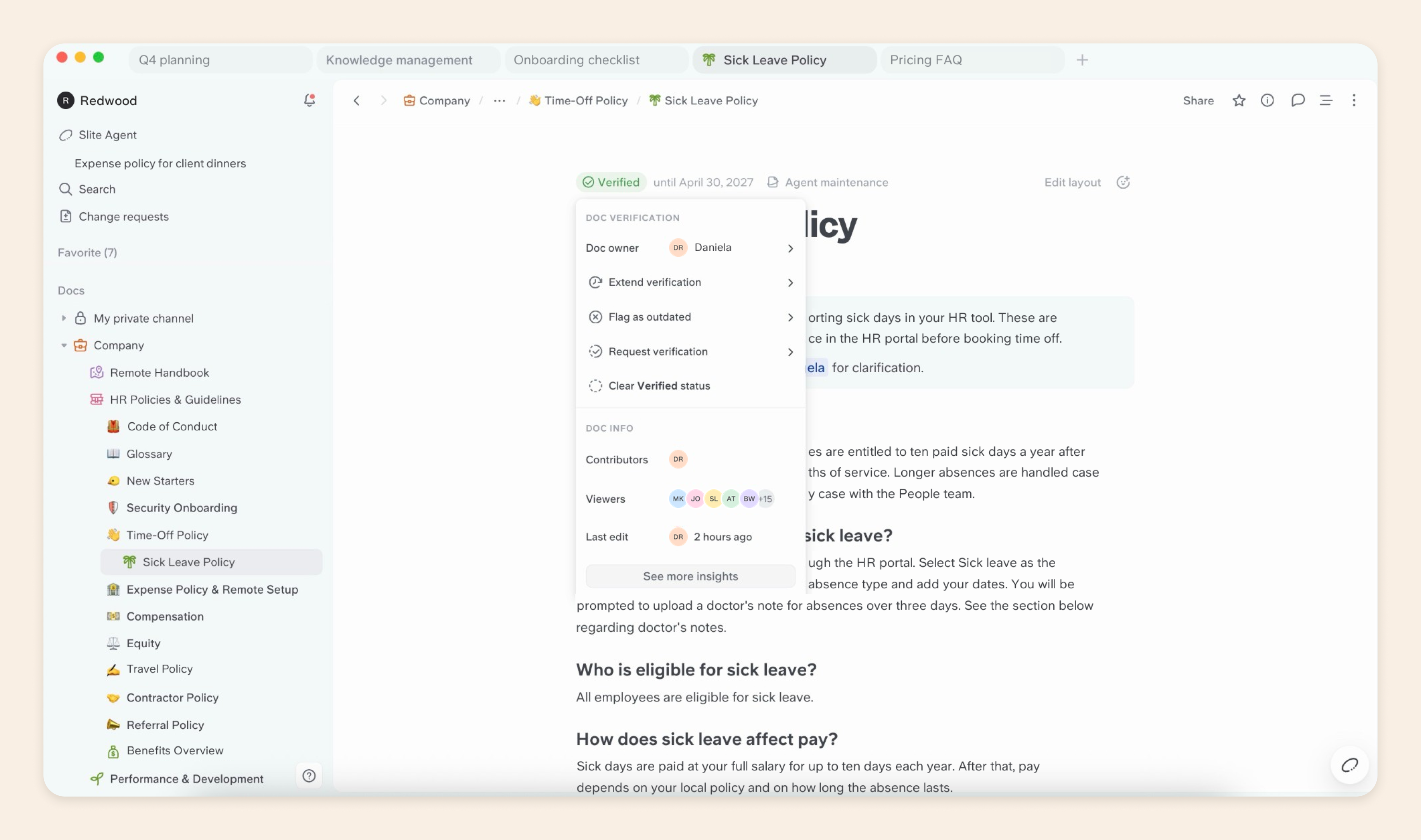
When someone leaves or a team is reorganized, an admin can reassign all of that person's documents to a new owner in one go from the Knowledge Management Panel. No document is left without someone responsible for it.
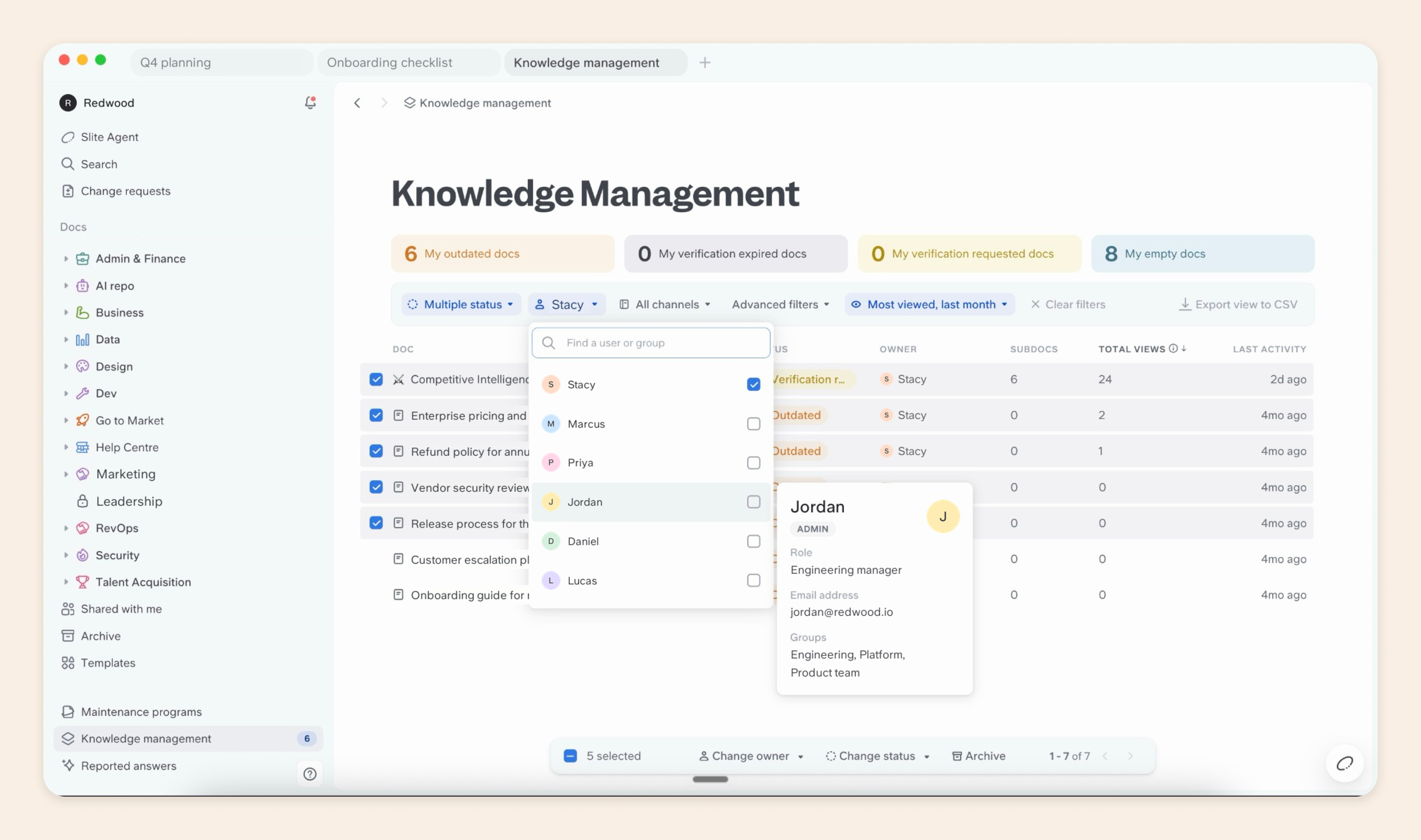
Slite Agent compares documents with the connected tools they describe and flags the ones that no longer match. It proposes the fix as a change request, and the document owner approves it before anything changes.
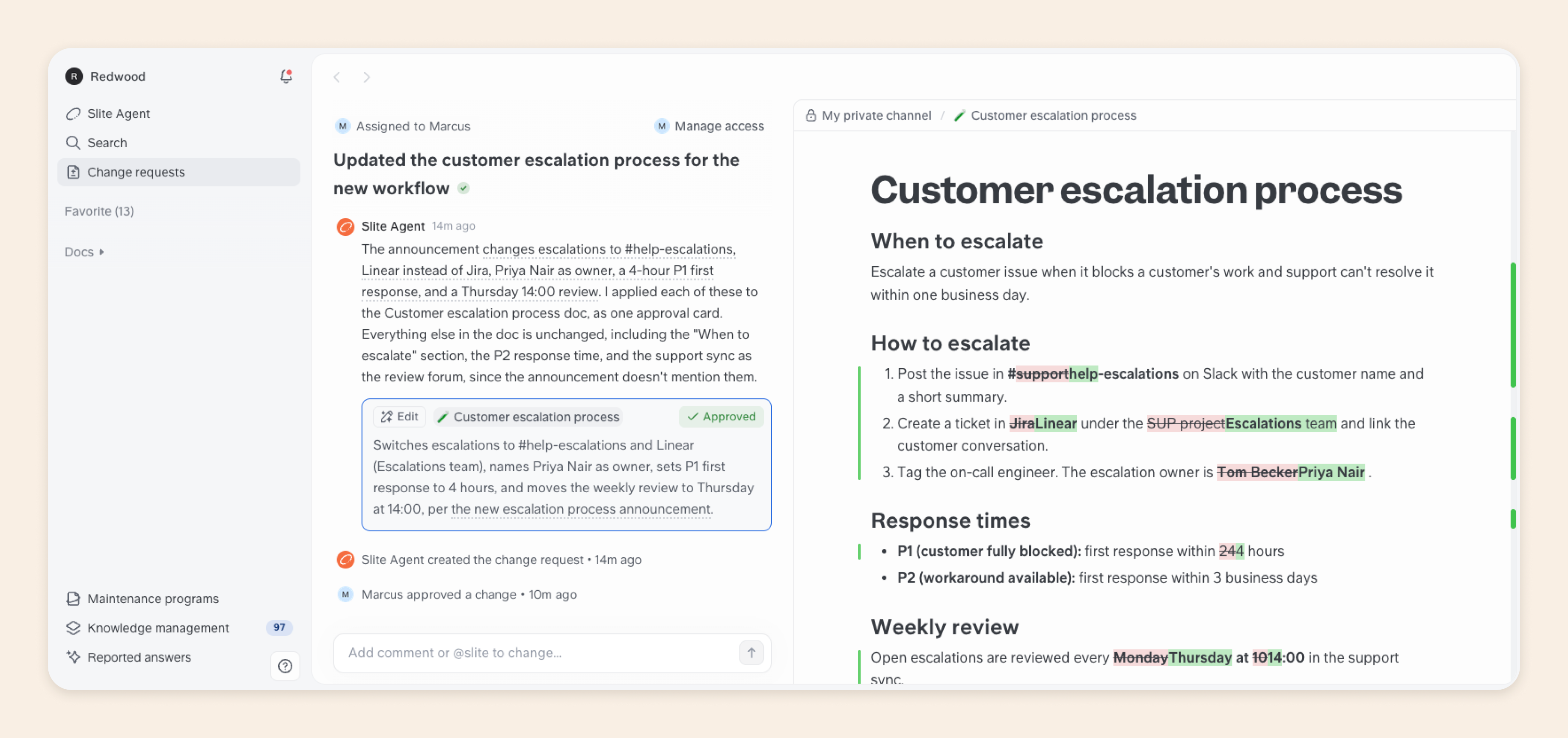
Ask Insights shows the questions people asked that the knowledge base couldn't answer, which points to knowledge that was never written down.
Slite connects to Slack, Google Drive, GitHub and other tools, and imports pages from other wikis. Knowledge from a migration or a chat thread ends up in one searchable place.
AI tools such as Claude, ChatGPT and Cursor can read and write Slite documents through MCP, so agents work from the same verified knowledge as the team.
Slite also has ready-made templates for knowledge transfer, time-off handovers and onboarding, alongside the exit interview template.
If you'd like to see how this works on your own documentation, book a demo and we'll walk you through it.
Final thoughts
Institutional knowledge leaves a company through more routes than resignations, and most of them come without a notice period. The companies that keep it treat it as upkeep that runs every week.
Start with one team this week. Answer the five questions for one knowledge area, and give every document that depends on a single person an owner and a review date.
FAQ
What's another word for institutional knowledge?
Institutional memory, organizational knowledge and corporate memory are the closest terms. Institutional memory usually refers to a company's ability to keep that knowledge over time, while institutional knowledge is the knowledge itself.
What are examples of institutional knowledge?
Examples include why a key client has custom contract terms, why a service is split the way it is, the workaround for a vendor's billing quirk, why the month-end close runs in a certain order, and the reason behind a policy exception. Each one is something a long-tenured employee knows and a new hire has to ask about.
What's the difference between institutional knowledge and tribal knowledge?
Tribal knowledge is the undocumented part of what a company knows, held by individuals or small groups. Institutional knowledge covers everything the company knows, documented or not, so tribal knowledge is one part of it. Our guide to tribal knowledge covers how to capture it.
What are the four types of knowledge?
The four main types of knowledge are tacit, explicit, procedural and declarative. Our guide to the types of knowledge explains each one with examples.