A new support hire follows the escalation document step by step and still sends a ticket to the wrong team. A senior agent would have spotted the problem straight away, because that type of error usually points to a billing issue. The rule was never written down, since nobody had thought to ask for it.
The same gap now affects AI.
An AI agent answering from the escalation document gives the wrong route with full confidence, and it has no colleague to check with.
Some of what your experts know is tacit knowledge, the kind they can't fully put into words.
Some of it is one question away from becoming a document. Tacit knowledge can only be passed on by showing someone the work or letting them learn it by doing it, while the rest only needs someone to ask. An AI agent can read neither until it's written down.
Key takeaways
- Tacit knowledge is know-how people use but can't fully put into words, like judgment and timing.
- Implicit knowledge needs someone to ask, while tacit knowledge needs observation, practice and questions about specific decisions.
- Tacit knowledge slows AI adoption: agents only work from what's written down, so expertise that stays in people's heads is missing from every answer they give.
What is tacit knowledge?
Tacit knowledge is the know-how people use in their work without being able to fully explain it, such as judgment or a feel for when something is off. It's learned through experience and passed on by working alongside someone, rather than by reading a document.
The philosopher Michael Polanyi, who coined the term, summed it up as "we can know more than we can tell."
Tacit knowledge is personal, because it lives in one person's experience. It's learned by doing. And it's hard to put into words, even when the person tries.
It's one of several types of knowledge, alongside procedural and declarative knowledge.
What's the difference between tacit, implicit and explicit knowledge?
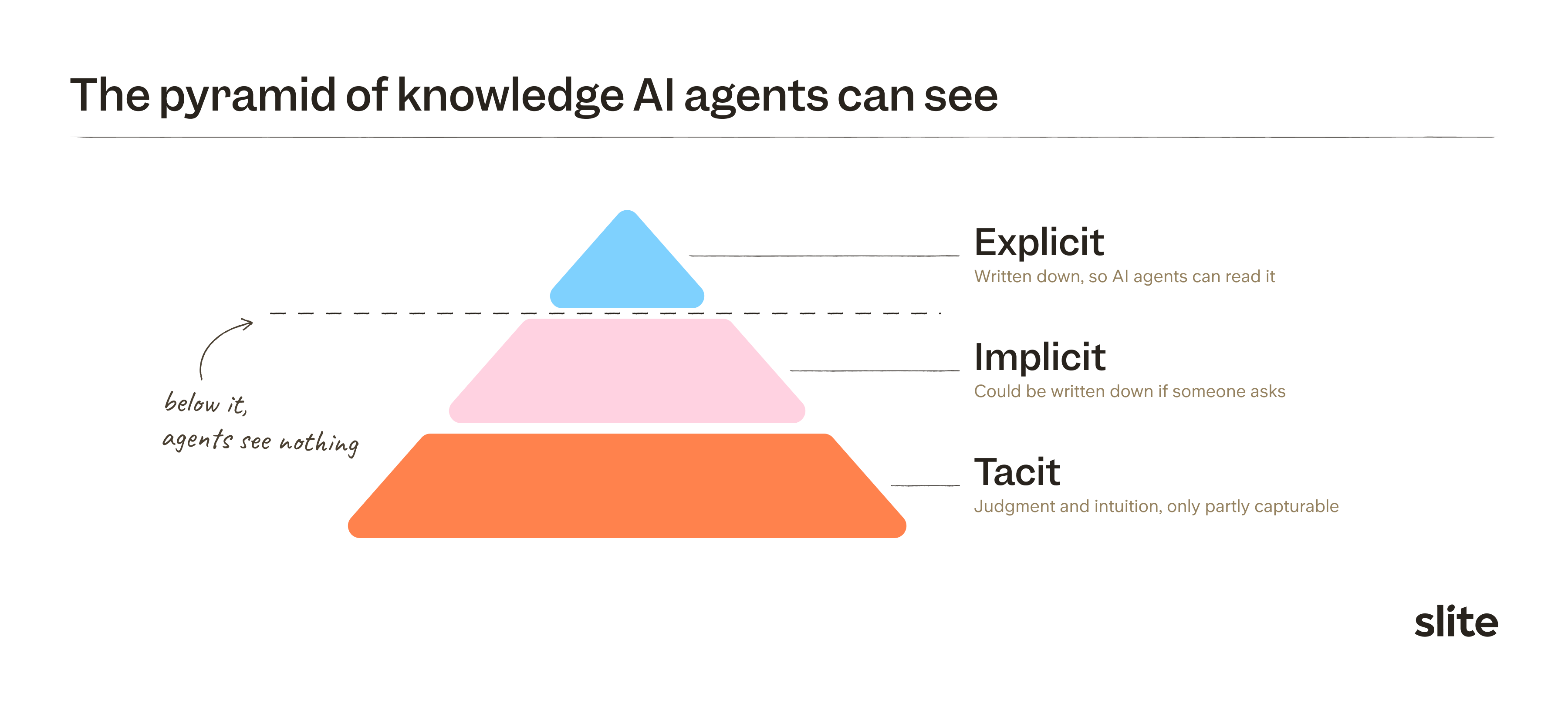
Explicit knowledge is written down in documents and policies. Implicit knowledge could be written down, but nobody has asked for it yet. Tacit knowledge resists being written down at all, because the person who has it can't fully explain it. The real difference between them is how much of each can be captured.
Some tacit knowledge could be told if someone put in the effort, and that part is what we call implicit knowledge. The rest can't be told at all.
Much of what teams call tribal knowledge is implicit: the go-to answers and workarounds a whole team shares but has never written down.
| Explicit | Implicit | Tacit | |
|---|---|---|---|
| What it looks like | Documents, SOPs, policies, specs | Workarounds, unwritten rules, the reason behind a decision | Judgment, timing, intuition |
| Can you write it down? | Already written | Yes, if someone asks | Only partly |
| How it moves between people | Reading and search | Asking the person who knows | Shadowing, practice and feedback |
| What an AI agent sees | Everything, and it treats it as fact | Nothing, unless it was said in a source the agent can read | Nothing |
Nonaka and Takeuchi's SECI model describes how knowledge converts between tacit and explicit forms, and it's one of several knowledge management frameworks teams use to plan that work.
Examples of tacit knowledge at work
Examples of tacit knowledge at work include knowing when a deal is about to stall, sensing which support ticket will escalate, judging which part of a codebase to change carefully, and reading when a team is too stretched to take on more risk. Each one is learned on the job and hard to explain step by step.
Every team holds all three kinds at once. Labeling each example by type shows what it would take to capture it.
| Team | Explicit | Implicit | Tacit |
|---|---|---|---|
| Sales | Pricing page, CRM loss reasons | The real reason a deal died, said on a call and never logged | Sensing which stakeholder holds the veto from how a meeting runs |
| Support | Macros, help-center articles | "This type of error code always means a billing issue" | Calming an angry customer, knowing when to escalate |
| Engineering | Runbooks, architecture documents | Why a service has an odd retry setting, from an incident nobody wrote up | Sensing a deploy is risky from the shape of a diff |
| Ops and HR | Handbook, SOPs | Policies that were agreed in a meeting but never written | Knowing when to bend a rule for one person |
The implicit column is usually the biggest, and the easiest to miss. We've seen a sales enablement team find the gap only when a new rep started and asked whether the onboarding document was current. Their best BDR leader's improvements had never been written up.
How to capture tacit and implicit knowledge
Match the capture method to the kind of knowledge. A request to "please document this" works for implicit knowledge, but tacit knowledge needs methods that don't depend on the expert explaining everything.
Both work best as part of a wider knowledge management strategy, where every captured document has an owner.
To pick the method, ask three questions in order.
- Is it already written somewhere?
- Could the person write it down if you asked?
- Or can they only show you?
Implicit knowledge: ask and write it down
Implicit knowledge shows up as a question that keeps coming back in Slack, answered by the same person every time. The fix is a short conversation with that person about one process, written up as a document straight after.
It's important to capture it soon after a decision is made, while the reasoning that was discussed is still clear. Weeks later, people usually remember what was decided but not why.
The same applies when someone is about to leave. An exit conversation about unwritten rules and pending decisions is part of any knowledge transfer plan.
Tacit knowledge: observe, practice and probe decisions
Tacit knowledge shows up when the expert says "it depends" or "you just know", or goes quiet when asked to write the steps down. Asking harder doesn't help, so the method has to work without the expert explaining everything.
These techniques work best:
- Shadowing and apprenticeship: a newer person watches the work, then tries it with feedback.
- Think-aloud sessions: the expert talks through a task while doing it, which captures reasoning that gets lost in a summary written afterwards.
- After-action reviews: a short debrief right after the work. Debriefs improve team performance by about 20 to 25% on average.
- Decision probing: instead of "how do you do it?", ask about one specific past call, what the expert noticed and what they weighed. Researchers call this the critical decision method, and it surfaces cues an expert wouldn't volunteer.
The reason behind a decision is the hardest part to capture. We learned this at Slite when we built a decision-log feature, and the hardest part was getting people to agree on what had actually been decided.
Why AI agents can't see tacit knowledge
AI agents answer from what they can read, such as documents and messages. Tacit knowledge lives in people's experience and never reaches those sources, and unlike a new hire, an agent can't ask a colleague to fill the gap.
Getting this knowledge written down used to matter mostly for onboarding new hires. Now that AI agents answer questions and do part of the work, anything that stays unwritten is missing from every answer they give.
Small teams used to manage without strong documentation because people just asked each other.
As Adrien, who designs how Slite's agents work with company knowledge, puts it, agents "can't be tapped on the shoulder."
Without context on how an organization works, AI agents are far more likely to hallucinate and produce unreliable results. Tacit and implicit knowledge make up much of that context, and no connector can pull them in until a person writes them down.
The practical fix is a knowledge base built for AI agents, seeded from short interviews with the people who hold that knowledge.
How to capture tacit knowledge and keep it current in Slite
Slite helps you find the knowledge your team keeps asking about, turn your experts' answers into documents, and keep those documents current for both people and AI agents.
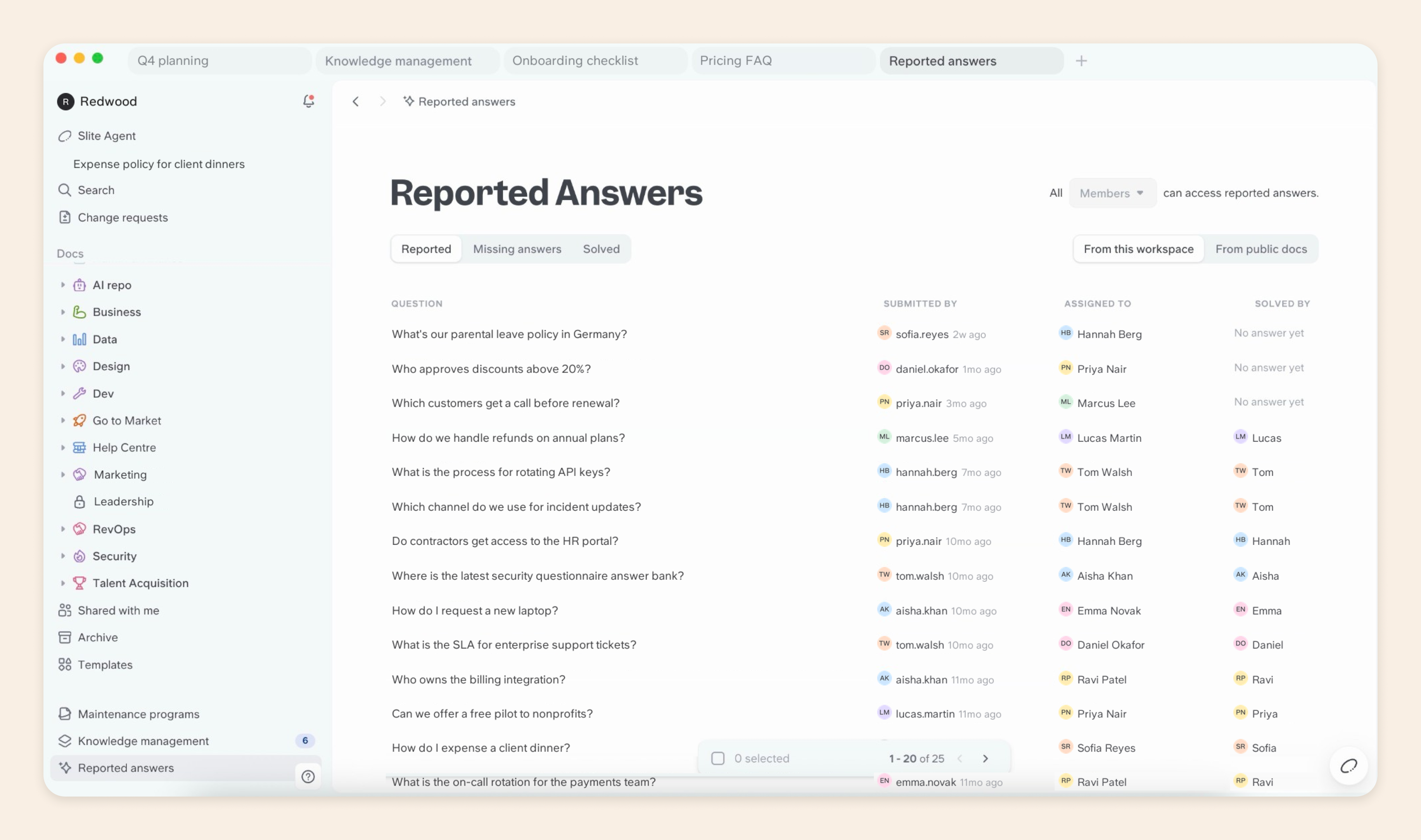
Reported answers lists the questions Slite Agent couldn't answer and the answers people flagged as wrong. Each one points to implicit knowledge someone on your team has, and you can assign it to that person to answer.
The Expert Interview template and the Exit Interview with Knowledge Handover template give that conversation a structure. Slite Agent can then draft a document from the answers or from a call transcript.
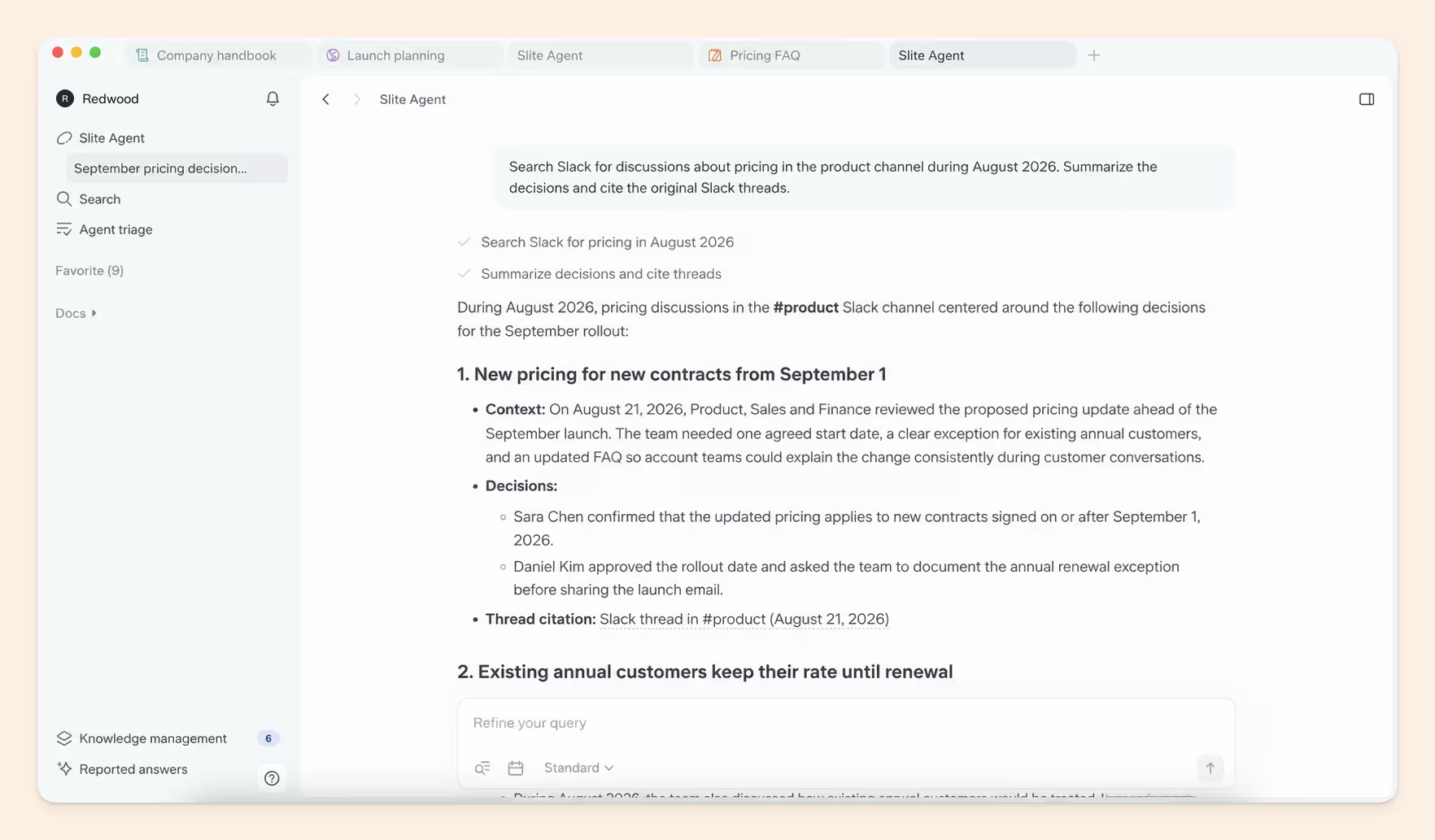
Slite Agent also reads connected tools like Slack and Google Drive, so implicit knowledge that was once said in a thread can be found and turned into a document.
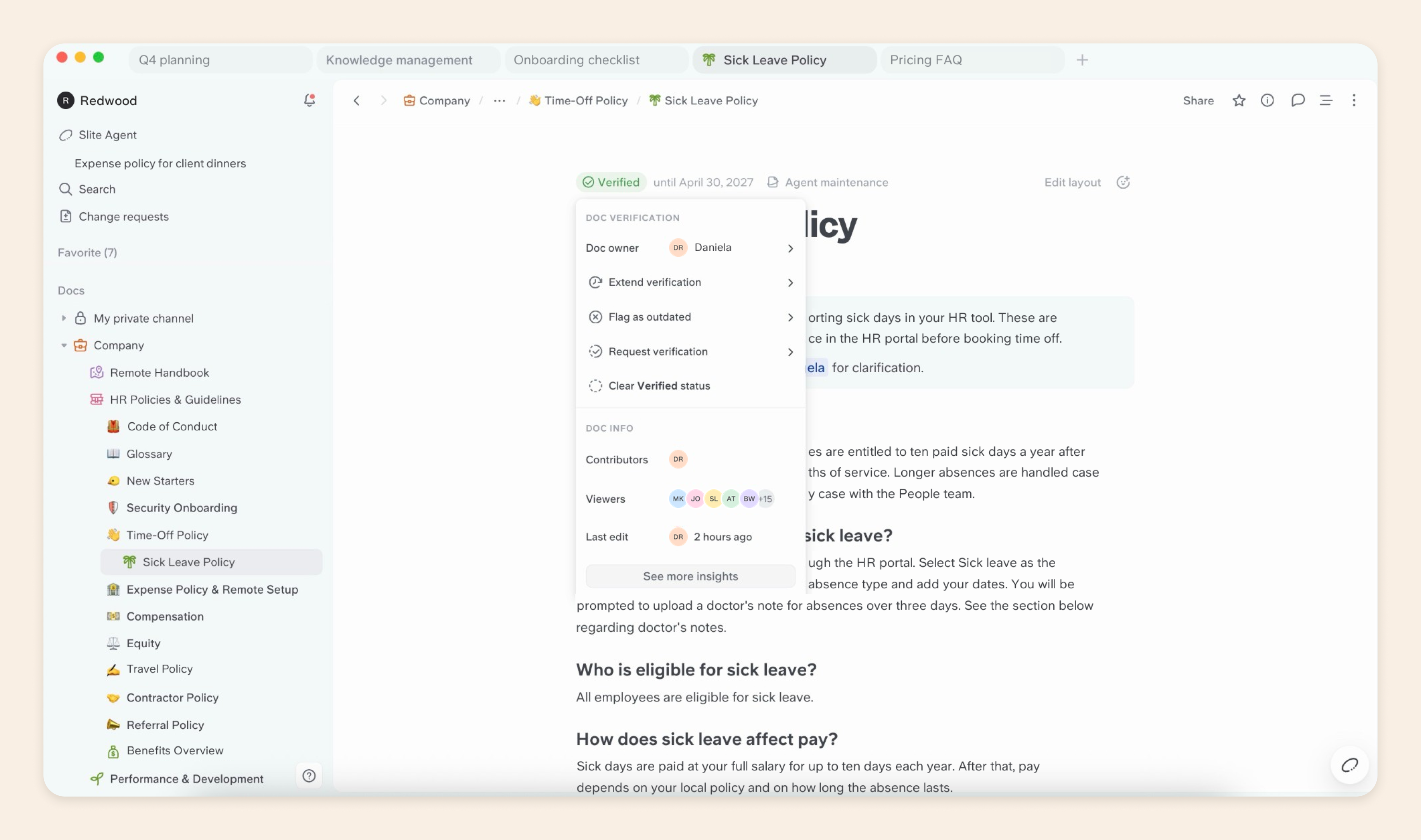
With verification, every document gets an owner and a verification status, and outdated documents are left out of Slite Agent's answers.
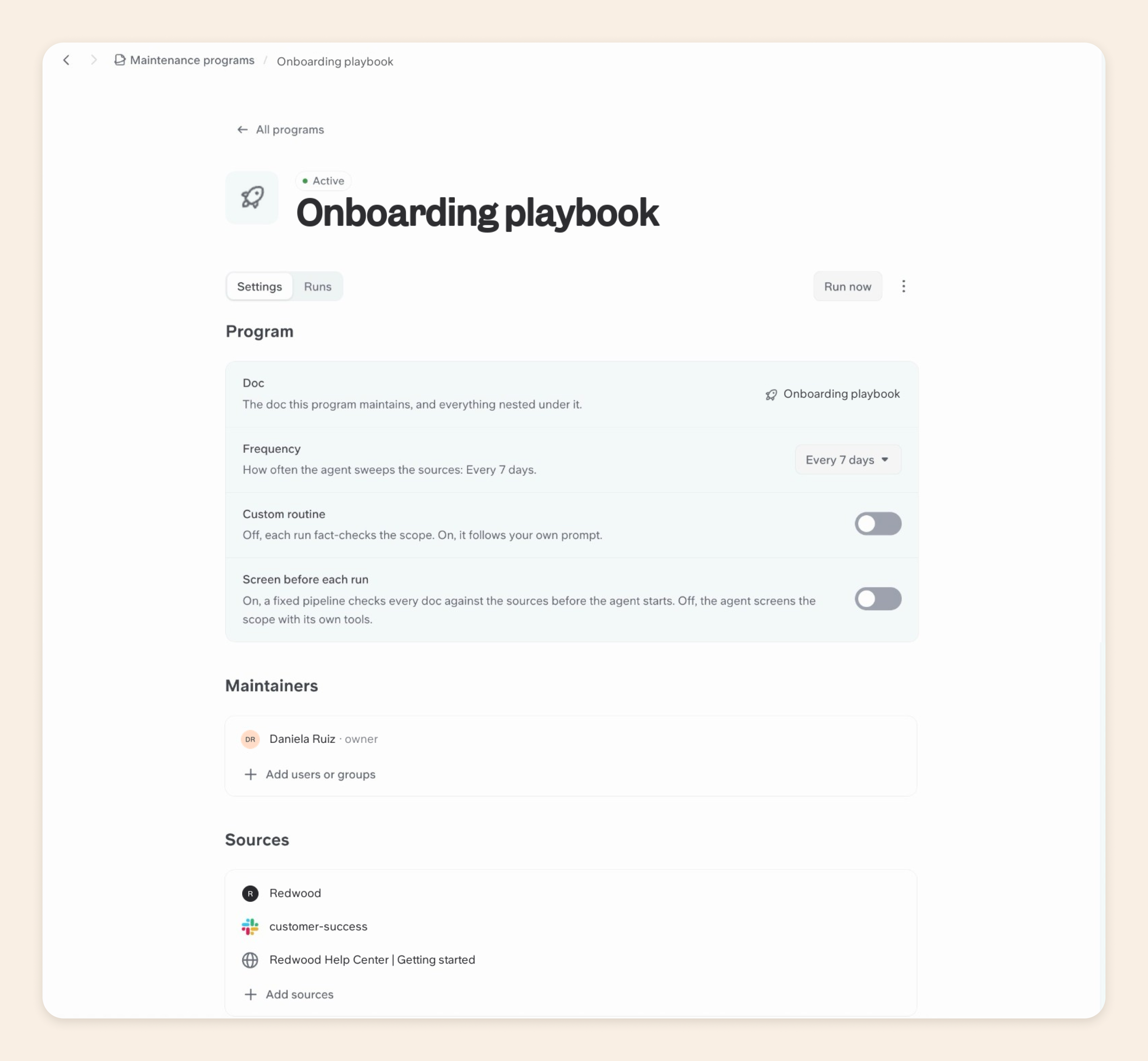
Once knowledge is written down, Slite Agent can watch the sources you choose, flag when a document no longer matches them and draft the fix. A person approves every change before it applies, which is how a self-maintaining knowledge base stays trustworthy.
Through the Slite MCP, tools like Claude and Cursor read the same verified documents, with the same permissions as the person using them.
If you want to see how this works on your own documents, try Slite Agent.
Final thoughts
Tacit, implicit and explicit knowledge differ in how much of each you can capture, and AI agents only ever read the captured part. That makes the implicit middle the most valuable place to spend your next hour of documentation.
Every question a teammate or an agent can't answer points to something a person on your team could write down.
FAQ
What are the three types of tacit knowledge?
Harry Collins splits tacit knowledge into relational, somatic and collective. Relational knowledge could be explained with effort, which is close to what we call implicit. Somatic knowledge lives in the body, like a craft skill, and collective knowledge belongs to a group, like the unwritten norms of a profession.
Is tribal knowledge the same as tacit knowledge?
Tribal knowledge is the unwritten know-how a team holds collectively, and much of it is implicit: go-to answers and workarounds that could usually be written down. Tacit knowledge is the narrower part that even the expert can't fully explain.
Can AI learn tacit knowledge?
Partly. An AI agent can rediscover some knowledge from raw Slack threads and call transcripts, but only what was ever said out loud, and it takes far more time and compute than reading one verified document. Judgment that was never put into words stays out of reach.