The cards exist. The answers look official. But the process changed six months ago; the owner never updated the doc, and the team has already gone back to asking in Slack.
In 2026, Guru repositioned as a governed knowledge layer for enterprise AI, moved pricing off the public page entirely, and started talking to a very different buyer.
For enterprise customers with a dedicated AI ops team, the shift makes sense. If you're not in that camp, you're probably wondering: Is Guru still the right tool for us?
To answer that, we reviewed each option, checked the claims, and matched each one to the actual gap it solves: trusted documentation, AI search, Slack Q&A, customer-facing docs, lightweight wiki setup, or enterprise AI agents.
Key takeaways
- Slite is the strongest Guru alternative for teams that need trusted documentation that is self-updating and AI search in one place.
- Notion fits teams already deep in the Notion ecosystem, where their docs, projects, calendars, and internal workflows already live.
- Tettra is best for Slack-heavy teams that want simple question-and-answer automation from team knowledge.
- Document360 is built for customer-facing documentation, help centers, and structured support content.
- Nuclino fits small teams that want a lightweight internal wiki with minimal setup.
- Glean, Dust, and Microsoft Copilot are worth considering when the need is enterprise search or AI agents across many tools, but they still depend on accurate source knowledge.
We compare the strongest Glean alternatives separately.
Book a demo to see how Slite keeps company knowledge verified, searchable, and ready for AI agents.
Why teams are reconsidering Guru in 2026
Guru is still a strong knowledge product. It combines a wiki, enterprise search, intranet pages, verification workflows, Knowledge Agents, and workplace integrations.
In fact, recent G2 reviews still praise Guru for centralized knowledge, verified cards, AI search, and Slack or Teams integrations.
But as knowledge bases grow, some teams start running into a different problem: finding the right answer quickly and consistently.
Some reviewers say search results can be too broad, too dependent on exact keywords, or difficult to narrow down when there are many similar cards.
Others point to content organization, filtering, reporting, and bulk management as areas that can become harder at scale.
Additionally, some teams are looking for a Guru alternative because:
- docs go stale easily
- search misses the right source
- employees keep asking repeat questions in Slack
- support teams need customer-facing documentation
- smaller teams want a simpler wiki
- growing teams need clearer ownership, structure, and maintenance
One recent reviewer said Guru worked well overall, but noted that using a synonym instead of the expected keyword sometimes failed to surface the right card.
Search is Guru's single most-flagged complaint on G2, cited in over 150 reviews. Worth keeping in mind for a product now positioning itself as the AI layer enterprises build on.
Guru alternatives compared
The right alternative depends entirely on why Guru stopped fitting. A team with stale internal docs has a different problem from a team that needs customer-facing help content, or one that lives in Slack.
Here's how the main options stack up before we go deeper on each one.
| Tool | Best for | AI angle | Main tradeoff | Pricing |
|---|---|---|---|---|
| Slite | Self-maintaining documentation that serves a trusted context layer for AI agents and humans+ AI search | Detects documentation drift, proposes updates, routes changes for human review, and searches across connected tools | Not a ticketing-first support suite or all-purpose workspace | $10/user/month Basic, $20/user/month Pro, billed annually |
| Notion | Flexible workspace | Notion AI for writing, search, summaries, and workspace assistance | Can become messy without structure | $10/user/month Plus, $20/user/month Business, billed annually |
| Tettra | Slack-first question-and-answer | Kai answers questions from team knowledge inside Slack | Less useful for teams that do not work mainly in Slack | $5/user/month Basic, $10/user/month Scaling, billed annually |
| Document360 | Customer-facing documentation | Eddy AI, AI chatbot, and documentation automation | Built for structured customer-facing docs, less so for general team collaboration | Quote-based |
| Nuclino | Lightweight internal wiki | Simple AI help for writing and documentation | Limited governance and advanced workflows | Free plan, $6/user/month Starter, $10/user/month Business, billed annually |
Slite
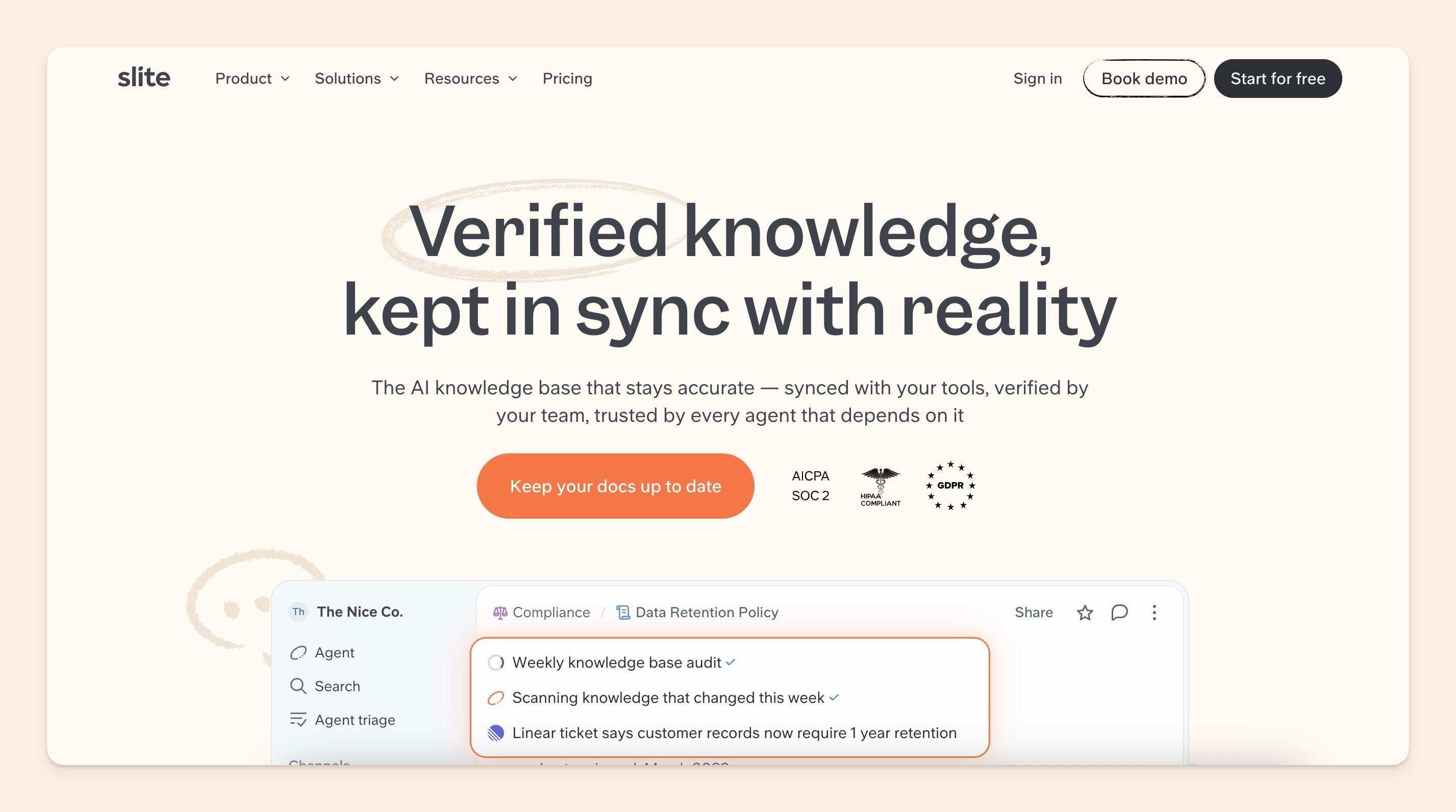
Slite is a self-maintaining knowledge base that keeps itself current and up-to-date, pairing a structured, verified wiki with Slite agent that detects when documentation has drifted from reality, proposes the fix, and routes every change through human approval before it becomes truth.
Both Slite and Guru tackle knowledge upkeep, but the motion differs.
Guru genuinely automates the upkeep workflow by flagging a card as stale and reminding a human, but a person still writes the correction.
The Slite Agent drafts the corrected text itself as a diff with per-edit rationale tied to the source, then routes it through human approval. Detection differs, and who does the writing differs.
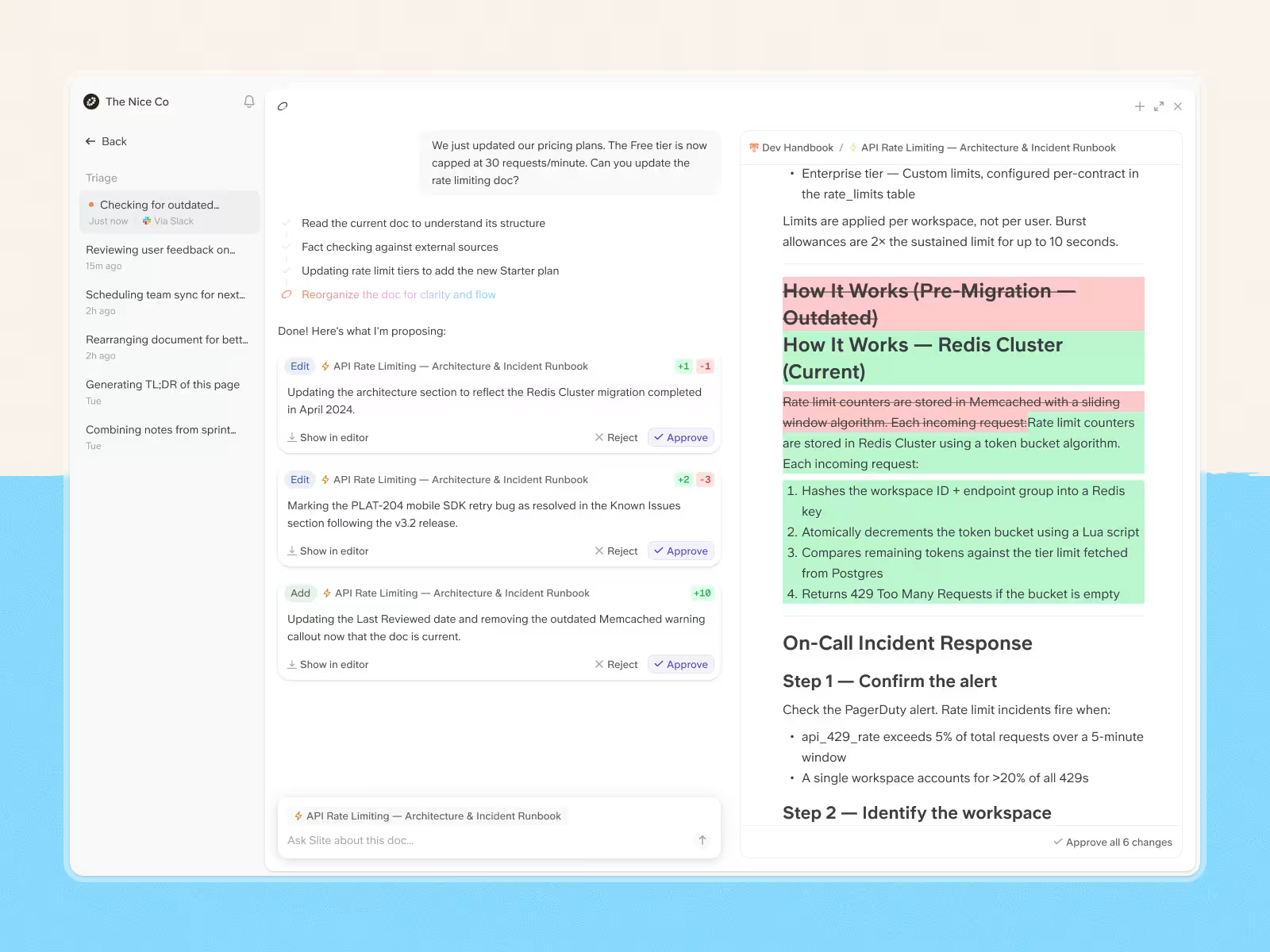
Most times, a process changes, a decision moves, a customer-facing workflow gets updated, and the source doc needs to keep up.
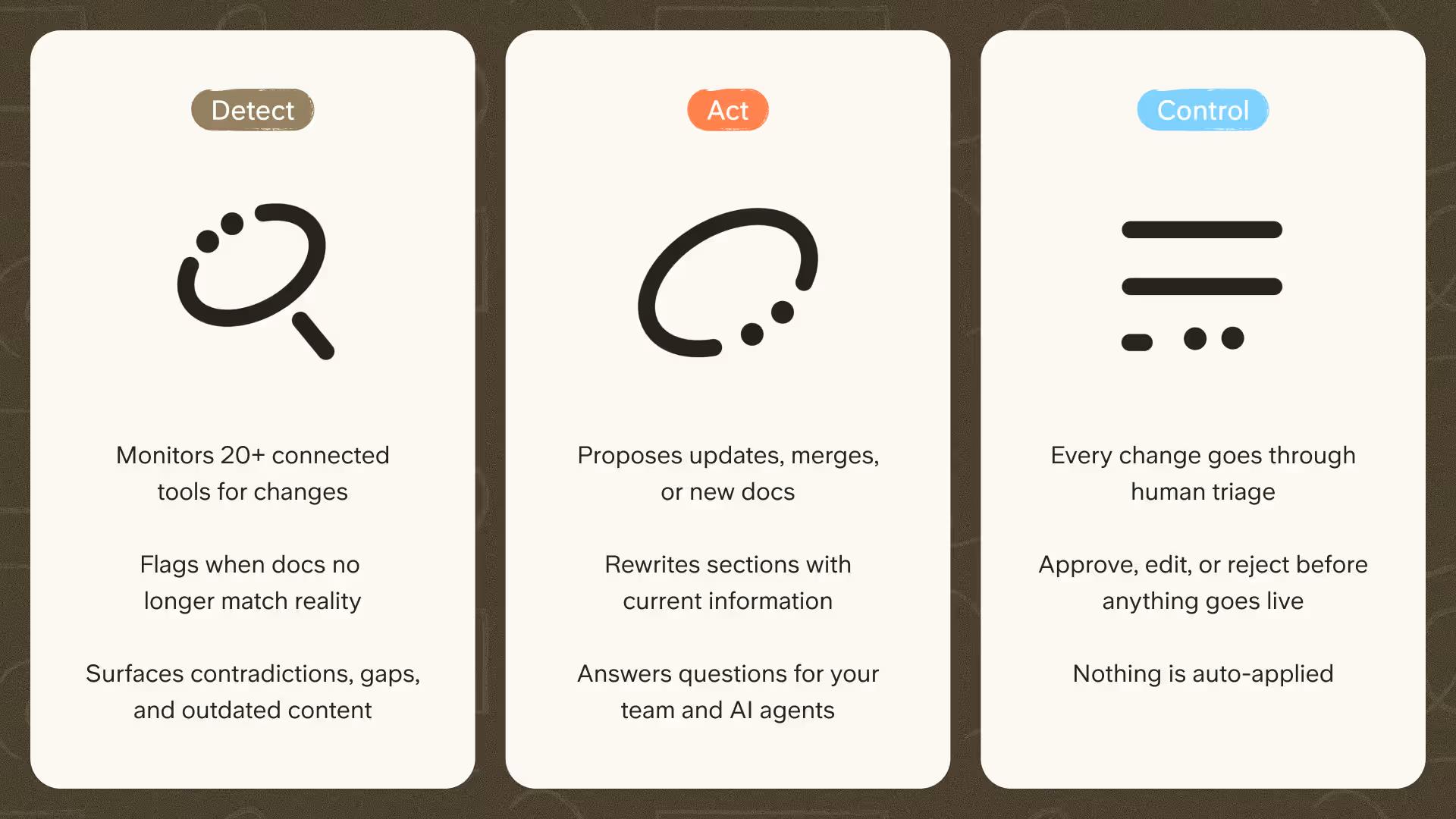
So the maintenance loop has clear steps:
- detect the drift,
- prepare the fix,
- humans review the pre-drafted change and approve,
and keeps the source knowledge current.
Use Slite if the problem is keeping knowledge accurate as processes, decisions, and workflows change.
Who it's best for
Growing teams that want a more structured approach to keeping knowledge accurate over time for both humans and as a context layer for AI agents.
Pricing
- Basic plan: $10/user/mo (billed annually; $12 monthly): full knowledge base with AI search (Ask), doc verification, Knowledge Management Panel, and MCP + API access.
- Pro plan: $20/user/mo (billed annually; $25 monthly): everything in Basic plus the Slite Agent, AI search across 20+ connected tools, agent workflows, and 50 agent credits/seat/month.
- Enterprise plan: custom pricing; it includes everything in Pro plus reader-only seats, audit logs, SCIM, SLA, and dedicated support.
No free plan; 14-day trial on Basic and Pro.
User ratings
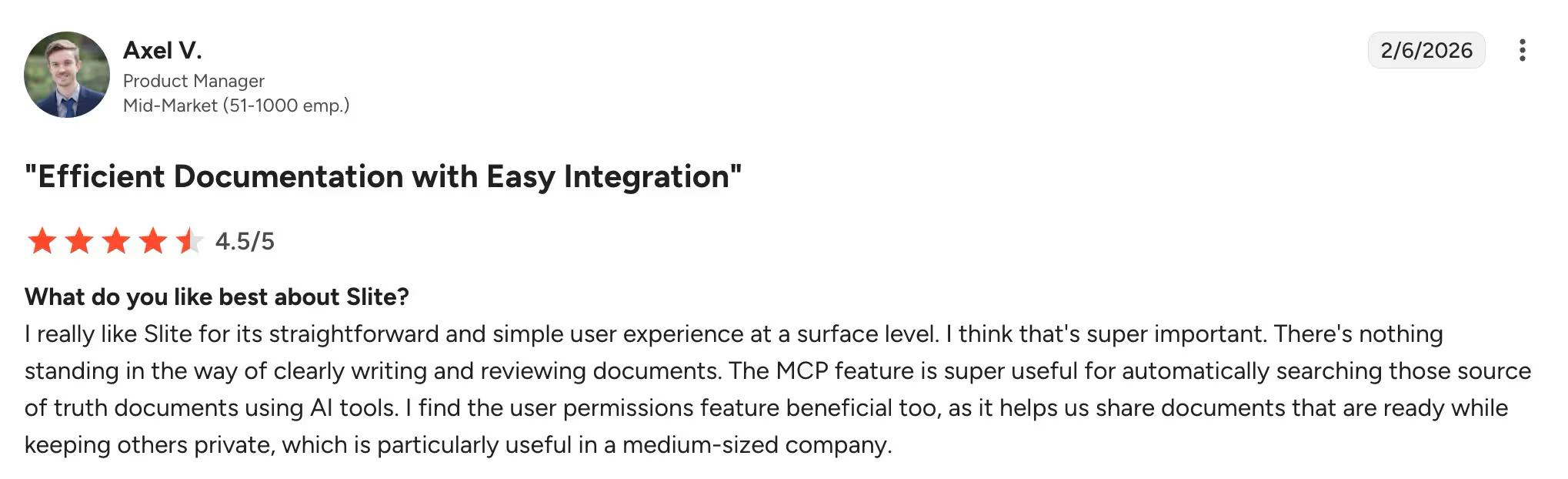
Slite has a 4.6/5 rating on G2.
Notion
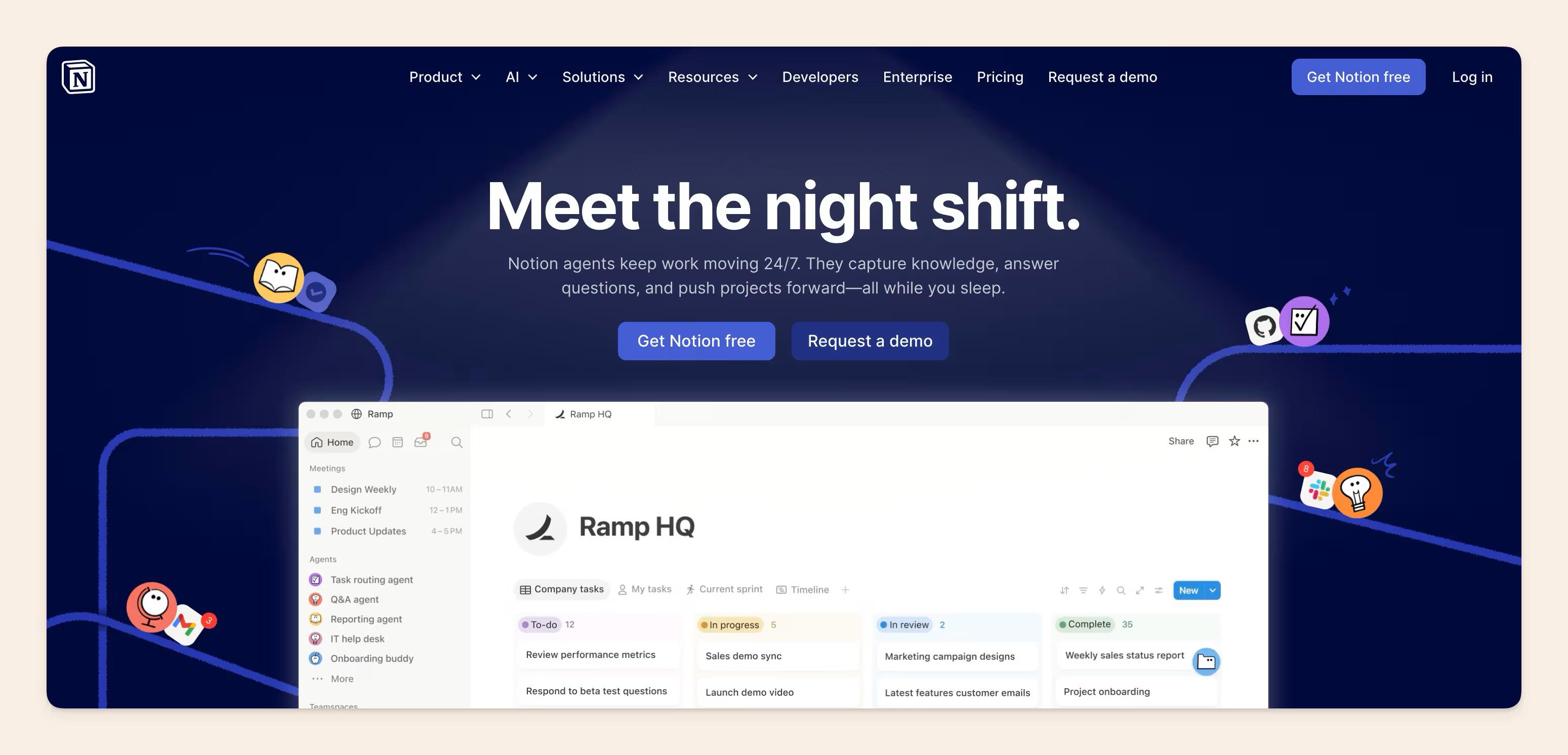
Notion is a good Guru alternative for teams that already run most of their work inside Notion. If docs, projects, calendars, meeting notes, and internal workflows already live there, Notion AI can feel like a natural extension of the workspace.
Teams can build a wiki, project tracker, meeting hub, roadmap, lightweight customer relationship management system, or internal operating system inside the same product.
That flexibility also creates the main tradeoff. Without clear owners, naming rules, and review habits, Notion can become messy.
Key features
- Flexible pages and databases for docs, projects, roadmaps, and team dashboards
- Notion AI for drafting, summarizing, searching, and answering questions from workspace content
- Templates for wikis, project plans, meeting notes, onboarding, and team processes
- Permissions, private teamspaces, and collaboration features for growing teams
- Integrations with tools like Slack, Jira, Asana, Google Drive, and more
Who it's best for
Notion is best for teams that have already built a lot of their work inside Notion and want docs, projects, and databases to remain in one flexible workspace.
Pricing
- Free plan with basic workspace features available.
- Paid plans start at $10/user/month, billed annually.
- Business plan starts at $20/user/month, billed annually, with Notion AI included.
- Enterprise pricing is custom.
User ratings
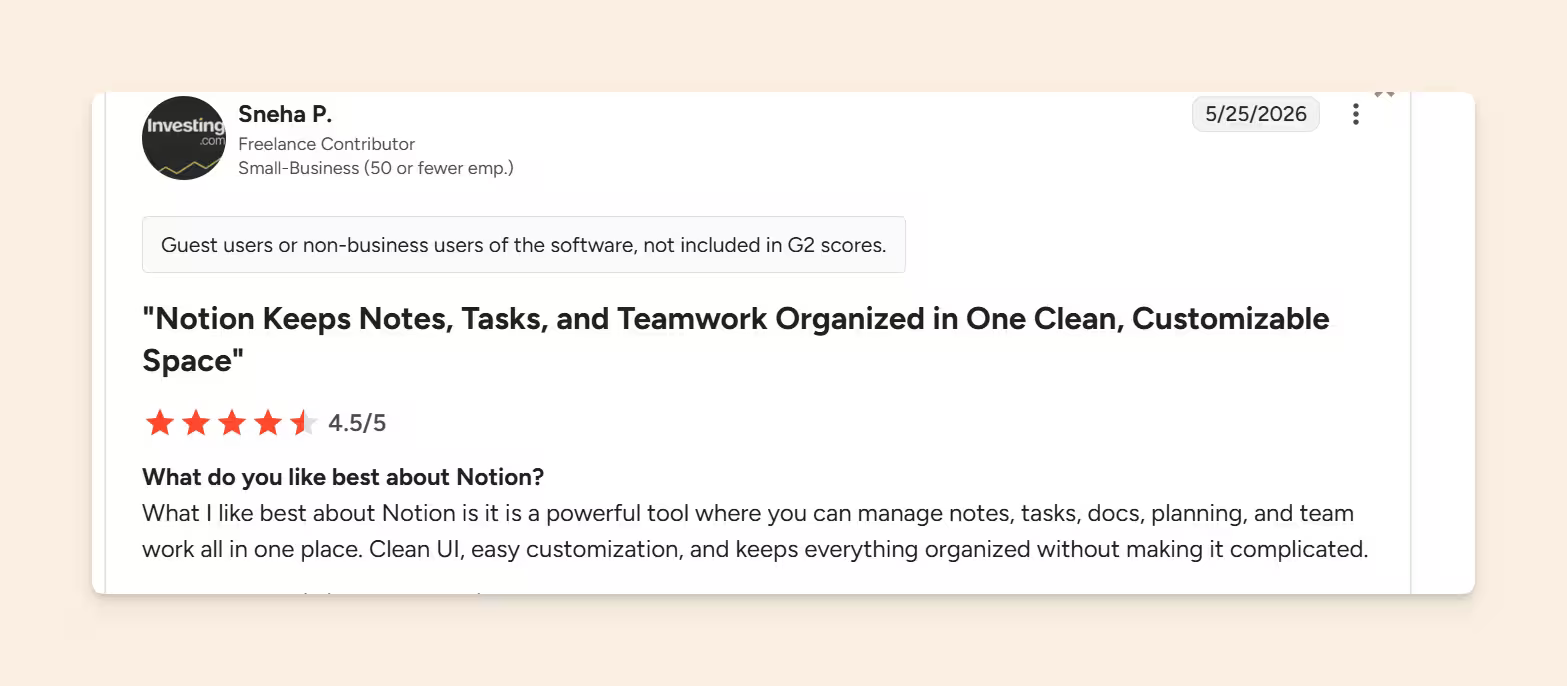
Notion has a 4.6/5 rating on G2.
Related read: The 10 Best Notion Alternatives in 2026
Tettra
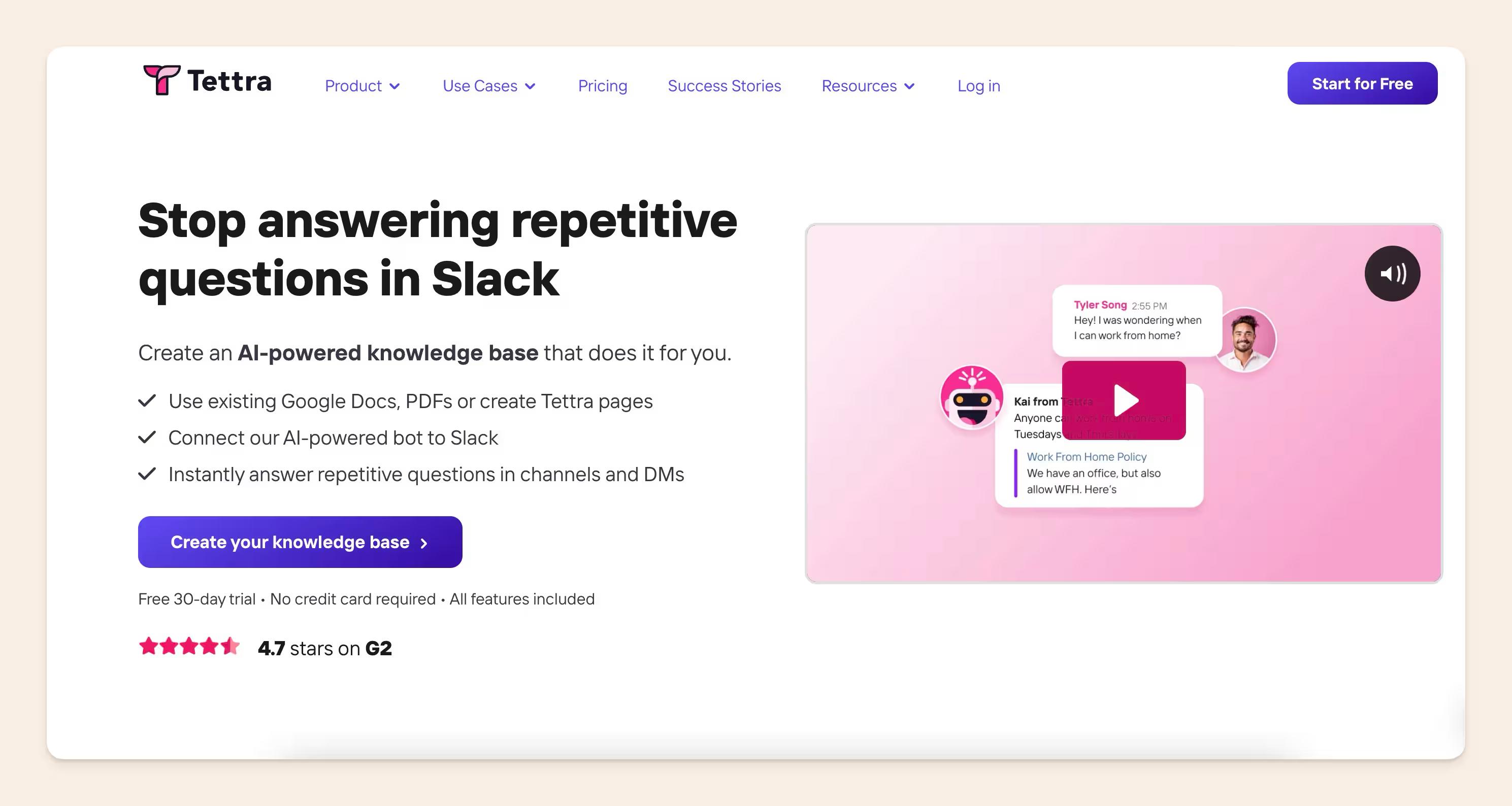
Tettra is a strong Guru alternative for teams that live in Slack and want repeated questions answered faster.
Its main strength is simple question-and-answer automation. Kai, Tettra's AI assistant, can answer questions from team knowledge inside Slack, tag pages automatically, and help turn repeated questions into reusable answers.
Tettra is the right choice when the problem is not a complex knowledge system, but the same questions keep coming up again and again in chat.
Key features
- Slack-based question-and-answer workflows
- Kai AI answers from team knowledge
- Internal wiki for documenting repeat questions
- Repeated-question detection and knowledge capture
- Simple setup for small and mid-sized teams
Who it's best for
Tettra is best for Slack-heavy teams that want a simple internal wiki and AI question-and-answer without a heavy governance setup.
Pricing
- No free plan, but a 30-day free trial is available.
- Paid plans start at $5/user/month, billed annually, with a 10-seat minimum.
- Full AI features are available on the Scaling plan, which starts at $10/user/month, billed annually.
User ratings
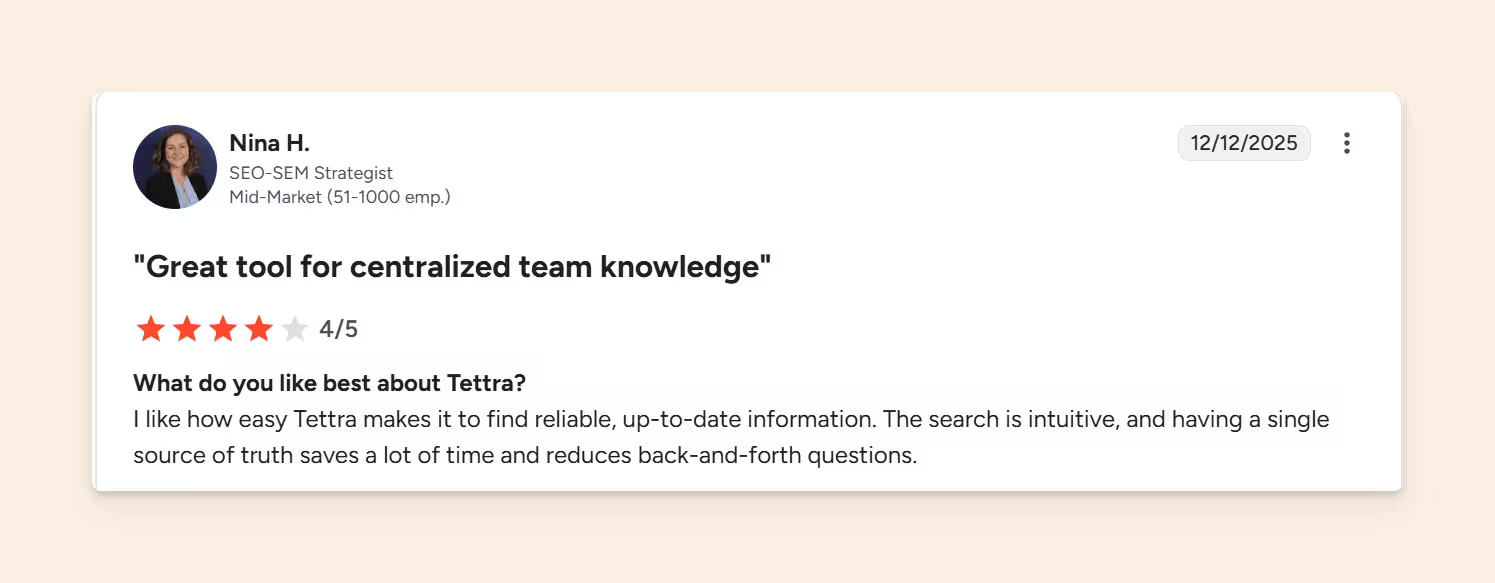
Tettra has a 4.7/5 rating on G2.
Document360
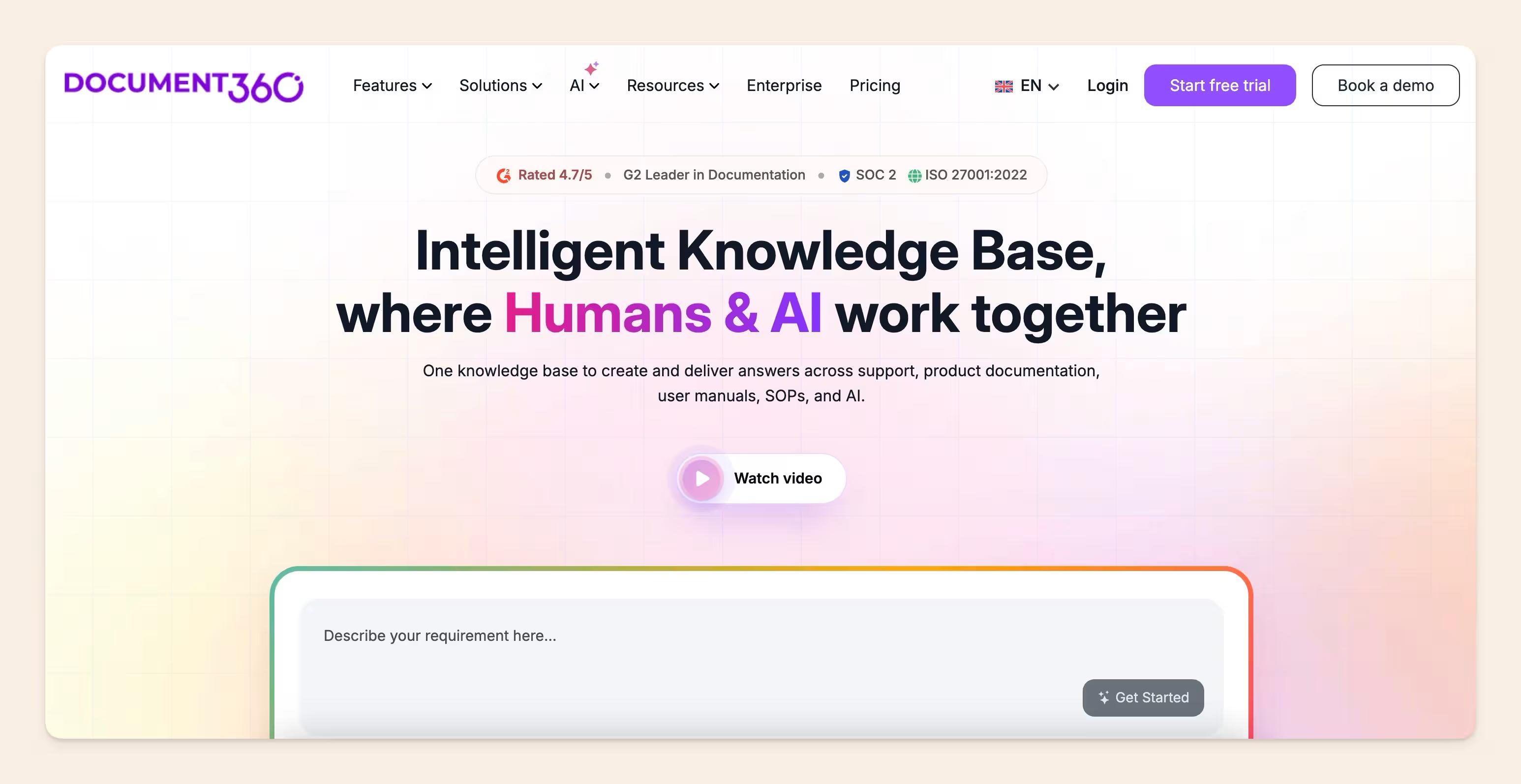
Document360 is the Guru alternative to consider when the knowledge base is customer-facing.
It is built for help centers, product documentation, support content, and customer self-service. Teams can use it to organize public or private documentation, manage versions, and support customers without sending every question to the support team.
Its AI features, including Eddy AI and AI chatbot capabilities, make the most sense when the goal is to help customers find answers from structured support content.
Key features
- Public and private knowledge bases
- Help center and product documentation workflows
- Eddy AI for content assistance
- AI chatbot for customer self-service
- Version control, multilingual support, and structured content management
Who it's best for
Document360 is best for support teams, product documentation teams, and companies that need a customer-facing knowledge base.
Pricing
- Document360 uses custom pricing based on each team's setup and AI usage, so plan details come from a quote.
- A 14-day free trial is available, and there is no permanent free plan.
User ratings
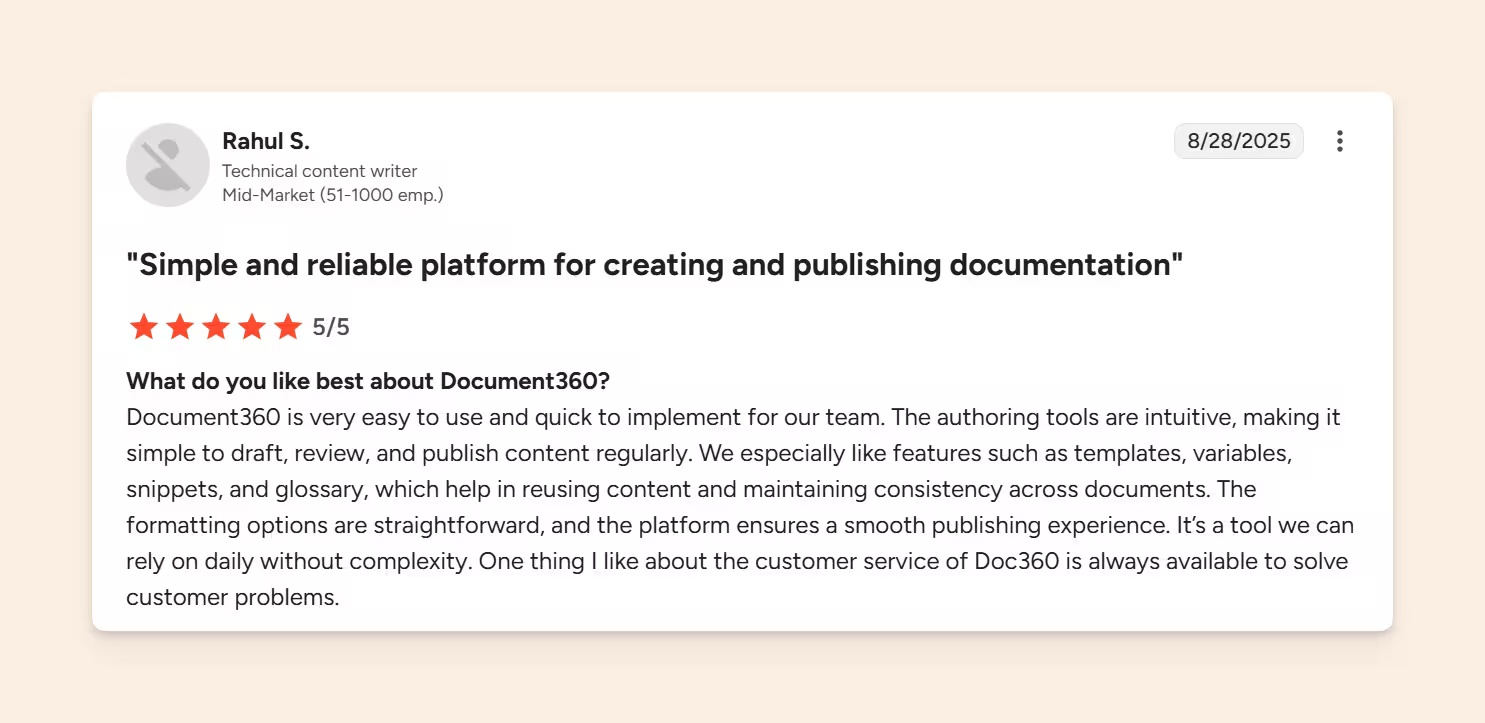
Document360 has a 4.7/5 rating on G2.
Nuclino
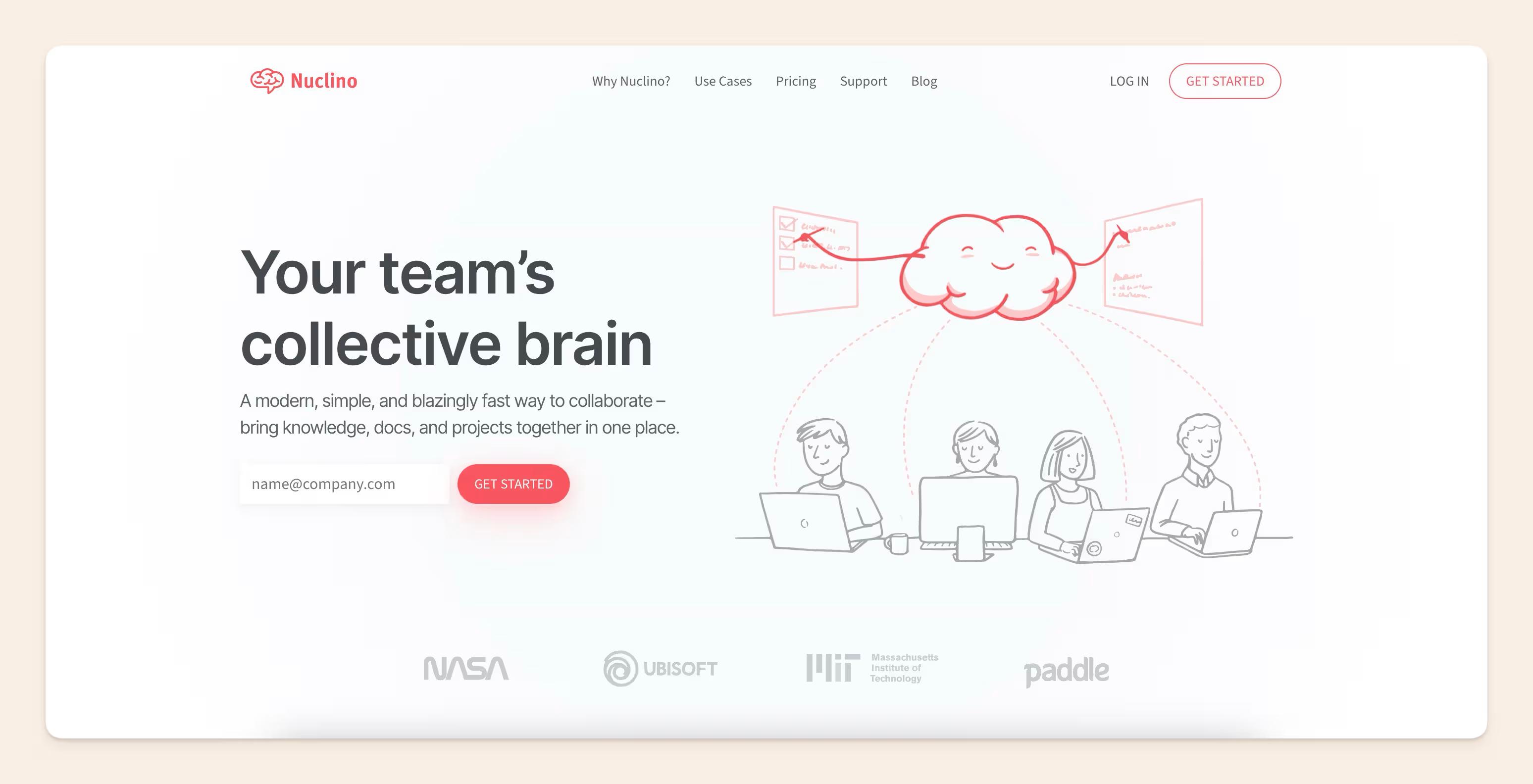
Nuclino is the Guru alternative for small teams that want a fast, lightweight internal wiki.
It has a clean editor, real-time collaboration, simple workspace structure, and a visual graph view for seeing how docs connect. Setup is quick, which makes it useful for teams that want to document work without managing a heavy knowledge system.
The tradeoff is depth. Nuclino is not built for advanced governance, agentic maintenance, or complex enterprise workflows.
Key features
- Clean editor for lightweight internal documentation
- Real-time collaboration
- Simple workspace structure
- Visual graph view for connected docs
- Quick setup for small teams
Who it's best for
Nuclino is best for small teams that want a simple wiki with minimal setup.
Pricing
- Free plan with basic wiki features available.
- Paid plans start at $6/user/month, billed annually.
- Business plan starts at $10/user/month, billed annually.
- Monthly billing is available at a higher rate.
User ratings
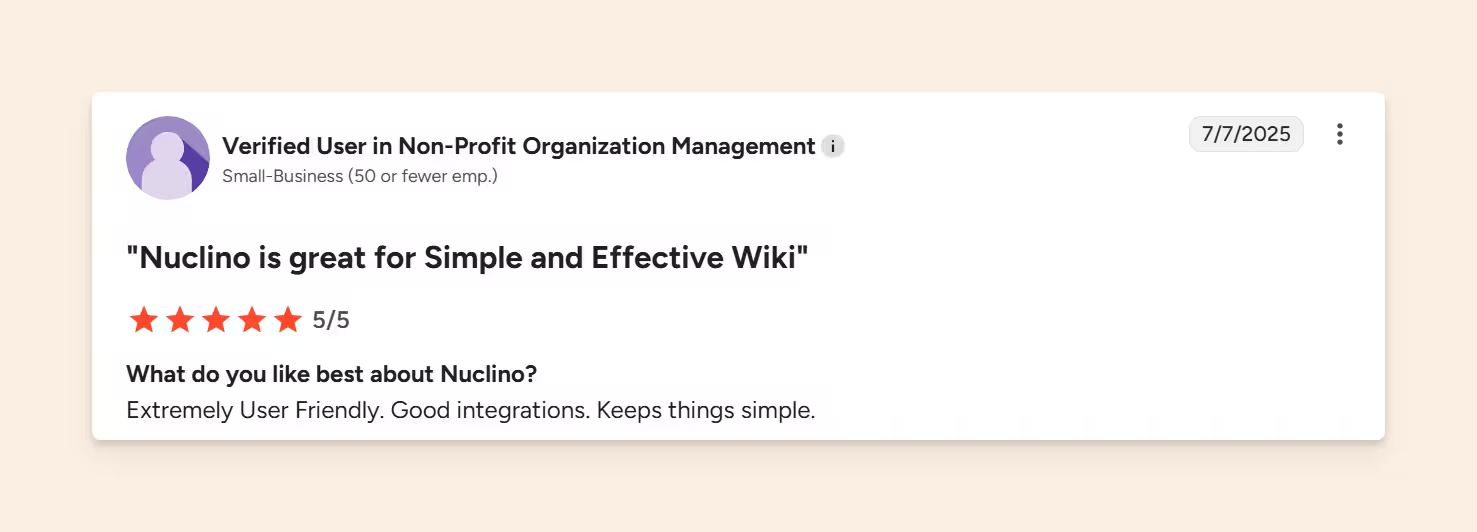
Nuclino has a 4.7/5 rating on G2.
How to choose a Guru alternative
Choose based on what Guru no longer solves well for your team.
- Choose Slite if your docs are stale, ownership is unclear, and the team needs trusted documentation, AI search, and a clearer system for keeping the underlying knowledge accurate.
- Choose Notion if you want one flexible workspace for docs, projects, databases, and AI.
- Choose Tettra if your team works mostly in Slack and needs repeated questions answered faster.
- Choose Document360 if your knowledge base is mainly customer-facing.
- Choose Nuclino if you need a simple internal wiki with minimal setup.
- If more than one category fits, start with the source of the problem.
If the source knowledge is stale, fix the knowledge base first. If the source knowledge is reliable but hard to find, search may be the bigger gap. If employees keep asking the same questions in Slack, a Slack-first question-and-answer tool may be enough.
Final thoughts
Guru still makes sense for teams that want a governed knowledge layer for enterprise AI.
But most teams comparing Guru alternatives are not all solving the same problem. Some need a cleaner wiki. Some just need Slack answers. Some need customer-facing documentation. Some need powerful enterprise search.
If your real issue is that company knowledge keeps drifting out of sync across teams and tools, Slite is the best place to start.
Slite gives teams trusted documentation, AI search, and an agentic maintenance loop in one. It detects when docs drift, proposes updates, and keeps humans in review before anything goes live, so company knowledge stays accurate for people to trust and agents to act on.
Want to see how? Book a demo.
Frequently asked questions about Guru alternatives
What is the best Guru alternative?
It depends on why you're leaving. Slite is the best Guru alternative for teams that need trusted documentation, AI search, and a clearer system for keeping knowledge accurate over time. Tettra fits Slack-heavy teams, Document360 fits customer-facing docs, and Notion fits teams that want an all-in-one workspace.
Is Guru still a knowledge base?
Yes, but Guru now sits closer to governed knowledge for enterprise AI than a traditional wiki. It still has knowledge base features, but its 2026 positioning leans into MCP support, Knowledge Agents, and a sales-led buying process.
What is the best Guru alternative for Slack teams?
Slite. Slite is the best Guru alternative for teams that want Slack answers alongside verified documentation, AI search, and clear knowledge ownership.
What is the best Guru alternative for small teams?
Nuclino for teams that want a fast, minimal wiki with light AI assistance. Tettra if the team lives in Slack and wants Q&A automation from day one.
Should I choose Glean instead of Guru?
Choose Glean if your main problem is enterprise-wide AI search across a large workplace stack. Choose Slite if the bigger issue is stale source knowledge, unclear ownership, and keeping docs accurate enough for people and AI agents to trust.